


In Europe, the response to trafficking has been shaped in part by a succession of tragedies. In June 2000, the bodies of 58 Chinese were discovered suffocated to death in the back of a lorry bound for Dover from Belgium. They had come from Fujian province and had been trafficked by a Triad group in China, who had subcontracted the last stage of the journey to a Dutch-Turkish criminal gang in Rotterdam. Then, in the summer of 2004, 20 Chinese cockle-pickers were washed up in Morecambe Bay in Lancashire, having been drowned in a racing tide that no local cockle-picker would have risked. They had paid around £17,500 each to traffickers in China and were working in dangerous conditions not only to pay back their fee but to meet exorbitant demands for rent, electricity and food from the traffickers' agents in Britain. Their families would suffer, the traffickers had warned, if the repayments were not met.
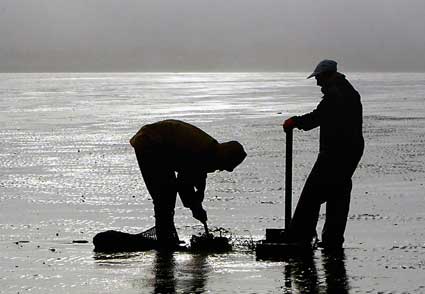
After the tragedy: Cockle-pickers in Morecambe Bay
The fate of the drowned cockle-pickers touched a nerve with the British public. Soon after the Morecambe Bay disaster, a Gangmasters Licensing Act was passed in the UK, providing prison sentences for unlicensed intermediaries. Although it was not explicitly intended to stop traffickers, the Act represents a valuable instrument that can be used to tackle the environment in which trafficking and exploitation thrive. Talks are continuing about extending their current remit in food production and agriculture to cover the construction industry, where widespread exploitation and trafficking is known to occur. Paul Whitehouse, the chairman of the Gangmasters Licensing Authority would like to see it extended still further, to take in cleaning, catering and domestic services. A UK Human Trafficking Centre was opened in Sheffield in 2006, to monitor and co-ordinate all aspects of the war on trafficking here. In March 2007, the government introduced an Action Plan on Tackling Human Traffic, the first policy document to include a focus on the human rights of victims.
In the worldwide campaign against trafficking, the US has not simply pursued a path of its own but taken a leading role. In October 2000, shortly before the UN General Assembly adopted the protocol, the US framed its own Trafficking Victims Protection Act (TVPA), signed into law by President Clinton, increasing the penalties for trafficking-related offences committed in the US. Its stated intention was to accomplish what the drafters of the act called the "three Ps" — prosecution, prevention and protection. In the wake of this new law came an Office to Monitor and Combat Trafficking and a Human Smuggling and Trafficking Centre.
The US has also set itself up as a policeman for other parts of the world. In December 2007, the office awarded anti-trafficking programmes in 46 countries $16.5 million to strengthen legal provisions, provide assistance to victims, raise public awareness and expand shelters and advice centres for people drawn into the traffickers' web. Launching the 2009 Trafficking in Persons Report last June, the Secretary of State Hillary Clinton said that trafficking is to be a "critical part of our foreign policy agenda".
The TVPA contains a set of minimum standards for the elimination of trafficking, which the US regards as applicable to all countries with more than 100 cases of what they call "victims of severe forms of trafficking". Assessed once a year in a report published by the Department of State, offending countries are placed in one of four tiers. Being in the most serious, Tier 3, leads to the possible withholding of non-humanitarian, non-trade-related assistance. Tier 2 Watch is for those on "probation", such as Russia, which has failed to make any real effort to combat the trafficking of children from Ukraine and Moldova to join beggars on the streets of Moscow, or the trafficking of men from Tajikistan, Uzbekistan and Kyrgyzstan for construction work. The TVPA programme has, however, come in for considerable criticism. In the 2009 report, Tier 3 included Iran, North Korea and Sudan, all countries notorious more for their poor relations with Washington than for their trafficking activities.


Post your comment
- The US Can Still Help Save Syria — and Iraq
- Russian Resurgence has Blindsided Nato
- On Europe, Nothing Less than Treaty Change will do
- Putin has his Useful Idiots on the Left and the Right
- Sarajevo: Where the Century of Terror Began
- Allen Lane’s Pelicans Take Wing Once More
- How Not to Remember the First World War
- Opera is Not Just Our Most Expensive Noise
- Jonathan Miller: One Man, Two Cultures
- Without a Big Idea, Cameron Will Lose
- A Christian Country? No, a Conservative One
- How to Get School Competition Right
- The War on the Firmest Bulwark of our Liberty
- How Modern Liberals Created Nigel Farage
- Caught in the Trap of His Own Metaphysics
- In Search of My Father, Agent of the Comintern
- Geoffrey Hill and the poetry of ideas
- Master of the Glories of the English Country Garden
- Independence Will Do Nothing for Scots
- Bullying and Bluff on the Road to Referendum
