


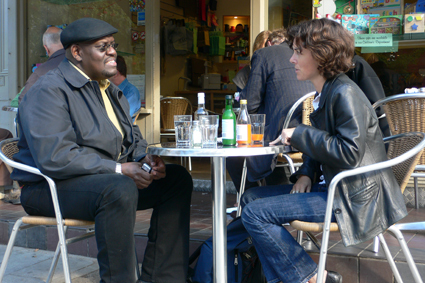
Michela Wrong with John Githongo, Kenya's whistleblower, in London
Long before their official launch, most books detach themselves from their authors. An editor calls to say the text has gone to the printers and no further changes are possible. You feel a pang of regret, tinged with relief. Like any anxious parent, you will do what you can to ease your creation's passage through a hostile world, granting interviews, giving the odd speech, but essentially it must now fend for itself. Your attention shifts to the next project.
That was certainly how it went with my first two. But my latest has broken with the pattern. Four-and-a-half months after publication, I am still as involved with It's Our Turn to Eat as when I was drafting it, fighting for its right to exist in its natural marketplace. My struggle to deliver this awkward offspring has taught me a great deal about an African nation I thought I already knew. It has also highlighted the hurdles facing the publishing industry in the internet age. None of these lessons is particularly reassuring.
It's Our Turn to Eat is the story of John Githongo, who was appointed anti-corruption chief after President Mwai Kibaki swept to power in 2002, vowing to eliminate the sleaze that had become a feature of predecessor Daniel arap Moi's regime. Githongo, an old friend, stumbled across a brand new government scandal, dubbed "Anglo Leasing". On probing, he realised his closest ministerial colleagues were involved. They expected him to turn a blind eye for one simple reason: he hailed from the same ethnic community as the "Mount Kenya Mafia", as Kibaki's coterie was known. Instead, he fled Kenya, taking with him hundreds of hours of secretly taped conversations, and eventually went public with what he knew.
I always knew the story would cause a stir. But I thought the reaction would quickly blow over. The Anglo Leasing scandal, after all, had been amply covered in both the Kenyan and international press when it first surfaced back in 2004. Since late 2005, a leaked dossier drafted by Githongo and naming the same politicians and businessmen featuring in my book could be called up on the internet. Any Kenyan taxi driver can tell you who Anglo Leasing's principals are. Why, the details are even splashed across Wikipedia.
My book's aim was never to name names, a job Githongo had already achieved. For me, Anglo Leasing's minutiae were of less interest than what the scandal revealed about a society I'd covered, on and off, for more than a decade. What fascinated me was the way ethnic rivalry — tribalism, to put it bluntly — was used to justify not only top-level looting by a ruling elite, but the sleaze tainting human interaction at every level of Kenyan society. It's a problem common to many African states.


- A Recipe For Disaster
- Culture And Politics In The Age Of Trumpery
- Will Labour Listen To Its Eurosceptic Voters?
- Would Brexit Play Into Putin's Hands?
- Why Brexit Could Be A Blessing For Europe
- Will The Pollsters Get It Right On The Referendum?
- The Great Illusion: Why We Are Still Europe’s Fall Guys
- Make June 23 Britain’s Independence Day
- Don't Pit Generations Against Each Other
- Let Justice Be Done Though The Liberal Heavens Fall
- A Fascist Coup In Poland? Give Us Poles A Break
- It's Sharia, Not Alcohol, That Threatens Women
- Double Games Of The UK Muslim Brotherhood
- The Land Where History Repeats Itself As Tragedy
- Holocaust Survivors Are Still Waiting For Justice
- Rhodes, Race, And The Abuse Of History
- Shame On The Liberals Who Rationalise Terror
- France, Islam, And The Second Class Sex
- Isis Is Not Invincible — If The West Has The Will
- After Paris, Who Will Speak For France?

- Shame On The Liberals Who Rationalise Terror
- The Cowardice Of John Le Carré
- Beyond Obama: Advice To The Next President
- The Establishment Is In Denial — Yet Again
- Is There A Right Way To Write?
- Did Burke Betray The Cause Of Liberty?
- Double Games Of The UK Muslim Brotherhood
- Two Languages And The Chasm Between Them
10:07 PM
2:07 PM