


Van Gogh was a voracious reader-fluent in Dutch, French and English. He read all of Dickens in English (Hard Times was his favourite), he was particularly moved by Shakespeare's history plays, and he loved Flaubert and Maupassant. Indeed, he was extremely knowledgeable about much of the French fiction of his day. In addition, he learned a great deal about Japan from the fiction of Pierre Loti, particularly his bestselling Madame Chrysanthème, the basis for Puccini's Madame Butterfly. Van Gogh identified particularly with French naturalist writers, and was inspired by Zola's depiction of Parisian life, reading all 20 novels in Zola's Rougon-Macquart cycle. "[They] paint life as we feel it ourselves, and thus satisfy that need which we have, that people tell the truth," he wrote to Wil in 1887.
Although Arles was once the capital of Gaul, in the western Roman Empire, Van Gogh was interested in none of its history. Instead, it was here that he wrote something of his mission statement to paint the here and now and the everyday. Unlike Gauguin, who declared that he sought only to paint his visions and his dreams, Van Gogh wanted to paint life as it was happening around him: "The zouaves, the brothels, the adorable little Arlesiennes going to their first communion...the priest in his surplice who looks like a dangerous rhinoceros, the absinthe drinkers..."
Although Van Gogh's art was firmly rooted in realism (Dutch realism and the slightly sentimental, slightly moralising French realism of Millet; Italian art didn't get a look-in) there was an overwhelmingly romantic strain underlying this realism: Van Gogh believed fervently that paintings should concern themselves predominantly with stirring up powerful emotions, that colour, expressive in itself, could convey such emotions, and that accurate draughtsmanship was secondary. His visual metaphors were simple and powerful. Even the roots of a tree in sandy soil could "express something of life's struggle".
However, as well as telling us so much of Van Gogh's artistic processes, the letters can show just how exasperating he could be. Many of them open and conclude with pleas to Théo for money. Théo was not only the respectable art dealer brother who was his constant confidant, but also the person who provided his brother with the monthly allowance that enabled him to pursue his single-minded ambition. At one point, Van Gogh had the gall to reproach his long-suffering brother for being like the unimaginative and narrow-minded businessman in one of Zola's novels. And to people who were not even related to him, he could certainly be direct to the point of rudeness. In one long letter, he criticises the Symbolist Emile Bernard because his paintings rely too much on what isn't there for the eye to see. Not surprisingly, Bernard remembers Van Gogh as "vehement in discourse, interminably explaining and developing his ideas."
Even Théo, writing to Wil, declares: "It appears as if there are two different beings in him, the one marvellously gifted, fine and delicate, the other selfish and heartless."
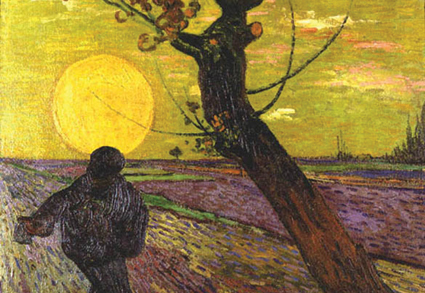
Ennobling the peasant's toil: Van Gogh's "The Sower"


- The Plot to Islamise Birmingham’s Schools
- Nigeria, Iraq, Gaza—The Threat is the Same
- Radical Islam and its Invisible Victims
- The Man Who Tried to Teach us all a Lesson
- Globalisation and The Crisis of the Nation State
- The Medium Isn’t Always the Message
- What sort of Europe does Cameron Want?
- Is China outstripping the West at innovation?
- Piketty’s panacea will make inequality worse
- The Moral Strength of Leonard Cohen
- Designer who taught us to keep it simple
- The US Can Still Help Save Syria — and Iraq
- Russian Resurgence has Blindsided Nato
- On Europe, Nothing Less than Treaty Change will do
- Putin has his Useful Idiots on the Left and the Right
- Sarajevo: Where the Century of Terror Began
- Allen Lane’s Pelicans Take Wing Once More
- How Not to Remember the First World War
- Opera is Not Just Our Most Expensive Noise
- Jonathan Miller: One Man, Two Cultures

2:02 PM
5:02 PM
9:01 AM
2:01 AM
2:01 AM
4:01 AM
10:01 PM
9:01 PM
8:01 PM
6:01 PM