



The painting was in marked contrast to a print Rembrandt produced on the same theme as an optimistic young artist in 1634. Here, in the earlier version, Potiphar's wife lay on a bed, nude from the waist down. She writhed and contorted her body as she clung to Joseph, who struggled to make his escape from her bedchamber. Her legs were parted lustily, leaving little to the imagination. The work foreshadowed several further prints, including one in which a couple made love in bed, and another in which a monk copulated with a woman in a crop field.
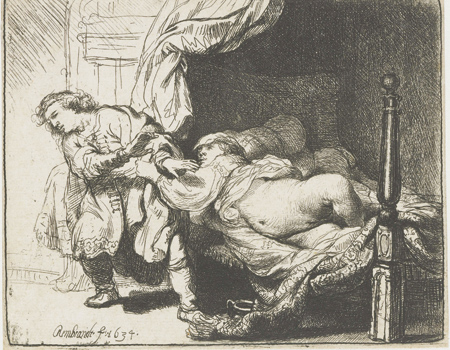
"Joseph and Potiphar's Wife" (1634): In this earlier print, Potiphar's lusty wife tries to drag Joseph into her bed (image: Rijksmuseum)
By comparison with these works, some of the wrinkled female nudes Rembrandt produced in his late years were restrained. Offensive though their flesh and status were to his critics, they lacked the earthiness of many of his earlier prints and drawings.
Rembrandt had not been the first artist to embrace the seedier side of life. But in seeking it so stubbornly in Amsterdam's most prosperous age, he went some way towards presenting himself as someone who could handle life's struggles.
Drained by paying maintenance to Geertje Dircks, whom he had locked away for five years in a house of correction, forced to give up his house on the Breestraat, which he never managed to pay off, struggling to sell his art in a difficult market, Rembrandt's predicament in the mid-17th century was unenviable.
Another man might have given up, or tried to save face by fleeing Amsterdam altogether, but Rembrandt did not. Supplementing his career as a painter with work in an art business for his son Titus and lover Hendrickje, both of whom would predecease him, Rembrandt lived out his final years in rented accommodation in Amsterdam's working-class district. It lacked the elegance of the Breestraat, but as Rembrandt had discovered years ago, life went on, however refined the windows one lived behind.
"Joseph and Potiphar's Wife" (1634): In this earlier print, Potiphar's lusty wife tries to drag Joseph into her bed (image: Rijksmuseum)
By comparison with these works, some of the wrinkled female nudes Rembrandt produced in his late years were restrained. Offensive though their flesh and status were to his critics, they lacked the earthiness of many of his earlier prints and drawings.
Rembrandt had not been the first artist to embrace the seedier side of life. But in seeking it so stubbornly in Amsterdam's most prosperous age, he went some way towards presenting himself as someone who could handle life's struggles.
Drained by paying maintenance to Geertje Dircks, whom he had locked away for five years in a house of correction, forced to give up his house on the Breestraat, which he never managed to pay off, struggling to sell his art in a difficult market, Rembrandt's predicament in the mid-17th century was unenviable.
Another man might have given up, or tried to save face by fleeing Amsterdam altogether, but Rembrandt did not. Supplementing his career as a painter with work in an art business for his son Titus and lover Hendrickje, both of whom would predecease him, Rembrandt lived out his final years in rented accommodation in Amsterdam's working-class district. It lacked the elegance of the Breestraat, but as Rembrandt had discovered years ago, life went on, however refined the windows one lived behind.
Like this article? Share, save or print using the icons below:


