


He mused on those who depended on alms for survival. One almshouse was established in the south-west of the city to support Roman Catholic women. Another would be founded in the mid-century to cater for the young and elderly, regardless of their religious denomination. Rembrandt made some small studies of families receiving their supplies. He was still more interested in the citizens who slipped through the net entirely.
In the early and mid-1630s, in pointed contrast to the portraits of noblewomen he was commissioned to paint, including that of Amalia van Solms, wife of the Prince of Orange, he made sketches of young women begging on the streets clutching babies to their breasts.
What seems to have interested him most about these unfortunate people was the emotion they carried in their bodies and faces. The heavy reworkings of his sketches reveal that he strove hard to capture the posture of each subject. A deceptively simple study of a hunched shoulder revealed the dejection these women felt. Unlike Rembrandt's wealthy sitters, the poor could not hide behind ruffed collars and etiquette that stifled all expression.
It was the bare-all approach that Rembrandt favoured in the 80 or more self-portraits he made across the course of his life, too. He often presented himself in elaborate costume, as if to highlight the distinction between artificiality and the nature of his painted flesh, which struck contemporary eyes as rough and imperfect. As these paintings showed, he was well used to looking beneath the surface.
Amsterdam provided an interesting vantage point from which to look outside as well as within. Many of the houses here were more remarkable for their windows than their doors. Residents could peer inquisitively out. Windows often figure large in Rembrandt's art. While life might have dictated that he spend the late 1630s looking indoors, where his wife Saskia was giving birth to child after child, and sadly seeing each buried in infancy, Rembrandt established a habit of looking out onto the streets.
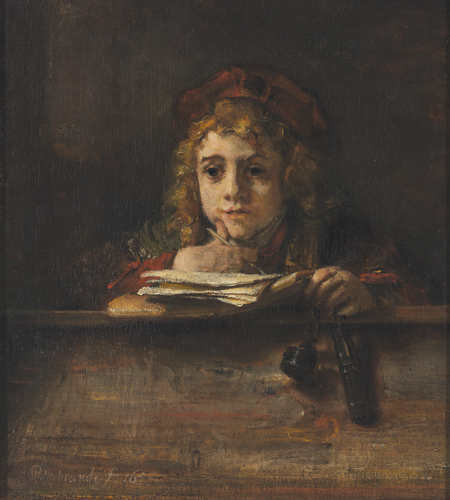
Portrait of the artist's son: "Titus at his Desk" (1655) (image: Museum Boijmans Van Beuningen, Rotterdam)
In the early and mid-1630s, in pointed contrast to the portraits of noblewomen he was commissioned to paint, including that of Amalia van Solms, wife of the Prince of Orange, he made sketches of young women begging on the streets clutching babies to their breasts.
What seems to have interested him most about these unfortunate people was the emotion they carried in their bodies and faces. The heavy reworkings of his sketches reveal that he strove hard to capture the posture of each subject. A deceptively simple study of a hunched shoulder revealed the dejection these women felt. Unlike Rembrandt's wealthy sitters, the poor could not hide behind ruffed collars and etiquette that stifled all expression.
It was the bare-all approach that Rembrandt favoured in the 80 or more self-portraits he made across the course of his life, too. He often presented himself in elaborate costume, as if to highlight the distinction between artificiality and the nature of his painted flesh, which struck contemporary eyes as rough and imperfect. As these paintings showed, he was well used to looking beneath the surface.
Amsterdam provided an interesting vantage point from which to look outside as well as within. Many of the houses here were more remarkable for their windows than their doors. Residents could peer inquisitively out. Windows often figure large in Rembrandt's art. While life might have dictated that he spend the late 1630s looking indoors, where his wife Saskia was giving birth to child after child, and sadly seeing each buried in infancy, Rembrandt established a habit of looking out onto the streets.
Portrait of the artist's son: "Titus at his Desk" (1655) (image: Museum Boijmans Van Beuningen, Rotterdam)
Like this article? Share, save or print using the icons below:


