



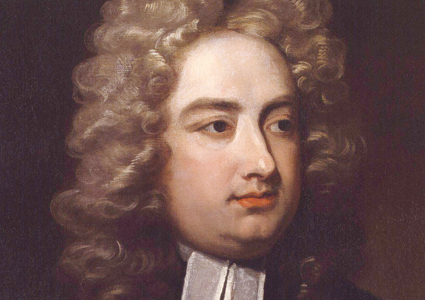
 Jonathan Swift: In a 1707 pamphlet he depicted England as a “gentleman” ruining his “mistress”, Ireland, with inconstancy
In 2005 the Cambridge intellectual historian John Robertson published a very original contribution to the scholarly debate about the Enlightenment. In one respect The Case for the Enlightenment: Scotland and Naples 1680-1760 was the reverse of original because it aspired to move the debate about the Enlightenment backwards. For many years the intellectual tide had set against the view that the Enlightenment was one thing — a view which derived ultimately from Kant’s famous essay Was ist Aufklärung? (What is Enlightenment?), and which found its most extreme form in Croce’s formulation of 1938 that the Enlightenment was “a perpetual form of the human spirit”.
The revisionists suggested that Kant had been mistaken in both the number and the tense of the verb in his famous question. The Enlightenment had been not one thing but many things, and it had been an historical episode in the intellectual history of the West, rather than a perennial aspect of humanity’s life of the mind. Led by the commanding figure of John Pocock, the revisionists discerned a number of discrete, and often only loosely affiliated, Enlightenments. They were divided along the axes of chronology, geography, and political tendency. There were, so we were now assured, early, “high”, and late Enlightenments. There were English, French, Arminian, and German Enlightenments. There were radical Enlightenments, and there were conservative Enlightenments.
Robertson resisted this “retreat into pluralism”, and nailed his colours to the mast of an argument asserting the essential unity of the Enlightenment. For Robertson, the intellectual coherence of the Enlightenment could be found in its commitment “to understanding, and hence to advancing, the causes and conditions of human betterment in this world” — a deceptively simple formulation which in fact yielded a rich agenda for research.
More eye-catching than Robertson’s assertion of the fundamental unity of the Enlightenment was his decision to illustrate its intellectual coherence by means of a comparative study of Scotland and Naples. Both of these peripheral states had seen a remarkable intellectual flourishing in the course of the 18th century. Robertson focused on the works of Vico and Hume to explore the affinities between these two episodes of intellectual renewal occurring at opposite ends of Europe. In both he discovered an intellectual substratum made of up a bricolage of Augustinian and Epicurean elements; in both he detected a foundational engagement with the work of Pierre Bayle; and in both he saw a commitment to the goal of human betterment in this world, pursued by means of the relatively new discipline of political economy. Struck by these similarities, Robertson went on to postulate that political dependency and relative economic immiseration might be, nothing so crude as the causes of the rise of enlightened thinking, but at least enabling conditions which in Scotland and Naples had encouraged Enlightenment to take root.
Like this article? Share, save or print using the icons below:


- Why On Earth Should Anyone Study Philosophy?
- The Dying Days Of Zuma's South Africa
- His Master's Voice: Scruton On Wagner
- Why The Most Civilised Of Men Felt Like A Fraud
- Political Misconduct
- Cicero's Analysis Of Decline Offers Lessons For The West
- The Dead End Of Identity Politics
- Trump's Appeal Is More Roosevelt Than Reagan
9:07 AM