



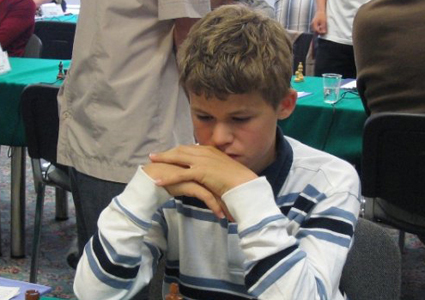
 The prodigy: Magnus Carlsen in 2005
On January 1, 2010, just a month after his 19th birthday, the Norwegian prodigy Magnus Carlsen became the world's highest-ranked chess player — based on a system similar to that used by international tennis to establish the pecking order among the likes of Nadal, Djokovic and Federer. But unlike tennis, there is also an official chess world championship, dating from Wilhelm Steinitz in 1886. Since 2007 this title had been held by the Indian Viswanathan Anand.
Yet as Carlsen's precocious pre-eminence became ever more marked, and Anand's ranking began to slip (as so often happens nowadays with players the wrong side of 40), it was widely anticipated that the long-awaited world championship match between these two men from opposite ends of the earth would see the supreme title pass to another generation.
And so, before a passionate audience in Anand's home city of Chennai, it proved. Carlsen scored the necessary 6.5 points (it was a best of 12 contest) with two games to spare, having won three of them and drawn seven. The last time the title was contested without the victor conceding a single loss was back in 2000, when Vladimir Kramnik achieved a "shut-out" against the defending champion Gary Kasparov. Interestingly, Carlsen chose exactly the same strategy Kramnik deployed to neutralise Kasparov's favourite Spanish Opening (which is also Anand's primary attacking weapon): the rock-solid Berlin Defence — sometimes known as the Berlin Wall.
Not only was the Indian driven to despair by its impermeability, just as Kasparov had been 13 years earlier: in the pivotal sixth game of the match Anand actually lost against it. Having also been defeated in the fifth game, this was a devastating blow. In both those games, Carlsen demonstrated his greatest competitive strength: he has prodigious reserves of patience and likes nothing more than grinding out wins from apparently drawish endgames, indeed in positions from which most grandmasters would be perfectly content with a draw.
It would be too simple just to say that Anand blundered in those two endings. The question is: why? As the Indian's friend, the three times British chess champion Jonathan Rowson observed: "The losses came from fairly simple positions, where clear thinking indicated few objective problems, but Magnus's will and relentless accuracy wore Vishy down and the psychological pressure made it hard for him to calculate." When one considers that razor-sharp rapid calculation had always been Anand's forte, it is clear just how much pressure Carlsen must have exerted: or as the new champion said after the match, "I would like to take some responsibility for his mistakes. People crack in the world championship . . . that is what I really wanted to do, to make him sit at the board and play for a long time."
Yet to Anand's credit, in the ninth game, when a win would have still brought him back to within a point of his remorseless opponent, he threw all caution away and with breathtaking bluntness attempted to play directly for checkmate almost from the opening. Carlsen responded with equal courage, surprisingly spurning the safest lines, rushing to counterattack on the other side of the board and positively challenging Anand to land the knock-out blow.
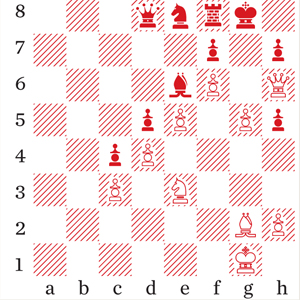
Puzzle: [Position after Black's 31st move] Here is the variation which had so excited Anand, White, to play: what he imagined would lead to a brilliant win and revive his chances of retaining the title of world champion. It seems that Carlsen, a rook up, has everything covered. But the Indian had prepared something special: can you see what it was?
Solution: Anand would have played 32.Bxd5!! After 32...Bxd5 33.Nf5 Black cannot prevent the annihilating 34.Ne7+ and mate to follow (for example 33...Be4 34.Ne7+ Qxe7 35.fxe7 and 36.exf8 (Q) mate). So Carlsen would have had to respond to 32.Bxd5!! with 32...Qxd5. But after 33.Nxd5 Bxd5 White's Queen and extra pawns easily outweigh Black's uncoordinated and scattered pieces.


Post your comment

- Shame On The Liberals Who Rationalise Terror
- The Cowardice Of John Le Carré
- Beyond Obama: Advice To The Next President
- The Establishment Is In Denial — Yet Again
- Is There A Right Way To Write?
- Did Burke Betray The Cause Of Liberty?
- Double Games Of The UK Muslim Brotherhood
- Two Languages And The Chasm Between Them