
You are here:   Civilisation >  Critique > The Loss Of Faith Made Music Mute
 

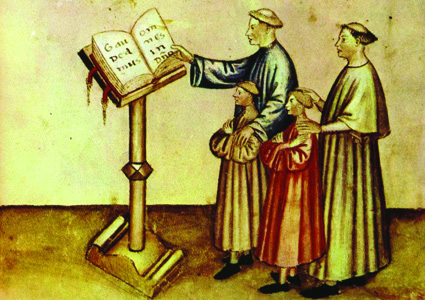
Church music: Seen here in the medieval treatise "Tacuinam Sanitatis", it forged the basis of classical music

It is a mystery to many people why so few contemporary classical composers seem capable of writing "a good tune". Surely, given the number of students who pursue composition in our universities and conservatoires, and the hugely increased access which technologies such as music-notation software give to prospective composers, we should expect to find at least one or two capable of making a popular impact? Why is it that, with more people than ever engaged in the activity of composing, our culture still seems incapable of fostering a contemporary Verdi or Stravinsky, with the celebrity and popular recognition that such great figures once garnered?

It is certainly true, as Simon Heffer has amusingly put it in Standpoint ("A Raspberry for Emetic Music", November 2014), that the musical establishment is "in hock to the crap merchants" and in thrall to the state, creating a tyrannical orthodoxy of ugliness, admission to which can only be gained by imitating the style of "orchestrated raspberries" currently in vogue. However, the underlying cause—though closely related to the over-reaching influence of the modern state—ultimately goes far deeper than this. To understand the deficit of successful contemporary classical music, what we need to uncover are the feelings which motivated the artistic instincts of the great composers of the past, but which are now absent in the minds of modern composers, thus accounting for their "emetic" output.  

In the year 1900, the following composers were alive, and the majority of them active: Saint-Saëns, Debussy, Ravel, Stravinsky, Rimsky-Korsakov, Rachmaninoff, Prokofiev, Bartók, Elgar, Vaughan Williams, Holst, Mahler, Strauss, Sibelius, Grieg, Puccini, Dvořák and Janáček. This list of exalted and well-known figures is far from exhaustive, and should give us pause. We cannot possibly pretend that the world today can boast a similar number or calibre of composers; indeed, any one of these figures is of far more interest to most of us than any of today's most famous composers. Moreover, if one expands this categorisation to include any composer active between the years 1850 and 1950, one possesses pretty much a complete list of the works in the standard orchestral repertoire (save the old German masters), and hence those pieces which one would find overwhelmingly on offer in any events guide produced by today's professional orchestras.

On closer inspection, it is not hard to see the idée fixe that unites this vast array of varied talent: nationalism. To varying degrees of explicitness, whether through the deliberate inclusion of folk elements, or simply a general over-arching style suggestive of national sentiment, all of these figures would quite happily have thought of themselves, not just as composers, but as French, Russian, Hungarian, English, German, Finnish, Norwegian, Italian or Czech composers. It is in fact a statement of the obvious to point out that the feelings that underpin a good deal of what these composers set out to accomplish was driven by a passion for the language, history, customs, traditions, institutions and, perhaps most prominently, the countryside of their native lands.

This surge of nationalist output, produced during the long 19th century, was an obvious accompaniment to the growth of the nation state itself. However, there is another deeper set of convictions which the classical composers held in common, and upon which the nation states of Europe themselves were predicated: Christianity.

View Full Article
 
Share/Save


Anonymous
March 2nd, 2015
7:03 AM
You are an ass, sir. You made it clear from the beginning that you prefer Michael Jackson to the Proms, so why should anyone listen to anything you have to say? Your analysis, while facile, does have some merit: Yes, there have been changes in the culture which have led to the decline in interest in art music, generally, and this includes Jazz, by the way, which is as rarified for younger audiences as a motet by Guillaume de Machaut. But what you have failed to take into consideration is the extent to which music education has diminished, both in the UK and in the States. As a famous Jazz musician once pointed out, one gets from music what one puts into it. Pop has become the soundtrack for the lives of younger people and it wouldn't matter if a classical composer wrote a good triadic ally based tune or not. There has been a decision made in those places where such decisions have clout that art music and art generally are no longer important. It has little to do with style, and in fact, younger people who listen to what is called classical music much prefer atonal music to "a good tune'. But it is clear that you came into the discussion with an axe to grind, so grind away. It will avail you nothing, as you are about as musically uninformed as the first auditors of Stravinsky's Le Sacre.

Jan Sand
March 2nd, 2015
4:03 AM
Beneath the surface gloss of Christianity the skeletal architecture of human decency and compassion for all living things gives Christianity and any faith a validity that inspires all great emotions, and music, more than many of the other arts captures this inspiration quite well. The secularities of necessity and full desires have always existed within civilization but of these later years the open horrors of unleashed greed and cruelty and total disdain for the values of the basic human being as expressed by the vicious moralities of the corporate-military-financial complex have totally trashed any expectations for the future of mankind or, indeed, life itself on the planet. The death of music is perhaps a symptom of the final vileness of the species and all its possible hopes.

George Balanchine
March 2nd, 2015
3:03 AM
You need to work on your prose style, it could use a bit of improvement.

Jim Reece
February 28th, 2015
1:02 PM
Thank you for the hope attendant to your well written article. There will again be harmony, counterpoint, "chili con carne, sparkling champagne" and it will be ruled with a rod of iron in the coming kingdom "where the soul of man never dies' However, in the literal 'meantime', if at all possible, "let there be love" in the understanding of how in the fullness of our times it is necessary, first, that thug life run its course. The best news? "Nothing can change the shape of things to come"

sd goh
February 28th, 2015
12:02 PM
My good friend, an ex-army doctor and a well-traveled man – and also a very liberal Sikh (an oxymoron perhaps) – once told me that of the many places he had visited, none impressed and inspired him more than Italy as here was a country, he said, where the fusion of Art, Religion & Life was more apparent than anywhere else he had been. To him, the whole country was a veritable living museum and the religious aspect palpable. (Perhaps he meant the Italy of old where church going was the normal thing to do every Sunday and feast day as it is a fact now, that most Italians are nominal Catholics only and churches in Italy, like elsewhere in Europe are almost empty, in obeisance to the secular zeitgeist! But I think it had to with the ubiquity of churches & cathedrals there.) He said that although China where he had been before, is a country of high material accomplishments, the spiritual aspect was conspicuously missing and India (where his forefathers came from and where he had spent years studying in a medical college there) was its antithesis: he found great piety there but also general indifference to the material world. Italy, or the Italy of yore, to him, was the embodiment of the good life: its demonstrative folks know how to enjoy fully the fruits of the earth but not at the expense of the spiritual, both manifested in their sensuous enjoyment of 'wein, weib und gesang' and the many religiously-inspired artistic creations, at any rate those of the past eg. Renaissance. He began to cultivate a love for their gastronomic delights and beyond, in particular, the great works of painting, sculpture and architecture. Names like Michelangelo, Raphael, da Vinci, Donatello, Titian, Brunelleschi, Palladio et.al poured from his mouth like olive oil from the stone mills of a farm in Puglia. But no sooner he told me the full extent of his predilections relating to the aesthetic creations of the West than I said to him that there was a missing link. He had not heard of Gregorian plainchant, Palestrina, Pergolesi, Vivaldi, Rossini, Verdi, Puccini and such. Though he knew the names of Mozart and Beethoven, of their music he had very little acquaintance beyond the opening “Fate knocking on your door” four notes of the latter's Fifth symphony. His love for music began and ended with Cliff Richard and Elvis Presley. At once I thought I had a duty to perform here, not that I was so presumptuous as to put myself in the role of 'savior of great music' but I just thought that he might find something new and different in the realm of so called 'serious music' and go on to develop an interest in it if the right notes were hit, so to speak, but before that can happen, he required an introduction. At that time I was a tenor in an amateur choral society here in KL and it so happened that we were about to stage Mascagni's opera verismo, Cavelleria Rusticana, with its combination of the themes of Sin & Sanctity (two sides of the same religious coin?) which only the Italians are best at. And here is an opera replete with beautiful arias & choruses and gorgeous orchestral music plus quite violent moments, albeit staged, which I was certain would bowled over Dr. Singh. (It did.) I gave him a complimentary ticket and he enjoyed himself. Sadly, he never got the full impact of the music as in lieu of an orchestra we had a pianist who turned out to be from Yorkshire, at that time he was working in KL. Incidentally, this choir I was in had quite a few expats, living in KL, and there was this red-haired soprano from Wales (married to a Londoner) whose voice was divine. Hardly surprising, as where else in Britain would you find the Eisteddfod?

Post your comment

CAPTCHA
This question is for testing whether you are a human visitor and to prevent automated spam submissions.