

You are here:   Civilisation >  Critique > The Loss Of Faith Made Music Mute
 

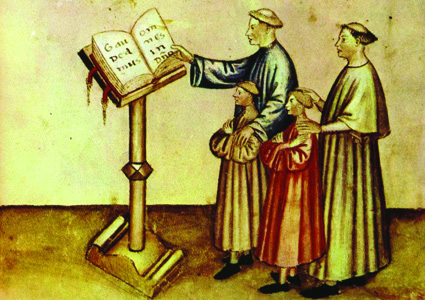
Church music: Seen here in the medieval treatise "Tacuinam Sanitatis", it forged the basis of classical music

It is a mystery to many people why so few contemporary classical composers seem capable of writing "a good tune". Surely, given the number of students who pursue composition in our universities and conservatoires, and the hugely increased access which technologies such as music-notation software give to prospective composers, we should expect to find at least one or two capable of making a popular impact? Why is it that, with more people than ever engaged in the activity of composing, our culture still seems incapable of fostering a contemporary Verdi or Stravinsky, with the celebrity and popular recognition that such great figures once garnered?

It is certainly true, as Simon Heffer has amusingly put it in Standpoint ("A Raspberry for Emetic Music", November 2014), that the musical establishment is "in hock to the crap merchants" and in thrall to the state, creating a tyrannical orthodoxy of ugliness, admission to which can only be gained by imitating the style of "orchestrated raspberries" currently in vogue. However, the underlying cause—though closely related to the over-reaching influence of the modern state—ultimately goes far deeper than this. To understand the deficit of successful contemporary classical music, what we need to uncover are the feelings which motivated the artistic instincts of the great composers of the past, but which are now absent in the minds of modern composers, thus accounting for their "emetic" output.  

In the year 1900, the following composers were alive, and the majority of them active: Saint-Saëns, Debussy, Ravel, Stravinsky, Rimsky-Korsakov, Rachmaninoff, Prokofiev, Bartók, Elgar, Vaughan Williams, Holst, Mahler, Strauss, Sibelius, Grieg, Puccini, Dvořák and Janáček. This list of exalted and well-known figures is far from exhaustive, and should give us pause. We cannot possibly pretend that the world today can boast a similar number or calibre of composers; indeed, any one of these figures is of far more interest to most of us than any of today's most famous composers. Moreover, if one expands this categorisation to include any composer active between the years 1850 and 1950, one possesses pretty much a complete list of the works in the standard orchestral repertoire (save the old German masters), and hence those pieces which one would find overwhelmingly on offer in any events guide produced by today's professional orchestras.

On closer inspection, it is not hard to see the idée fixe that unites this vast array of varied talent: nationalism. To varying degrees of explicitness, whether through the deliberate inclusion of folk elements, or simply a general over-arching style suggestive of national sentiment, all of these figures would quite happily have thought of themselves, not just as composers, but as French, Russian, Hungarian, English, German, Finnish, Norwegian, Italian or Czech composers. It is in fact a statement of the obvious to point out that the feelings that underpin a good deal of what these composers set out to accomplish was driven by a passion for the language, history, customs, traditions, institutions and, perhaps most prominently, the countryside of their native lands.

This surge of nationalist output, produced during the long 19th century, was an obvious accompaniment to the growth of the nation state itself. However, there is another deeper set of convictions which the classical composers held in common, and upon which the nation states of Europe themselves were predicated: Christianity.

View Full Article
 
Share/Save


Tim Cavanaugh
March 2nd, 2015
10:03 PM
Not sure what Schoenberg is being blamed for here, but if irreligion is (as it seems to be) the author's explanation for the decline of popularity, something doesn't add up. Schoenberg had no choice but to take his religion very seriously, and the equation of religious discipline and musical discipline is at the center of much of his work -- most notably Moses & Aron, which amounts to a dramatic argument for the tonal row as the musical equivalent of God's will revealed through the commandments. It's certainly true that many or most people don't care for how it sounds, but lack of faith does not seem to explain that lack of appeal. As for the loss of nationalism, connection to the supernatural, direct emotional appeal and the other elements the author mourns, you can find them abundantly in the work of Jerry Goldsmith, Bernard Herrmann, John Williams and dozens of other Hollywood composers working in the period covered by this article.

FRANCIS SCHWARTZ
March 2nd, 2015
8:03 PM
Balderdash.

Derrick Norman
March 2nd, 2015
6:03 PM
How could you leave out the tunefull music of John Rutter? ost of it "faith" inspired.

Callum Hackett
March 2nd, 2015
4:03 PM
It doesn't surprise me any longer that published criticisms of contemporary music are written by people who are wilfully ignorant of the cultural history of the twentieth century, but it still frustrates me. One can tell from the outset that the essential premise of this article is nonsense by the fact that the first composer's name to pop up is 'Verdi'. Whatever the subjects of Verdi's music, Verdi was an atheist, and that this could at least in theory be defended but is not even mentioned shows that the writer does not seriously engage with his theme. One also needn't even bother to follow the deeply biased line of argument to know in advance that it must be false: IF it were the case that classical music has been supplanted because of a severing of its Christian roots, then surely whatever popular medium has replaced it will be a medium that maintains that essential mythology. Look to the kinds of music that has replaced classical in the public consciousness and show me where Jesus is in that miasma of commercial dross. Then, I'm afraid, we have to out the author as a fabricator; a liar; a fraud. He claims, with no substantiation, that conservatoires and music departments don't teach standard harmony and counterpoint any more. On what basis? Why, no basis at all because it's made up! As a recent university student (2013) with ties to classical music (I was an English student but I conducted the nearest orchestra), I know that music curricula still place heavy emphasis on common practice techniques. I also know, as the partner of a musicologist and composer, that knowledge of such things is essential even to the most avant-garde of today's composers. Claims to the contrary are utterly without foundation. Don't even take my word for it - just do the basic research, apparently beyond this article, of looking up a random university or conservatoire prospectus and you will see these foundational aspects of composition as core components. This is specious nonsense dreamt up by a conspiracy theorist living in an imagined world that he supposes must be set against him because he can't quite understand why his tastes have never matured since an adolescent love of sentimental Romanticism. You may do better buying film soundtracks than pursuing art. I would also counter that, as a regular concert-goer and listener of contemporary music, the likes of the venues I attend - whether a small chapel or the Royal Festival Hall - are always packed and always delighted with the programmes, be it Birtwistle, Dutilleux, Ligeti, or some up-and-coming youngsters yet to embed their name in the industry (just to mention composers I have heard from the past few months). Once again, these complaints come from people who do not even attend the institutions they disparage and who therefore have no grounding whatsoever for their laments. If, article reader, you do actually care about your cultural heritage and you want to learn about the genuine history of music, even if you may disapprove of certain styles, then instead of submitting yourself to this effortlessly faked hysteria, read Alex Ross's 'The Rest is Noise'.

The Sanity Inspector
March 2nd, 2015
4:03 PM
As has been observed, time puts a stop to all things, and this is commonly mistaken for tragedy. Our civilization is unlikely to ever top the achievements of 18th century classical or 19th century romantic music--but we don't need to. We still have these mighty works. Just as we still have Chartres and Notre Dame, even though we're right out of the habit of cathedral building. As for modernism, the most withering dismissal I ever read was this: "Ives, Vivaldi, Schoenberg, Glass--no matter how much you hate them, they are not "bad" composers. A "bad" composer is the associate professor at South Succotash State who cranks out imitation Hindemith every couple years with a title like "Directions" or "Vortex." It gets played by the student orchestra and is promptly and appropriately forgotten." --Walter C. Koehler

The Sanity Inspector
March 2nd, 2015
4:03 PM
As has been observed, time puts a stop to everything, and this is often mistaken for tragedy. Eighteenth Century classical and 19th Century romantic music are the twin pinnacles of Western music. We are never going to top them, or extend them, using the principles and tools they used. We are used to this in other forms of art. We are right out of the habit of building cathedrals, yet our appreciation of the great Gothic edifices is undiminished. It will be so with music as well. As for modernism, the most withering assessment I ever read was this: "Ives, Vivaldi, Schoenberg, Glass--no matter how much you hate them, they are not "bad" composers. A "bad" composer is the associate professor at South Succotash State who cranks out imitation Hindemith every couple years with a title like "Directions" or "Vortex." It gets played by the student orchestra and is promptly and appropriately forgotten." --Walter C. Koehler

Anonymous
March 2nd, 2015
3:03 PM
Underlying all this is the growing western view of religion as harmful and spirituality as for the weak minded and un-scientific. So I blame the downfall on Darwin. He has become god, making man the equal of dogs, making beauty an accident, making morality laughable, making transcendence meaningless, making the eternal a farce. I'm not debating Darwinism rather am speaking of it's consequences. The great themes of nationalism, Christianity, and spirituality are meaningless on the foundation of materialistic naturalism. Eat, drink and be merry for tomorrow we die (ie YOLO)(pop music's arch-theme?) It's the inescapable consequence of this worldview, fed to generations now as the unable-to-be-challenged truth. It provides meaninglessness as a purpose. Besides, popular music always changes and in 100 years many will be pining for our current pop music of the good old days.

Taeho Paik
March 2nd, 2015
12:03 PM
What nonsense! The problem is how music itself and its purpose is truly misunderstood and people go to schools to learn it! Classical musicians are highly capable technically but in the academies they learn nothing about keeping time and creating a groove. So one falls asleep while listening unless one is looking out for specific musical qualities in the composition. In short great music is played in a boring way. Loss of faith is another matter but only blues musicians go to the crossroads to ask the Lord or the Devil for help.

John Borstlap
March 2nd, 2015
11:03 AM
This article confuses two things: Christianity with spirituality, and entertainment with art music. It was not Christianity perse that inspired classical composers but spirituality, i.e. the faith (however vague) in the existence of a spiritual realm and hence, in ethical values. None of the mentioned classical composers were strong adherents of whatever church. Religion is merely a channel for the inner experience of the spiritual, whatever it may be. Then, although the article rightly observes the sudden increasing dominance, in society, of pop music and youth culture since the sixties, this happened entirely in the territory of entertainment, it had and has nothing to do with art music. For the rest, the article rightly touches a couple of unfortunate but very true points. But nowadays there are composers of great talent who introduce exactly the element that had become missing within the realm of art music, of which I want to mention: Nicolas Bacri and Richard Dubugnon in France, and David Matthews in England, who manage to achieve recognition and success within the very context that cultivates the classical composers. They had and have to battle against the grave suspicion at orchestras and concert promotors against contemporary music, but succeeded to overcome these barriers. It is a new trend that wants to reconnect with the earlier 20C as mentioned in the article, comparable with the resurgence of figurative painting - both movements still strongly ignored and taboo'd by the modernist establishment (who want to keep the decreasing money flow into their direction). Recommended: 'The Classical Revolution', Scarecrow Press 2013, which explores this subject. This book got a very mixed reception, fiercely condemned by some, enthusiastically embraced by others. www.amazon.com/The-Classical-Revolution-Thoughts-Traditionalist/dp/08108...

mr.ed
March 2nd, 2015
10:03 AM
Based on my observation of audiences over the last 40+ years, if it weren't for the high percentage of Jews, there would be no classical music, at least in the west.

Post your comment

CAPTCHA
This question is for testing whether you are a human visitor and to prevent automated spam submissions.