
You are here:   Civilisation >  Critique > The Loss Of Faith Made Music Mute
 

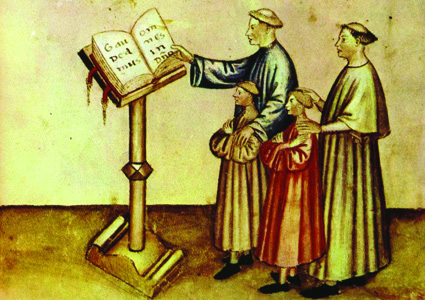
Church music: Seen here in the medieval treatise "Tacuinam Sanitatis", it forged the basis of classical music

It is a mystery to many people why so few contemporary classical composers seem capable of writing "a good tune". Surely, given the number of students who pursue composition in our universities and conservatoires, and the hugely increased access which technologies such as music-notation software give to prospective composers, we should expect to find at least one or two capable of making a popular impact? Why is it that, with more people than ever engaged in the activity of composing, our culture still seems incapable of fostering a contemporary Verdi or Stravinsky, with the celebrity and popular recognition that such great figures once garnered?

It is certainly true, as Simon Heffer has amusingly put it in Standpoint ("A Raspberry for Emetic Music", November 2014), that the musical establishment is "in hock to the crap merchants" and in thrall to the state, creating a tyrannical orthodoxy of ugliness, admission to which can only be gained by imitating the style of "orchestrated raspberries" currently in vogue. However, the underlying cause—though closely related to the over-reaching influence of the modern state—ultimately goes far deeper than this. To understand the deficit of successful contemporary classical music, what we need to uncover are the feelings which motivated the artistic instincts of the great composers of the past, but which are now absent in the minds of modern composers, thus accounting for their "emetic" output.  

In the year 1900, the following composers were alive, and the majority of them active: Saint-Saëns, Debussy, Ravel, Stravinsky, Rimsky-Korsakov, Rachmaninoff, Prokofiev, Bartók, Elgar, Vaughan Williams, Holst, Mahler, Strauss, Sibelius, Grieg, Puccini, Dvořák and Janáček. This list of exalted and well-known figures is far from exhaustive, and should give us pause. We cannot possibly pretend that the world today can boast a similar number or calibre of composers; indeed, any one of these figures is of far more interest to most of us than any of today's most famous composers. Moreover, if one expands this categorisation to include any composer active between the years 1850 and 1950, one possesses pretty much a complete list of the works in the standard orchestral repertoire (save the old German masters), and hence those pieces which one would find overwhelmingly on offer in any events guide produced by today's professional orchestras.

On closer inspection, it is not hard to see the idée fixe that unites this vast array of varied talent: nationalism. To varying degrees of explicitness, whether through the deliberate inclusion of folk elements, or simply a general over-arching style suggestive of national sentiment, all of these figures would quite happily have thought of themselves, not just as composers, but as French, Russian, Hungarian, English, German, Finnish, Norwegian, Italian or Czech composers. It is in fact a statement of the obvious to point out that the feelings that underpin a good deal of what these composers set out to accomplish was driven by a passion for the language, history, customs, traditions, institutions and, perhaps most prominently, the countryside of their native lands.

This surge of nationalist output, produced during the long 19th century, was an obvious accompaniment to the growth of the nation state itself. However, there is another deeper set of convictions which the classical composers held in common, and upon which the nation states of Europe themselves were predicated: Christianity.

View Full Article
 
Share/Save


Butch
March 3rd, 2015
4:03 PM
A much simpler view in my mind is that modern technologies have provided humans with instant access to almost everything in a non stop 24/7 electro-sphere of incessant and mostly irrelevant piping from which there is no escape. No time for absorption of material yet alone reflection, which is really what listening to classical music requires. A 3 minute sound byte is the maximum tolerance level, now lets move on.

Michael B.
March 3rd, 2015
4:03 PM
Yes, let's go back to that wonderful time when religion and the state were completely intertwined. I am sure that everyone is fondly remembering pogroms, the Thirty Years' War, the burning of Jews and heretics at the stake, and the persecution of scientists for stating that the earth revolves around the sun or that the theory of evolution explains many facts about the biology of humans. The interesting thing is that there are plenty of composers still writing religious music (Arvo Pärt and James MacMillan come immediately to mind), but they are doing so out of their own individual creative impulses (yes, and using variations on traditional tonality), rather than acting out of compulsion by the state.

amcdonald
March 3rd, 2015
3:03 PM
Music and art critic Paul Morley and other writers and musicians at the Spectator highlight the poshification of pop. Morley himself once an enthusiastic Joy Division/Factory Records advocate last year was advocating classical music (Eric Satie)and even created and recorded some compositions with musician friends. That today both classical and pop has gone flat,formulaic and nothing special is just routine mainstream/avantgarde business as usual.Passive nihilism,middleclassitus and lack of personality not lack of religious faith are some of the root causes. Lack of faith in art too.Bloke-ism and indifference to politics and philosophising are also causes of boredom being the central production of the society of the spectacle . It took Pussy Riot art to shake it all up. With the new technology available it`s never been easier to create,record and market art and music. My artists record `The Lady Vanishes` was recorded with some musician friends in Newcastle. It`s available as a free mp3 from [email protected] until the end of March when it`s available for sale in the physical cd/artwork format,itunes etc. If you`ve got it flaunt it. What was it Schopenhauer said about music ?

Anonymous
March 3rd, 2015
3:03 PM
So contemporary music isn't 'Christian' enough? Seems like a fairly superficial treatment of an otherwise-interesting subject. Methinks the cause of classical music's shift in importance is quite complex, and is related to very many factors and events. So the notion that good tunes equal "Christian" and not-good tunes equal "atheist" is rather laughable. On a pure musical plane, one can only look at what Wagner and the post-Wagner crowd did to exhaust the harmonic possibilities of the twelve-note scale, leaving Schonberg and the rest to ask what could be done after Wagner. Factor in the whole history of the 20th century, including probably the greatest surge of interest in classical art music in western history, a proliferation of orchestras, opera companies, chamber music groups, etc. Add in the whole ability to record EVERYTHING and maintain private collections of these recordings. Add in the rise of popular music. Factor in the globalization of music to encompass musical tastes from around the whole world and not just Europe. Just start with those things. There are many others, but just start with those, and then you'll begin to understand why classical music has come to the marginalized state it occupies in popular culture today. I've come to see this as not necessarily good or bad. Just understandable. Will it resurge? Probably. Like any great art, its values are there to be discovered and uncovered and revealed to a new generation. Will it ever occupy the position it held in, say, the mid-20th century. I rather doubt it, and I say that as someone who grew up in this tradition and practiced the art in various forms over the course of my lifetime. To set up some 'Christian-Non-Christian' polemic seems naive at best and if not simply mistaken, certainly a very limited perspective on a question that probably has a much more complicated answer.

Rick Robinson
March 3rd, 2015
3:03 PM
I agree with much (let's say half) of what you publish here. Without critiquing what I disagree with, let me just say that my own compositions (cuttime.com) attempt to bring an American nationalism to classical music with urban pop and folk styles vaguely familiar to us. This is having a measurable impact on the audiences I play them for. "The genie is out of the bottle", to continue all the cliches. But there IS this chance to reframe the context for largely instrumental music as either spirituality or sexuality. The former is best done in a concert hall, a defacto sanctuary of music, and the latter in club, a sanctuary of secularity. Many of us in the Classical Revolution movement that began in San Francisco in 2006 are working to improve what is already working, albeit on a small scale.

John Evans
March 3rd, 2015
3:03 PM
A lot of the most interesting work by modern composers is hidden in plain sight, as BBC Radio 3's excellent 'Sound of Cinema' series has conclusively demonstrated week by week for a long time now.

Charles
March 3rd, 2015
2:03 PM
We have nationalism and Christianity to thank not only for great music and art but also for the Crusades, the Inquisition, the grisly 17th century religious wars and runaway stake-burnings, the two world wars, slavery, colonialism, the genocide of the Native Americans and the near-genocides of the Armenians and the Jews. So on balance perhaps we are better off without these social forces even though they inspired great art.

Kamathymous
March 3rd, 2015
2:03 PM
Brilliant , I liked the comments by Anonymous.

Anonyclaudiomous
March 3rd, 2015
7:03 AM
Mr. Rudland (et al) may enjoy this. http://youtu.be/Yot1zZAUOZ4

Zak44
March 2nd, 2015
11:03 PM
Interesting then, that so many great works on religious themes were written by composers either atheist or agnostic. Berlioz, Verdi, and Brahms (requiems); Janacek (Mass, The Eternal Gospel); Wagner (Parsifal), Vaughan Williams (Mass, edited The English Hymnal).

Post your comment

CAPTCHA
This question is for testing whether you are a human visitor and to prevent automated spam submissions.