
You are here:   Civilisation >  Critique > The Loss Of Faith Made Music Mute
 

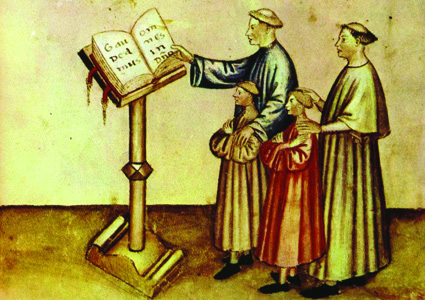
Church music: Seen here in the medieval treatise "Tacuinam Sanitatis", it forged the basis of classical music

It is a mystery to many people why so few contemporary classical composers seem capable of writing "a good tune". Surely, given the number of students who pursue composition in our universities and conservatoires, and the hugely increased access which technologies such as music-notation software give to prospective composers, we should expect to find at least one or two capable of making a popular impact? Why is it that, with more people than ever engaged in the activity of composing, our culture still seems incapable of fostering a contemporary Verdi or Stravinsky, with the celebrity and popular recognition that such great figures once garnered?

It is certainly true, as Simon Heffer has amusingly put it in Standpoint ("A Raspberry for Emetic Music", November 2014), that the musical establishment is "in hock to the crap merchants" and in thrall to the state, creating a tyrannical orthodoxy of ugliness, admission to which can only be gained by imitating the style of "orchestrated raspberries" currently in vogue. However, the underlying cause—though closely related to the over-reaching influence of the modern state—ultimately goes far deeper than this. To understand the deficit of successful contemporary classical music, what we need to uncover are the feelings which motivated the artistic instincts of the great composers of the past, but which are now absent in the minds of modern composers, thus accounting for their "emetic" output.  

In the year 1900, the following composers were alive, and the majority of them active: Saint-Saëns, Debussy, Ravel, Stravinsky, Rimsky-Korsakov, Rachmaninoff, Prokofiev, Bartók, Elgar, Vaughan Williams, Holst, Mahler, Strauss, Sibelius, Grieg, Puccini, Dvořák and Janáček. This list of exalted and well-known figures is far from exhaustive, and should give us pause. We cannot possibly pretend that the world today can boast a similar number or calibre of composers; indeed, any one of these figures is of far more interest to most of us than any of today's most famous composers. Moreover, if one expands this categorisation to include any composer active between the years 1850 and 1950, one possesses pretty much a complete list of the works in the standard orchestral repertoire (save the old German masters), and hence those pieces which one would find overwhelmingly on offer in any events guide produced by today's professional orchestras.

On closer inspection, it is not hard to see the idée fixe that unites this vast array of varied talent: nationalism. To varying degrees of explicitness, whether through the deliberate inclusion of folk elements, or simply a general over-arching style suggestive of national sentiment, all of these figures would quite happily have thought of themselves, not just as composers, but as French, Russian, Hungarian, English, German, Finnish, Norwegian, Italian or Czech composers. It is in fact a statement of the obvious to point out that the feelings that underpin a good deal of what these composers set out to accomplish was driven by a passion for the language, history, customs, traditions, institutions and, perhaps most prominently, the countryside of their native lands.

This surge of nationalist output, produced during the long 19th century, was an obvious accompaniment to the growth of the nation state itself. However, there is another deeper set of convictions which the classical composers held in common, and upon which the nation states of Europe themselves were predicated: Christianity.

View Full Article
 
Share/Save


Jimbob
March 7th, 2015
12:03 AM
This article makes some good points, but I don't know if I can follow it along to the conclusion. I do think that the rise of "art for art's sake", which at one time must have seemed liberating, has instead led to a mostly barren and stifling insularity. So much music seems to exist only to comment on other music--most of which is unknown to the public, creating an ever deepening spiral of obscurity. Or it drily works out variations on some musical idea with no real sense of direction. On the other hand, there's still plenty of music that attempts to comment on something other than itself--see last year's Pulitzer prize winner in the USA, a piece by John Luther Adams inspired by rising ocean levels. I don't think the overall thesis holds up. Are Edward Gregson and Kenneth Hesketh household names? If the author were right, Messiaen, whose music is profoundly spiritual, should be as well-known as Brahms.

amcdonald
March 6th, 2015
9:03 PM
To Pete Byrne`s "irrelevant" I would add twee and quaint. Popular culture has more to say about faith,atheism,misotheism and creation sacred and profane. Kraftwerk,The Revolutionary Army of the Infant Jesus, Heart`s female version of Led Zep`s `Kashmir` (live with Led Zep and President Obama in the audience)are all on Youtube. God must have abandoned official Christian music when it invented `Christian-rock` . His grace is bestowed elsewhere. Not much sign of it in anti-bohemian Islam either. Decadence and nihilism are also forms of mysticism. Decadence in the history of art is a classical category and part of the creative cycle in the rise and fall of empires. A pistol to the head or the foot of the Cross was the critics advice to Huysmans for his book `Against Nature`. To be stuck in the 20th century is the fate of many artists and musicians.

Pete ByrneAnonymous
March 5th, 2015
9:03 PM
The zeitgeist changes and music changes. Classical music has simply become irrelevant in light of the world as it's lived in.

Tedd
March 5th, 2015
4:03 PM
I'm not sure I agree with the conclusion but, as an atheist, I agree completely with the rest of the article. Rather than try to explain these developments away, or mis-characterize the thesis as Christian-good/non-Christian-bad, other atheists ought to spend some time thinking about what will reliably help people see something larger than their own ego at work in their psyche, which is what Christianity (and other forms of spiritualism) can do, at their best. That is what elevates us above the "cheap thrills of recreational sex" and other shallow pursuits. And that is also what, despite its otherwise-extraordinary success, the Godless world has not yet been able to do.

amcdonald
March 5th, 2015
4:03 PM
Is Jeff Butler simply jealous ? How unbecoming and poor form of him. Critics who are not `rational actors` create negative publicity. Nothing in Standpoint has or is being co-opted. "If there`s one thing worse than being talked about it`s not being talked about at all."- Oscar Wilde.

Jeff Butler
March 4th, 2015
7:03 PM
@amcdonald, @Rick Robinson: What makes you think it is acceptable to co-opt this forum to shill your own music, couched in an otherwise utterly irrelevant comments? It's unbecoming, and poor form.

Anonymous
March 4th, 2015
3:03 PM
The title I feel is a bit misleading because while the author does talk about the lack of Christianity (which I disagree with) a good portion of it does talk about the atonality of music that SADLY is in vogue. For me, the decline of classical music is that the music is made for musicians...there isnt a human element anymore that people can connect to. Music is about connection. Such operas like Demandolx which is currently in development seeks to connect audiences again (www.opera-demandolx.com) and others that are trying hard to bring the classical music back to the people. There is a concept: bring the music to the people! Atonality and this John Cageism that is so prevalent today only succeeds with two things: 1. makes the audience feel they dont 'get it' and as such, they tune out, 2. strokes the composers ego for being 'cutting edge' which it really isnt anymore. I dont think it has to do with religion or nationalism. It has to do with creating music that is, in fact, music.

John Porter
March 4th, 2015
12:03 PM
Well, there's one thing clear from this essay, that the author has no interest in anything written in the latter part of the 20th century. There are many, who will put Steve Reich or Arvo Part up against any of those listed as active in 1900, including Mahler or Stravinsky. What is more, many of those composers are fading into oblivion. You're not going to hear much Janacek or Rimsky Korsakov performed today. The bulk of Saint Saens is pretty light weight. It's hard to afford credibility to an author so biased against music based on chronology.

pdq
March 3rd, 2015
9:03 PM
Hm. I was taught that one of the features of _classical_ music was that it _wasn't_ nationalistic; that's part of what made it classical. It's part of what classical means. Nationalism was a move away from the classical ideal.

Serge
March 3rd, 2015
6:03 PM
Interesting analysis, although perhaps over-generalizing. Is not much music even of the classical era under discussion motivated by other passions than nationalism and Christianity? For example: romantic love, the beautiful and sublime in nature, Enlightenment reason, the discoveries of science, the human condition in all its varieties, death (whether of others or in consideration of one's own death), etc. Also, no mention of composers like Arvo Pärt, Glass, etc? What of film composers, who have a tremendous influence? The rising neoclassical music, which fuses classical minimalism with the ambient electronic instrumental movement, which may itself may be considered a continuation of the classical tradition? I am also not convinced that the answer is a return to nationalism and Christianity as sources of inspiration; this seems like a regressive step. Finally, whereas admittedly much popular music focuses on the casual sexual relationship, this is not true of all. Much focus on idealized romantic love, for example, and many other themes. Regardless, thank you for this thought-provoking article.

Post your comment

CAPTCHA
This question is for testing whether you are a human visitor and to prevent automated spam submissions.