

You are here:   Civilisation >  Critique > Strange Death of the English Gentleman


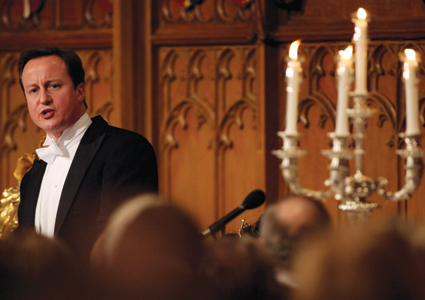
David Cameron: The PM plays down his gentlemanliness for fear of sounding snobbish 

Who is the Dr Thomas Arnold of the comprehensive schools? There does not appear to be one. Socialists and egalitarians have an unshaken faith in the virtue of the comprehensive ideal. But they have failed to call forth the inspiring figure who could offer, in his or her own school, an elevated demonstration of the ideal put into practice. It is all very well to wear a T-shirt bearing a picture of a Latin American revolutionary, if anyone still does, but Che Guevara wasn't running a school. The socialists suffer from an acute shortage of constructive heroes, which is why the Soviet Union was reduced to inventing such ludicrous ones.

But this is not just a problem for socialists. As headmaster of Rugby from 1828 to 1841, Dr Thomas Arnold sought to instil "1st, religious and moral principles: 2ndly, gentlemanly conduct: 3rdly, intellectual ability." The new or revived public schools of the 19th century had all sorts of practical purposes, being designed to enable their pupils to pass the exams which permitted entry to various professions, and to provide an imperial ruling class. But the education they offered was saved from becoming aridly utilitarian because they were devoted to the formation of Christian gentlemen. One of the distinguishing marks of a gentleman was that he did things because he knew they were the right thing to do, not because they would bring him personal advantage. Captain Oates was a very gallant gentleman.

The idea of a gentleman was a more inclusive one than it sounds to modern ears. One of its greatest advantages was that you could define it so as to include yourself. You could behave like a gentleman, without possessing any of the social attributes which a gentleman might have: there was no need to possess a coat of arms, or a country estate, or engage in field sports, or wear evening dress. At least since Chaucer's time, there had been a distinction between the social meaning of the word, and the moral. It was evident that well-born people, who ought to know how to behave like gentlemen, did not always do so, while others sometimes did.

Philip Mason, whose perceptive study, The English Gentleman, was published in 1982, argues that "the desire to be a gentleman" runs through and illuminates English history from the time of Chaucer until the early 20th century. He suggests that "for most of the 19th century and until the Second World War" the idea of the gentleman "provided the English with a second religion, one less demanding than Christianity. It influenced their politics. It influenced their system of education; it made them endow new public schools and raise the status of old grammar schools. It inspired the lesser landed gentry as well as the professional and middle classes to give their children an upbringing of which the object was to make them ladies and gentlemen, even if only a few of them also became scholars."

View Full Article
 
Share/Save


Jon
September 7th, 2012
1:09 AM
The decline of the gentleman is very interesting, but now as it appears along with a thousand other signs of cultural feudalization, I cannot somehow make myself yearn for the gentleman's return. The education of gentlemen is a fundamentally aristocratic act. There is no getting around it -- and this includes the "fundamentally hypocritical" connotation; a gentleman must be blind to his own self-interest and self-regard. There are always those few wonderful examples, but they are equally as rare as the wonderful examples of gentlemanly scientific diligence and genius: notable because of their rarity, but remembered as part of a golden age whose chief characteristic was... (drumroll please) -- the favored position of the gentleman.

Gregory Smith
September 5th, 2012
11:09 PM
Read Shirley Letwin's book, The Gentleman in Trollope, referred to in this article. Anyone who is interested enough in this subject to have read this far would find it fascinating - perhaps even uplifting. It is a work of astute observation and intelligence, on a subject that deserves far more attention than it gets.

Lucius Annaeus
September 5th, 2012
8:09 PM
I think the report of the demise of the gentleman is exaggerated. I shall give you one example. In the recent horrific shootings in Aurora, Colorado, it was mentioned that three of the victims were young men who died whilst protecting their girlfriends from the shooter by covering the girls with their own bodies.

Charles Jaffe
September 5th, 2012
5:09 PM
Doesn't the concept of being a gentleman come from ancient Greece? Did not the Renaissance revivification of such attitudes,adapted by the Christian culture create the European gentleman. Much of what we consider gentlemanly behavior doesn't seem specifically Christian to me but shares characteristics with pagan and oriental variants. A specifically Christian gentleman then may be a stage in a continuing evolution.

BMerker
September 5th, 2012
4:09 PM
In letting the ideal of 'the gentleman' slip into oblivion the modern world has missed the chance to equip itself with an universal ideal or identity-model for adulthood, something it so obviously both needs and lacks. It is not inconceivable that a transition could have been made from the Christian gentleman to a secular ideal of gentleman and gentlewoman, embodying the best we can conceive of in terms of personality, bearing, and dealings. I am afraid that Andrew Gimson is right, however, no such transition has been made. The gentleman is no longer a live ideal, and that should be an occasion for sadness and regret. But perhaps it is still not too late???

stephenkennamer...
September 5th, 2012
3:09 PM
The conservative nostalgia for a way we never were always astounds me. As I have just finished reading Dickens's Bleak House, forgive me for demurring from the rosy picture of Victorian morality presented here. The author bestows the accolade of "so great a man" upon that inveterate careerist and opportunist Cardinal Newman, who was so narcissistically impaired that he dealt with every petty theological dispute by moving to another sacred venue and trying once again to have it all his own way. From Calvinism to Anglicanism to Roman Catholicism, he moved ever rightward in search for an authoritarianism that he could call his own. But switching never made him more tolerant: he could never endure any dissent from the dogma of whichever catechism he was currently espousing or whichever church he was currently attending. When he was a fervent Anglican at Oxford, he tried to keep his former evangelical associates out. When he became a fervent Catholic in his Third Great Awakening, he wanted Catholics in. Early and late, it must be Newman's Oxford. As Nietzsche said: "A religious person thinks only of himself." But I suppose Newman was a gentleman--held the door for any ladies who had to be expelled from the Oxford library. The good old days!

andrewe5
September 5th, 2012
12:09 PM
That's Alec Douglas-Home, Bernie, not Hume. You're confusing him with a lesser order of Humes. Goodness, how quickly we forget. Sic transit gloria mundi.

Dismanirie
September 5th, 2012
11:09 AM
The monstrous burden taken on by my parents to educate my brother and me in the preparatory and public school system in the UK may not have been entirely wasted. Although my brother determined that school was not for him by his mid-teens, I was too chicken to run away, and endured the full gamut of 12 years in two institutions. I look back on that time with little emotion, but have daily been gratified by evidence that my education (in the literal sense) conferred on me a humanistic discipline to always consider the perspectives and interests of the other party. "Do unto others ...." is the one great philosophical tenet of behaviour which these twelve years of schooling gave me. It may be presumptuous to assume that I am a "gentleman" by virtue of this education, but the truth is that the syllabus and teaching examples are sorely lacking in today's curricula and styles of schooling. God bless my parents for their sacrifice!

Bill Robertson
September 5th, 2012
11:09 AM
My dear Bernard the Falconer, there is at least one gentleman left in the world. Good day to you, sir - good day to you!

Jan Sand
September 5th, 2012
10:09 AM
Although I am neither English nor Christian nor a graduate of any of the mentioned institutions I try to behave decently to all humans and whatever animals come within my contacts. I take occasional exception to mosquitoes and cockroaches but I try to be fair. Turning the other cheek to some creatures of the lower species such as the bulk of politicians and those engaged in financial manipulation merely presents them with opportunities so they must be treated with the harshest responses.

Post your comment

CAPTCHA
This question is for testing whether you are a human visitor and to prevent automated spam submissions.