



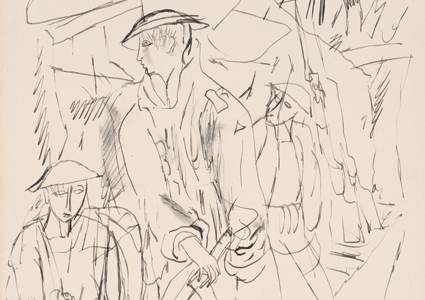
 Detail from "Life in the Trenches: Sketch B", 1936, ink on paper
Naturally any food, whether toffees, bully beef or margarine, has to be protected from the rats who thrive in what Jones calls this "amphibious paradise". When the artillery barrages over no man's land stop for long enough, the men hear the "scrut-scrut-scrut" of the rats patiently working their way through corpses and rations.
But these privations, the damp, the cold, the mean, congealed rations, the rats, are as nothing compared to the screaming violence of modern warfare. Soon after Jones's arrival in France, his illusions about knights-errant, quests and holy grails were shattered.
In December 1915, at Riez Bailleul, a cluster of small farms not far from the front, Jones first witnessed the explosion of a long-range heavy shell. It was to provide one of the most vivid passages of In Parenthesis.
It opens with the most banal of incidents. The young Private Ball, fumbling in his pocket for a match, scatters its contents on the ground, among them a front-door key to the family home in Stondon Park — a south London suburb. He chides himself: "Stupid Ball, it's no use here." Then, preparing to turn in for an hour's sleep before reveille, he hears the whistling of a shell.
"Out of the vortex, rifling the air it came — bright, brass-shod, Pandoran; with all-filling screaming . . . all bursting out; all sudden up-rendings and rivings-through."
It tears the landscape apart, turning a field of beetroots to red pulp. In the aftermath, ears ringing, the horrified, uncomprehending Ball can do no more than fret that his mess tin has been lost in the blast.
Jones loathed the mechanisation of warfare. He believed that while there was nobility in fighting at close range with a lance, a sword, even a bayonet, there was something inhuman about unleashing death from the skies. The Somme battle marked a turning point: the end of the individual rifleman and the beginning of "wholesale slaughter", the "sinister" shell and the insidious creep of gas.
It is with the Somme offensive and the battle for Mametz Wood that the poem reaches its climax. In chilling detail Jones describes the slow, expectant agony of waiting to go over the top: an officer's announcement of "zero minus seven minutes", an optimistic private cheerfully wondering "perhaps they'll cancel it", a young recruit who in his terror loses control of his bowels, and the platoon mate who tenderly wipes away his tears and lends him a stick of eau de cologne.
The assault on Mametz Wood took three days and the British forces succeeded in pushing back the enemy lines — but at huge cost. Jones's battalion alone lost a third of its men, killed or wounded.
The poem watches them as they fall. A private who married his sweetheart when last on leave is pierced through by a razor of shrapnel. One man, even as he bleeds to death, still fumbles with the wretched straps of his uniform, trying to loosen the choking buckle of his tin hat. Not far from his prone body lies the severed head of a private grinning "like the Cheshire cat". It was images like this, grotesque, absurd and brutal, that would haunt Jones for decades.
The final pages follow one soldier, grievously wounded, crawling to some place of safety — as Jones himself did. We leave him calling for the stretcher bearers — "why don't the bastards come?" — as the boots of the reserve units troop past on their way to annihilation.
The poem ends with Mametz Wood, but for Jones the war went on. Mametz saw him invalided back to England, but he returned to the front in late October 1917, just north of Ypres, then the area of most concentrated violence.
And so the routine of sandbags and shelling and cups of char resumed. It was the coldest winter in 50 years. Jones, who had always believed that he would survive the war, began to lose his nerve. "I felt the sands running out," he later wrote.
In mid-February 1918, Jones came down with trench fever and was evacuated to a base hospital with a 105-degree temperature. There the pale printmaker with his deficient chest measurement came closer to death than he ever had in the field. He would not return to the front. Nor would he recover from those three years. Though he never called it shell shock, Jones was diminished and unmanned by all that he had seen.
Jones never married, never had children. He lived a monkish existence in a series of guest rooms and bedsits, which he referred to as his "dug-outs". His prints, paintings and poems brought a small income but financially he relied on his parents and then on the generosity of friends and patrons. To the end of his life the clatter of a tea-tray or a foggy day would rend his nerves. Each July the horrors of the Somme and Mametz Wood would return, triggering debilitating insomnia.
If In Parenthesis was an attempt to exorcise these demons, it failed. The completion of the poem in 1932 brought a shattering nervous breakdown. It took five years for Jones to summon the courage to have it published. T.S. Eliot, who oversaw its publication by Faber, called it "a work of genius".
Its title was an attempt to put into brackets all that had happened in those 117 weeks at the front. "The war itself was a parenthesis," Jones wrote in his introduction to the poem. "How glad we thought we were to step outside its brackets at the end of '18." But Jones, like so many other men of his generation, never did step outside the war's brackets. In an interview given two years before he died at the age of 78, he confessed: "The memory of it is like a disease . . . I still think about it more than anything else."
Next year, we will reach for Graves, Owen and Sassoon to make sense of what was suffered on the Western Front. But In Parenthesis alone does justice to the unrelenting nature of the war, the weeks, months and years lost to the routine of sandbags, entrenching tools and death. There is no witness more eloquent, angry, trench — damp and footsore than Private David Jones, the pale, "deficient" poet-painter made warrior by circumstance.


Post your comment
- The Lod Mosaic
- Disparaged masters of the late Renaissance
- The Arrival of Spring
- Henry Tonks: A Strange New Art
- A Roman Pilgrimage
- Back to the Drawing Board with Andrew Marr
- Giovanni Benedetto Castiglione
- Honoré Daumier
- Sir Hugh Casson
- Bernard Hailstone: The Artist And His Sitter
- The Roy Davids Collection
- Fritz Schaefler
- Shots from Russia's Edgelands
- Patrick Heron
- Erin Bannister Townsend
- Quentin Blake
- Royal Academicians
- Paul Johnson
- Barry Martin
- BP Portrait Award 2012
