



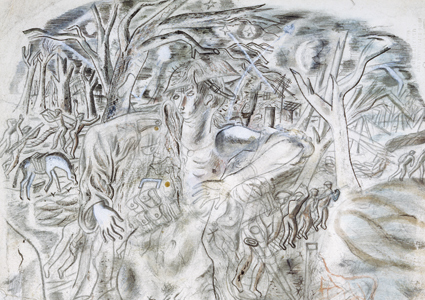
 Detail from the frontispiece for "In Parenthesis", 1937, watercolour and ink on paper
Jones, who was slight, who felt the cold, who had often played sick to get off school, felt the physical hardships of war keenly. When he enlisted, he was not quite 5ft 7in and weighed around seven stone. His pack, hung about like a Christmas tree with mess tin, compass, penknife and entrenching tool, weighed five-and-a-half stone. On the march from the battalion's training ground on Salisbury Plain to Southampton in December 1915, a platoon mate carried Jones's rifle, taking it from him with the words "poor little sod".
Conditions in France were infinitely worse. That Christmas, as the platoon marched from Le Havre to the front, the country received more rain than in any December for 39 years.
The physical discomforts of marching are a mainstay of the poem: the weeping blisters, the socks stuffed under pack straps to relieve chafing and the endless adjusting of rifle slings, buckles, belts and buttons. The poem complains of the entrenching tools slung from belts "going on bruising, however much you re-adjusted the brasses". Worse still are the boots-especially when new. The men despair of the way "weeping blisters stick to the hard wool of grey-government socks". At the front, though relieved of the aches of marching, there is the cold and damp to contend with. The early-morning fogs are as penetrating as mustard gas. Jones writes of a "cloying drift-damp . . . It hurts you in the bloody eyes, it grips chill and harmfully and rasps the sensed membrane of the throat; it's raw cold, it makes you sneeze-christ how cold it is."
In such conditions, comfort comes from a cup of tea served in an enamel cup, the loose leaves tied in a scrap of sandbag. On the dampest days, when any kindling is wet through, fires remain stubbornly unlit and the men engage in jealous bartering over mess tins of lukewarm water. The poem asks: "How do you get hot water in this place of all water-all cold water up to the knees."
Then there's the food: bully beef and ration biscuits, bread "ill-baked and sodden in transit" and, if you're lucky, "one piece of cheese of uncertain dimension, clammy, pitted with earth and very hairy". Few things give the men greater rapture than the arrival of a Fortnum and Mason's hamper to celebrate a lieutenant's 21st birthday.
If anything makes the front bearable it is the company of platoon mates. In Jones's regiment, half the soldiers were Cockneys, noisy, joshing, swearing men who spoke execrable franglais. The poem touchingly recreates the night-time comradeship, the echoed "goodnight; goodnight, chum; bon swores, cheriees; night sergeant; night chaps" as the men bed down on dug-out slats.
They keep their spirits up with snatches of song: "The British Grenadiers" and "Johnny's so long at the fair". When off duty they suck Mackintosh's toffees and litter the ground with greaseproof paper twists. In moments of extreme boredom they lob margarine tins into flooded shell craters and watch them float like children's sailing boats.


Post your comment
- The Lod Mosaic
- Disparaged masters of the late Renaissance
- The Arrival of Spring
- Henry Tonks: A Strange New Art
- A Roman Pilgrimage
- Back to the Drawing Board with Andrew Marr
- Giovanni Benedetto Castiglione
- Honoré Daumier
- Sir Hugh Casson
- Bernard Hailstone: The Artist And His Sitter
- The Roy Davids Collection
- Fritz Schaefler
- Shots from Russia's Edgelands
- Patrick Heron
- Erin Bannister Townsend
- Quentin Blake
- Royal Academicians
- Paul Johnson
- Barry Martin
- BP Portrait Award 2012

- Conduct Unbecoming: The Classical Commentaries of Norman Lebrecht in Standpoint
- Propaganda Shouldn’t Pay
- The US Can Still Help Save Syria — and Iraq
- A Putrid Pact between Devils
- Strangers in their own Holy Land
- The Taboo of the Tombola
- Putin has his Useful Idiots on the Left and the Right
- Russian Resurgence has Blindsided Nato