



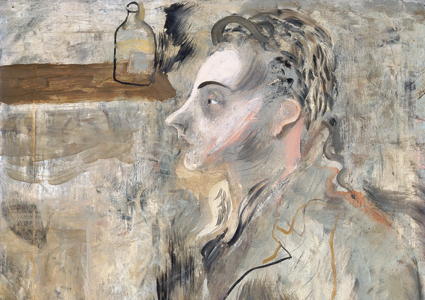
 Detail from "Portrait of a Maker", 1932, oil on canvas
 Today, the poem is little read. It is deemed too long — 225 pages in the Faber edition — too difficult, too abstract. Due to its "scale and complexity", it is excluded from the Penguin Book of First World War Poetry. Its absence from the anthologies-even in extracts-ensures against its discovery by new readers.
Next year, with the centenary of 1914, we will rehearse Wilfred Owen and Siegfried Sassoon's ready lines "dulce et decorum est" and "everyone suddenly burst out singing", but few will read Jones's haunted and haunting account of the three years he spent on the Western Front. By virtue of its length, it has more in common with Robert Graves's Goodbye to All That or Erich Maria Remarque's All Quiet on the Western Front than with the six-stanza poems of the anthologies which offer only fleeting snapshots of the front.
No other poem of that war gives such a sustained account of young lives wasted in the trenches. Jones spent 117 weeks at the front — longer than any other war poet. He served in trenches and dug-outs for two months longer than Edmund Blunden, six months longer than Isaac Rosenberg, twice as long as Sassoon and Ivor Gurney and more than twice as long as Owen and Graves.
Jones differed from these men in another crucial respect. Unlike Blunden, Sassoon, Graves and Owen, who were all junior officers, he never rose above the rank of private.
It is Jones's military ordinariness, however, that gives the poem its power. The hero of In Parenthesis is the everyman soldier, the Cockney Tommy with blisters on his feet and a uniform soaked to the vest with February rain.
From the opening of the poem in December 1915 to its close in July 1916, we are embedded with a platoon of men. We follow them from fumbled rifle drills on the parade grounds of England to the blasted landscape of the Western Front.
It is a poem about the relentless foot-slogging, sand-bagging, rat-shooting, duckboard-laying, sleepless grind of trench warfare. It is a tedious, repetitive rut violently punctuated with deafening artillery fire, the percussive explosions of shells and the right-you-'orrible-lot bark of a newly-promoted sergeant-major. Though it is not directly — the poem shifts its viewpoint between the men of a platoon and their commanding officers — Jones said that he had witnessed everything described in the poem.


Post your comment
- The Lod Mosaic
- Disparaged masters of the late Renaissance
- The Arrival of Spring
- Henry Tonks: A Strange New Art
- A Roman Pilgrimage
- Back to the Drawing Board with Andrew Marr
- Giovanni Benedetto Castiglione
- Honoré Daumier
- Sir Hugh Casson
- Bernard Hailstone: The Artist And His Sitter
- The Roy Davids Collection
- Fritz Schaefler
- Shots from Russia's Edgelands
- Patrick Heron
- Erin Bannister Townsend
- Quentin Blake
- Royal Academicians
- Paul Johnson
- Barry Martin
- BP Portrait Award 2012

- Conduct Unbecoming: The Classical Commentaries of Norman Lebrecht in Standpoint
- Propaganda Shouldn’t Pay
- The US Can Still Help Save Syria — and Iraq
- A Putrid Pact between Devils
- Strangers in their own Holy Land
- The Taboo of the Tombola
- Putin has his Useful Idiots on the Left and the Right
- Russian Resurgence has Blindsided Nato