


"What the cynics fail to understand is that the ground has shifted beneath them," President Barack Obama declared in his inaugural address in January 2009. "The stale political arguments that have consumed us for so long no longer apply."
What a difference a year makes.
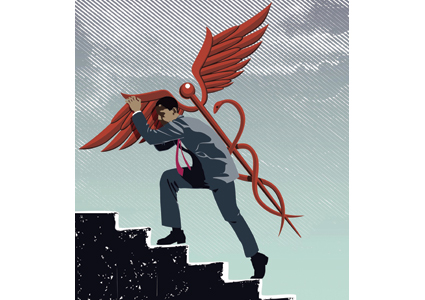
Sisyphean task: Barack Obama hasn't convinced the American public that his healthcare bill will work
Arriving in Washington on the eve of President Obama's "bipartisan" healthcare summit, I found the capital more divided than ever. What's more, the political momentum that carried Obama to the White House seems to have deserted him. As Juan Williams, the author and political analyst for National Public Radio and Fox News, remarked to me: "For this to happen just one year after he was elected with an historic majority, and on such a tremendous tide of popular goodwill is just astounding."
Recent events show that Obama, once the Democratic Party's greatest asset, may have become a liability. Over the past three months, Republicans have won three major electoral victories against Democratic incumbents by campaigning against Obama explicitly, and his approval rating has dropped by nearly 20 per cent since his Inauguration, the steepest decline in a first-year President's approval rating ever recorded.
"In five decades of closely following American politics, I have never seen the Democratic Party in worse shape," noted the political analyst Michael Barone, whose biennial Almanac of American Politics is required reading in political circles. Just a year ago, the Republicans were preparing themselves for a long spell in the political wilderness. Today, they are energised and readying themselves for a reprise in November of the 1994 midterm elections in which the Republicans took back the House of Representatives.
Speaking in his office overlooking McPherson Square, Kenneth Weinstein, the CEO of the Hudson Institute think-tank, summarised the conservative take on Obama's downfall. "He fundamentally misinterpreted his mandate," Weinstein argued. "Obama and his advisers believed that the financial crisis would make Americans embrace the kind of big government solutions which they usually oppose. They were wrong."


Post your comment
- Admit It, Mr Kerry: You Blundered
- Bismarck Versus Blair — A Foreign Policy Crossroads
- Arab Spring, Islamist Summer — What Next?
- The Diplomat the Whole World Ignores
- The Blob Has Run Schools For Decades. Not Any More
- Would You Intervene — Or Pass On The Other Side?
- He Died That Others Might Live In Peace
- The Hero's Journey is Hollywood's McMyth
- Online Only: Countering the Counter-Jihadists
- Online Only: The Price Paid for Criticising Islam
- 'Please Sir, I Just Want to Learn More'
- Why Students Should Be Glad To Pay Tuition Fees
- A 'Liberal Racist'? Me? I Felt Like a Heretic
- Demolish the Relics of Yesterday's Future
- Was Britain Right To Go To War In 1914?
- German Victorians Who Helped Transform Britain
- The Alternative History of an Undivided India
- Online Only: Heirs to the Left
- ONLINE ONLY: The Hayward Gallery's Fashionable Primitives
- ONLINE ONLY: A Spiritual Corner of Southwark

- The Zombie Argument that Refuses to Die
- Online Only: The Price Paid for Criticising Islam
- Overrated: Dan Brown
- Is the Brain the Key to Understanding Religion?
- Overrated: George Monbiot
- Time to Wise Up to the Muslim Brotherhood
- 'Please Sir, I Just Want to Learn More'
- The Alternative History of an Undivided India
- The Zombie Argument that Refuses to Die
- Online Only: The Price Paid for Criticising Islam
- Overrated: Dan Brown
- Is the Brain the Key to Understanding Religion?
- Overrated: George Monbiot
- Time to Wise Up to the Muslim Brotherhood
- 'Please Sir, I Just Want to Learn More'
- The Alternative History of an Undivided India
- Decline and Fall of the History Men
- Uncritical Theorists Who Misread the Nazis
- The Zombie Argument that Refuses to Die
- The Banality of Hannah Arendt
- From Kitsch to Cool: Picasso and Modern Art
- Is the Brain the Key to Understanding Religion?
- Time to Wise Up to the Muslim Brotherhood
- Midfield Virtuoso Finds His Perfect Pitch
- Online Only: The Price Paid for Criticising Islam
- Overrated: George Monbiot
- Letter from Ukraine: Reviving Lost Literature
- Tsar Of The Holy Land
- On Pilgrimage with the Hasids
- The Blob Has Run Schools For Decades. Not Any More
- My Dieting Guide: Listen To Mother
- Bismarck Versus Blair — A Foreign Policy Crossroads