



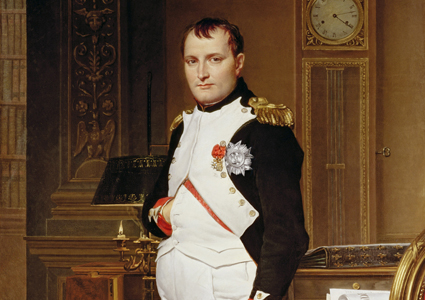
 Object of mockery: Jacques-Louis David’s portrait of Napoleon
When Winston Churchill appointed R.A. Butler as the president of the Board of Education in 1941, he advised him: "I should not object if you could introduce a note of patriotism in our schools. Tell the children that Wolfe won Quebec." Butler believed it would be too autocratic to dictate to schools what lessons they should teach, and it was not until 1988 that Kenneth Baker imposed a national curriculum on Britain's state schools.
Since the arrival of the national curriculum, public debate on school history has focused almost exclusively on what topics should be taught, namely whether the emphasis should be on British or world history. This debate has been fuelled by a steady stream of surveys revealing the ignorance of today's school-leavers. One commissioned last summer by Lord Ashcroft found that while 92 per cent of 11- to 18-year-olds could identify the animated dog from the car insurance advertisements as Churchill, only 62 per cent could identify a photograph of Britain's wartime prime minister. Fewer than half knew that the Battle of Britain took place in the sky.
However, having become a history teacher at a state secondary school two years ago, I have realised that such debates miss the real problem. I was surprised to learn that since its inception the national curriculum has stipulated a sensible split of British and world history: every pupil between the ages of 11 and 14 is expected to study a chronological sweep of British history from 1066 to the present day. To understand the degradation of history teaching, one has to focus not on what history is taught, but how it is taught.
I was inspired to become a teacher by a desire to emulate two history teachers I was fortunate enough to have at school. They loved history, liked children, and had a gift for communication. But once I embarked on my teacher training, everything I was told about good practice opposed such a vision. Apparently, such teaching is old-fashioned. I was quickly accused of having a tendency towards "didacticism", a cardinal sin in today's state sector.


- Trump's America: The End Of Exceptionalism
- The Kaliningrad Contingency
- Mrs May Is Too Canny To Say Farewell To Arms
- To Understand Trump, Read Huxley — Not Orwell
- A Letter To Our Great-Grandchildren
- Trump Is No Loser, But Government Will Be Harder
- Trump's Appeal Is More Roosevelt Than Reagan
- The Trump Presidency: A Worst-Case Scenario
- We Cannot Take Liberal Democracy For Granted
- No Need To Fear Russia. The Bear Is Broke
- Who Will Do Justice To Our Judiciary?
- Trust Westminster On Brexit: It's All We've Got
- Back to the "Future Of Socialism", Mr Corbyn?
- Would The Little Lady Like A Wee Dram?
- The Coalition We Need To Defeat Islamism
- Are We Losing The War On Home-Grown Terror?
- Cameron Gave Libyans A Chance. Pity They Blew It
- Brexit Will Give Global Free Trade A Boost
- The Real EU Referendum Winner May Surprise You
- Is Theresa May The True Heir To Mrs Thatcher?

- Why On Earth Should Anyone Study Philosophy?
- The Dying Days Of Zuma's South Africa
- Time To Revisit The Two Cultures
- Who Will Do Justice To Our Judiciary?
- Political Misconduct
- Why The Most Civilised Of Men Felt Like A Fraud
- Trump's Appeal Is More Roosevelt Than Reagan
- Anything Dennett Can Do, Scruton Does Meta
2:12 PM