

You are here:   A Little History Of The World > History Lessons for the 21st-Century Classroom
 

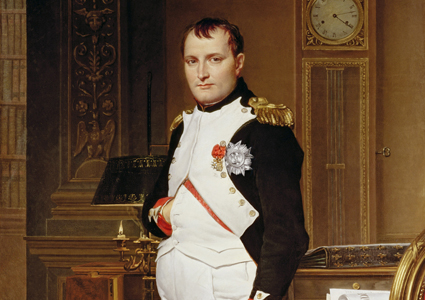
Object of mockery: Jacques-Louis David’s portrait of Napoleon 

When Winston Churchill appointed R.A. Butler as the president of the Board of Education in 1941, he advised him: "I should not object if you could introduce a note of patriotism in our schools. Tell the children that Wolfe won Quebec." Butler believed it would be too autocratic to dictate to schools what lessons they should teach, and it was not until 1988 that Kenneth Baker imposed a national curriculum on Britain's state schools. 

Since the arrival of the national curriculum, public debate on school history has focused almost exclusively on what topics should be taught, namely whether the emphasis should be on British or world history. This debate has been fuelled by a steady stream of surveys revealing the ignorance of today's school-leavers. One commissioned last summer by Lord Ashcroft found that while 92 per cent of 11- to 18-year-olds could identify the animated dog from the car insurance advertisements as Churchill, only 62 per cent could identify a photograph of Britain's wartime prime minister. Fewer than half knew that the Battle of Britain took place in the sky. 

However, having become a history teacher at a state secondary school two years ago, I have realised that such debates miss the real problem. I was surprised to learn that since its inception the national curriculum has stipulated a sensible split of British and world history: every pupil between the ages of 11 and 14 is expected to study a chronological sweep of British history from 1066 to the present day. To understand the degradation of history teaching, one has to focus not on what history is taught, but how it is taught. 

I was inspired to become a teacher by a desire to emulate two history teachers I was fortunate enough to have at school. They loved history, liked children, and had a gift for communication. But once I embarked on my teacher training, everything I was told about good practice opposed such a vision. Apparently, such teaching is old-fashioned. I was quickly accused of having a tendency towards "didacticism", a cardinal sin in today's state sector. 

View Full Article
 
Share/Save


Heather F
January 12th, 2013
12:01 PM
Perhaps I am illiterate and should throw in the towel. I think my post had lots of typos because I find typing on my ipad a nightmare. Actually I agree that literacy standards are generally too low among graduates but your comment is just nasty.

HeatherF
January 12th, 2013
12:01 PM
Laurence that is a really pointless comment. Interesting... a human being writing late at night on her new ipad (that doesnt seem to want to cooperate) made some errors.... Anything to comment on the actual content of my post?

MISSRG
January 12th, 2013
10:01 AM
Whilst I think the author of this article makes some interesting points (I have a distinct proclivity towards chalk and talk from time to time, I often find its the best fit to actually disseminate the information)I would disgaree wholeheartedly on his comment re SHP. Having used their texts throughout my career (10+ years) in a varoety of setting including UK State, private and international schools I find its focus on second order concepts and investigation excellent at instilling at KS3 the skills needed to be successful from GCSE all the way through to degree level. The skills that are taught in History outside the facts themselves are every bit as valuable and have far reaching benefits beyond the subject itself. Not all the activities and methods espoused by SHP will suit individual teachers (or their students for that matter)but that is where one's own skill as a teacher come into affect, modify, change, adapt, but don't blame if it doesn't work for you.

Shaun Harbord
January 8th, 2013
8:01 AM
"In the case of history, the main skill we teach is "source analysis"......,pupils are now taught to become junior historians, building their own knowledge of the past through the first-hand study of historical evidence." Oh dear, this means pupils will develop analytical skills which will enable them to make up their own minds!!! That that is horrifying to the author tells you all you need to know about him and his conception of education.

Laurence
January 4th, 2013
11:01 AM
How very interesting that Heather F. - a teacher, apparently - does not appear to be able to write grammatical or properly punctuated English.

Heather F
December 29th, 2012
10:12 PM
Yes that is so right. The obsession from critics of modern history teaching over what is taught does entirely miss the point. When I was trained I accepted the SHP version of history teaching uncritically and was fired up to teach skills through history. However, i always felt a need to ensure my students knew lots of detail to us in their answers as it was so clear that otherwise they wrote vacuous tosh. Ironically the old SHP GCSE textbooks are very detailed cared with many. However, i do think the emphasis on explanation as superior to narrative in modern school history is good. I teach in the private sector and if you have ever marked history common entrance papers you'll know what I mean. The average kid 'vomits' reams of facts onto the page with little understanding of or real focus on the question. I think the should be more emphasis on assimilating lots of knowledge but it should be used to explain as secondary students are capable of doing this and should be expected to do more than re-tell a story.

Winston
December 28th, 2012
10:12 PM
For Orwell's 1984 to work, where history is re-written according to political diktat, one neeeds a populace with no memory of the facts. The SHP propoduces a populace with no historical memory and a middle class leftwing wing view of the World. One aspect of the left wing middle class view of history is that they ignore the fact that British people had more liberties, opportunities for advancement, freedom of expression and a more just legal system than practically any other country for the last 1200 years and these were major reasons for our success.

burkard@tiscali...
December 25th, 2012
2:12 PM
Brilliant article. Just about my only criticism is that history is also about how the ideas and actions of great men and women have changed the world. The old Whig version of history may have been wide of the mark--the Whigs were far from being proto-democrats--but our children should understand the central role Britain played in creating the modern world. It's the last thing our educators are interested in--they're doing their best to forget that liberty and limited government unleashed human potential in a way the world had never before seen.

Sarah
December 23rd, 2012
2:12 PM
I found this article really interesting and agree with many of the ideas in it - I wonder though, in your teaching experience since graduating have you not met any recently qualified teachers (5 years experience or less) that combine active learning with more didactic techniques? I have met many at conferences, training sessions etc. so can't help but think that there's more common sense about than the comments around the 'soft-left' and child-centred training would indicate. Also sometimes I wonder if history teaching wouldn't be a whole lot more useful/interesting if various governments stopped changing or intervening in it (and I mean of both political bents!)

R Cronenbourg
December 23rd, 2012
2:12 AM
It is all up to the parents. Those with means: invest your all into a decent school, eschew that holiday in the Seychelles and the second home in Italy. Those without: home-school! It really is that simple. Break the Gramscians' monopoly over education and put entire legions of the kommissariat out of business.Our children are far too important to be left at the mercy of the `experts.'

Post your comment

CAPTCHA
This question is for testing whether you are a human visitor and to prevent automated spam submissions.