



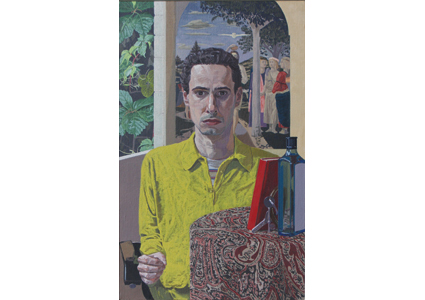
"Als Ich Kan" (2007-11) by Jacob Willer
How much do people know of what goes on in art schools nowadays, of what constitutes an education in, and for, art? Very little, I suspect, for even I, who had decided that art would be my life's occupation, knew next to nothing of it when I was preparing to enrol for art school. I wanted to learn to paint, and by visiting museums I knew how far I had to go; I wanted especially to be taught by those further on in life who shared my enthusiasms and ambitions. I never met such a teacher, despite my studying at one point or another in four different schools. At the first, for a foundation course, I lasted two days. Those days were enough to convince me I had nothing to gain by being there. By the time I had entered what was to be my final school, three years later and for a three-year degree course, I was no longer so naive; I knew what to expect, but I supposed — foolishly, it turned out — that it would be better, or at least would look better, if I were to finish something I had begun.
I didn't learn a single thing there that would be of use to me, or anyone else, becoming an artist. Thankfully I was then old enough, and familiar enough with the great art of the past, to be protected by experience from accepting the doctrines of the school. To others, though, these doctrines, and the attitude they encourage, are more damaging, and I watched as they effectively smothered the sparks of talent. My years in art school did serve to expose me to a sort of person, and a sort of thinking, that I would not otherwise have met; it was against these that I began to define all I valued. Now, years later, I have tried to consider my experience with more detachment, in order to characterise the ways by which art is too often taught.
Most of the famous art schools have a history of over a hundred years. Many of these schools once took students through a sequence of exercises intended to develop their facility and attune them to the manners and masteries of the past. Students copied successful designs, drew from casts and studied anatomy; then, having acquired the appropriate skills, they would move on to drawing, and eventually painting from, the live model. This has now all changed, yet the schools have kept their premises and names, and one of them, to the annoyance of its staff, still has a brass plaque on the door that reads "School of Drawing". This school, for the first year students at least, still runs a course called "Drawing"; perhaps there is a sense of duty to that plaque, but the tasks set are made sure to undermine its proud claim. One week there might be "drawing" with a pin, which means poking holes in a sheet of A4 in any pattern the student may choose. For the next week, it might be string, instead of pins, which can be hung in or strewn across a room. I remember only once when drawing meant pencil on paper, after observation; on this occasion the students were bounced in a bus over speed bumps, from which they were asked to draw an impression of the industrial wastelands that passed them at the windows, their hands shaken by the diesel engine.
This same school is, as far as I know, the last still to offer a compulsory anatomy course. But it skims over studying the skeleton, and the major muscle groupings, as the briefest preliminary — or pretext — so that it can rush the students to a medical school where they will draw from human cadavers in various stages of dissection. They are left to peer into dead bodies, with no idea how to distinguish tissues, let alone understand their function — but they would have no chance of usefully drawing tissues anyway, because they do not know how to draw an apple on a table, unless by private study. Clearly this anatomy course is not offered for practical improvement of the students' pictures — especially since most of the students would never even try to make a picture. No, the unspoken aim is to effect an emotional response. This is no more than a presumptuous, indeed impertinent confrontation with death.
Every art school now runs a course in history of art, but such courses are coming to be called "visual culture" instead. You might assume the ostensible purpose of such courses is to ground the students' thoughts in artistic tradition, in the best precedents; but in fact they try for the opposite. Old art is not to be appreciated in its own right; it is made merely to serve as justification for whatever the teachers actually value. In my course the first lecture was the only one to mention an artwork from before the 20th century. It was Botticelli's Primavera, and it was projected beside a Jeff Koons basketball. There was an hour-long argument which somehow turned Botticelli into an excuse for Koons. The details now escape me, probably because they made little sense anyway, but the conclusion was clear: modern art, or contemporary art, despite appearances, is the same thing as old art, just a bit cleverer, since having been liberated from duty. Naturally, after this there was no need to look at old art ever again.


- Trump Is No Loser, But Government Will Be Harder
- Trump's Appeal Is More Roosevelt Than Reagan
- The Trump Presidency: A Worst-Case Scenario
- We Cannot Take Liberal Democracy For Granted
- No Need To Fear Russia. The Bear Is Broke
- Who Will Do Justice To Our Judiciary?
- Trust Westminster On Brexit: It's All We've Got
- Back to the "Future Of Socialism", Mr Corbyn?
- Would The Little Lady Like A Wee Dram?
- The Coalition We Need To Defeat Islamism
- Are We Losing The War On Home-Grown Terror?
- Cameron Gave Libyans A Chance. Pity They Blew It
- Brexit Will Give Global Free Trade A Boost
- The Real EU Referendum Winner May Surprise You
- Is Theresa May The True Heir To Mrs Thatcher?
- Race To The White House Through The Looking-Glass
- Brexit Gives Us A Historic Opportunity
- American Conservatives Must Stand Up To Trump
- Cicero's Analysis Of Decline Offers Lessons For The West
- Deepdene: Rise and Fall of the House of Hope

- Why On Earth Should Anyone Study Philosophy?
- The Dying Days Of Zuma's South Africa
- His Master's Voice: Scruton On Wagner
- Why The Most Civilised Of Men Felt Like A Fraud
- Political Misconduct
- Trump's Appeal Is More Roosevelt Than Reagan
- Cicero's Analysis Of Decline Offers Lessons For The West
- Andalusia Was No Golden Age
1:09 AM
10:07 AM
10:06 PM
1:06 PM
3:06 PM
2:06 PM
11:06 AM
11:06 AM
5:06 PM
11:06 AM