
You are here:   Eastern Europe > A Hungarian Democrat Takes on the Old Guard
You can't request more than 20 challenges without solving them. Your previous challenges were flushed.


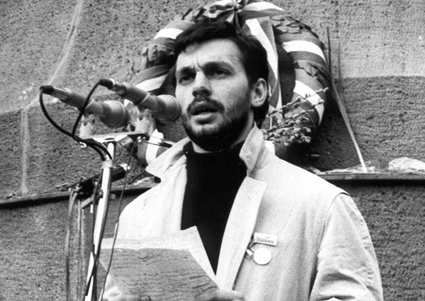
Orator '89: Viktor Orbán commemorating Hungary's National Day on March 15

Hungary has always felt a little forgotten in the European mind, but its recent prominence in the world's media is something it could have done without. Probably no one would even be aware of Hungary holding the EU presidency, but for the hysteria that has erupted around its media law which also came into force in January, as Hungary assumed the presidency.

I'm not going to defend the media law but I am going to reflect on the hypocrisy, double standards and ignorance of those who have so shrilly attacked it and Hungary's Prime Minister Viktor Orbán. Outside Hungary, attacks on the media law in the EU have come principally from the Left, but they have gained bandwagon momentum in political circles and the press, and even the illegal download website The Pirate Bay, based in Sweden, shut down its services for 24 hours to protest against the law.

For one democracy to interfere in the internal affairs of another requires a great deal of justification. The media law may indeed be badly thought-out or poorly drafted, but poorly drafted and badly thought-out legislation passes through democratic legislative bodies every day. 

I haven't read the full text of the law (it's far too long), but then neither have its critics. Most of the condemnations came long before the law was translated into English, so critics like Luxembourg's Foreign Minister Jean Asselborn and the New York Times who incorrectly claimed that Angela Merkel had "spoken out strongly" against the law are lining up with the Ayatollah Khomeini in attacking something they haven't read (unless they've been taking evening classes in Hungarian).

If someone in Hungary who didn't speak English, who'd never been to Britain, who had made no study of its culture or history were to start fulminating about the state control of the media in the UK (the sinister Ofcom scouring television channels for "offensive" material at the state's behest), we'd laugh or feel sorrow at such patent lunacy. Yet that's precisely the sort of absurd and uninformed criticism that Orbán and his party Fidesz have faced.

Every country has regulation of the media and there is nothing, absolutely nothing, contained in Hungary's media law that isn't found in other EU countries or the US. Lord Annan's sparkling line that the authorities should "censure but not censor" is the ideal a democracy should work towards, but how do you achieve that? Even in Britain with a long tradition of  unfettered news and opinion, we still have arguments about exactly where lines should be drawn (and who should be drawing them).

View Full Article
 
Share/Save


Istvan Gereben
March 5th, 2011
3:03 PM
Mr. Fischer prooves himself misinformed right in the title of his defense of Prime Minister Orban’ policies by caling him a Democrat. Mr Orban defined his vision for Hungary’s political future in an article published in the February 16, 2010 issue of Nagyitás, a Fidesz controlled magazine: „The political field of force seems to take a new form. Currently the system’s duality apparently ends, partly as the result of the development of favorable circumstances for right wing ideology and rhetoric, and partly as the result of our party’s gaining strength. There is a realistic possibility in Hungary that politics in this country for the next 15-20 years will be defined not by a dualistic field of force, which with constant debates generates divisive, captious and unnecessary societal consequences. Instead of these debates one big governing party, a central political field of force will become in existence, which will be able to define the national agenda. It will do that not by participating in constant debates but with presenting that agenda with the party’s own creativity.” The agenda of the Hungarian Prime Minister is summarized above with brutal clarity. This much is more than enough about Mr. Orban’s current views of democracy. This is a very strange concept of a very strange Democrat. Does this concept reflects Mr. Fischer’s idea of democracy or he just does not know better? The notion of “democracy” defined by Mr. Orban perceptively was described as one party democracy by engineer-writer Rudolf Ungvary. I remember it as people’s democracy maintained by Matyas Rakosi, Erno Gero, Janos Kadar, and Karoly Grosz. Those of us, who paid attention to Mr. Orban’s statements and actions in the past twenty years were aware of his “creative vision” described above, are not and will not be astonished by its practical implementation now that he gained power. In the light of Mr. Orban’s obstinate announcement of his vision of Hungary’s future, Mr. Fischer and all Hungarians should not be taken aback by the yet to come events in Hungary. An other fictitious assumption in Mr. Fischer carelessly phrased title is the suggestion that Mr. Orban takes on the Old Guard of the pre-1990 Communist regime in Hungary. The fact is that he took in many of them to serve in high positions in his Government or in state institutions. The list of them revealing:: the President of the Republic of Hungary, Paul Schmitt, the Foreign Minister of his Cabinet, Janos Martonyi, his trusted advisor on the new Constitution, Imre Pozsgay, his mentor in college and newly appointed justice of the Constitutional Court, Istvan Stumpf.. All were trusted members of the influential circle of the pre-1990-Communist regime. The practical consequences of Mr. Orban’s anti Communist rhetoric are limited only to those who are threatening his aim at absolute power. Mr. Fischer ignores to consider and explain these very telling facts in his analysis: Mr. Orban was forced by the EU to modify those parts of the Media Law, which were branded as violating EU standards. A bigger blow to Mr. Orban is the postponement of the summit meeting of heads of State and Government scheduled for the end of May in Godollo, Hungary to discuss the issues of the Eastern Partnership Initiative of the EU to the second half in 2011 and the change of its location to Poland. This represents a significant prestige loss for Mr. Orban. It shows that the EU lost confidence in his ability to prepare and execute the agenda for such a meeting, The fact that Mr. Orban, the current President of the EU was not invited to a meeting of Chancellor Angela Merkel, Presidents Sarkozy and Komorowski on February 7 in Warsaw where the agreement was reached about the changes regarding the time and location of the Summit. Mr. Orban’s and Hungary’s name was not mentioned in the Communique issued at the conclusion of the meeting. The European Parliament still keeps the discussion of the issues related to the Media Law on its agenda. The content and the language of the new Constitution are hotly debated and many of Mr. Orban’s recommendations are rejected even by his closest collaborators. Mr. Fischer’s analysis is incomplete and superficial.

Fabio P.Barbieri
March 3rd, 2011
9:03 PM
Now, let's see. Country origin, check. Family man with five children, check. No respect for elders fond of compromise and for "corrupt bastards' club", check. Hated and hounded by the international coven of left-wing journalists, check. Made temporarily unelectable by their lies, check. Immensely popular with ordinary folks, check. Folks, if Mr.Orban were female, pretty and American, he would be called Sarah Palin.

George C.
February 28th, 2011
2:02 AM
What a breath of fresh air. Orban is a man for all seasons and Hungary finally has a man to lead it out of 40 years of communist morass and 20 years of neo-communist, socialist corruption. I wish him success and hope he leads Hungary to a better future.

IM
February 27th, 2011
8:02 AM
People serving foreign oppressors from the East or West have torn our country for most of history. It is time for the poststalinists to be exposed, underlining that Gyurcsany and his comrades are earlier communist leaders, turned high capitalists, not socialdemocrats.

Chris Szabo
February 26th, 2011
1:02 PM
Well done! It's time someone outed the so-called freedom-loving "liberals" in Hungary! Sadly, this situation came about because they didn't face the communist era past, and still haven't. This situation couldn't arise in Cambodia, or Guatemala, or here in South Africa, because we did face our pasts. There's a lesson there for Hungary.

Chris
February 25th, 2011
4:02 PM
Finally an article which reflects the reality and not the biased preconceptions of lazy western journalists. Thanks!

Andris
February 25th, 2011
3:02 PM
I think we should wait with condemning the media law or any actions of Orbán until we see it in its full extent. I agree that the international media fails to see the true nature of what's going on in this country - and provides easy evidence of its ignorance by calling Népszabadság the "leading daily newspaper". What's the idea of calling this particular one the leading? Western journalists should be taking their jobs a little bit more seriously and try to remain neutral in their reviews.

Post your comment

CAPTCHA
This question is for testing whether you are a human visitor and to prevent automated spam submissions.