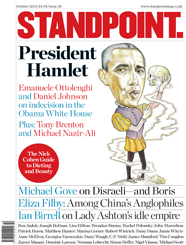



The issue now, of course, is what happens next. The West can justifiably be optimistic about the legitimate aspirations for freedom and true democracy many demonstrators in Egypt and elsewhere expressed. Tunisia, for example, now seems the most likely candidate to make a successful transition from authoritarian rule to truly representative government. But a pragmatic assessment of the situation in Egypt and elsewhere in the Middle East nonetheless underlines the daunting obstacles in the way of that transformation. Moreover, critical US national security interests, such as the stability of the Egyptian-Israeli peace agreement, Egypt's 35-year strategic alignment with America following Sadat's pivot away from the Soviet Union, and the fate of the Arabian Peninsula's oil-and gas-producing regimes, justifiably weigh in the balance for Washington's decision-makers, and the West as a whole.
Many others also have strategic interests at risk. Suddenly, one of the foundations of Israel's security, the Camp David Accords, is potentially imperiled. Pro-Western Arab governments, particularly monarchies from Morocco to the Gulf, see their stability endangered. They watched in dismay the way in which Obama treated Mubarak, loyalty to unappealing allies in trouble not having been a strong suit in Washington for many years. If the White House threw Mubarak "under the bus", they wondered, what would be their fate if they faced internal turmoil? And concern whether loyalty was a principle that counted in Washington was not confined to the Middle East, but extended globally.
Conceptually, of course America supports democracy for all people; how could we do otherwise? But in international politics, as in life, key moral principles and deeply held philosophical values can conflict. Statesmen necessarily face deeply unappealing choices which academics and commentators in their suburban literary redoubts are spared. Sad to say, it is comforting but utterly unrealistic to believe that pursuing one value to the effective exclusion of the others will nonetheless result in all being reconciled satisfactorily.
Advocating democracy and actually building it are two radically different things. Jeane Kirkpatrick's 1979 Commentary article, "Dictatorships and Double Standards," which first brought her to the attention of prospective presidential candidate Ronald Reagan, deftly skewered Jimmy Carter's handling of two earlier regime crises, which may have uneasy parallels with what is transpiring in Egypt. Kirkpatrick's characteristic honesty made famous the argument that pro-Western authoritarian governments had at least the potential for a gradual transformation to democracy, something no repressive communist government had ever done. But Kirkpatrick's thesis was more profound than simply a Cold War polemic; she explained eloquently why proclaiming support for democratic ideals in no way guaranteed implementing them successfully. Her case studies were the Shah's government in Iran and the Somoza dictatorship in Nicaragua, replaced, respectively by ayatollahs in Tehran and Sandinistas in Managua. We thus moved from two authoritarian, pro-US regimes to two even more authoritarian, anti-US regimes, partially thanks to Carter's bungling. The lesson was plain.


- Admit It, Mr Kerry: You Blundered
- Bismarck Versus Blair — A Foreign Policy Crossroads
- Arab Spring, Islamist Summer — What Next?
- The Diplomat the Whole World Ignores
- The Blob Has Run Schools For Decades. Not Any More
- Would You Intervene — Or Pass On The Other Side?
- He Died That Others Might Live In Peace
- The Hero's Journey is Hollywood's McMyth
- Online Only: Countering the Counter-Jihadists
- Online Only: The Price Paid for Criticising Islam
- 'Please Sir, I Just Want to Learn More'
- Why Students Should Be Glad To Pay Tuition Fees
- A 'Liberal Racist'? Me? I Felt Like a Heretic
- Demolish the Relics of Yesterday's Future
- Was Britain Right To Go To War In 1914?
- German Victorians Who Helped Transform Britain
- The Alternative History of an Undivided India
- Online Only: Heirs to the Left
- ONLINE ONLY: The Hayward Gallery's Fashionable Primitives
- ONLINE ONLY: A Spiritual Corner of Southwark

- The Zombie Argument that Refuses to Die
- Online Only: The Price Paid for Criticising Islam
- Overrated: Dan Brown
- Is the Brain the Key to Understanding Religion?
- Overrated: George Monbiot
- Time to Wise Up to the Muslim Brotherhood
- 'Please Sir, I Just Want to Learn More'
- The Alternative History of an Undivided India
- The Zombie Argument that Refuses to Die
- Online Only: The Price Paid for Criticising Islam
- Overrated: Dan Brown
- Is the Brain the Key to Understanding Religion?
- Overrated: George Monbiot
- Time to Wise Up to the Muslim Brotherhood
- 'Please Sir, I Just Want to Learn More'
- The Alternative History of an Undivided India
- Decline and Fall of the History Men
- Uncritical Theorists Who Misread the Nazis
- The Zombie Argument that Refuses to Die
- The Banality of Hannah Arendt
- From Kitsch to Cool: Picasso and Modern Art
- Is the Brain the Key to Understanding Religion?
- Time to Wise Up to the Muslim Brotherhood
- Midfield Virtuoso Finds His Perfect Pitch
2:03 PM
9:03 AM
8:03 AM
1:02 PM
5:02 PM