




Hosni Mubarak's resignation as president of Egypt, after thirty years of authoritarian rule, is a major seismic event in the unstable Middle East. Although not as shattering as the 1981 assassination of his predecessor, Anwar Sadat, Mubarak's departure may actually pose more of a challenge to Egypt's long-ruling military than either Sadat's murder or the natural death of Gamal Nasser, the first officer in the modern military line after the 1952 overthrow of King Farouk. The "regime" thereafter was the military itself; while Mubarak was obviously its apex in recent years, the military establishment as a whole governed, not just one man.
When Nasser and Sadat died, the collective military leadership knew its next step: have another military leader succeed his fallen predecessor. That outcome seems very unlikely today, although not impossible. In the short term, the military's highest body, the Supreme Council of the Armed Forces, is in charge, having dissolved parliament and suspended the constitution, pending parliamentary and presidential elections to be scheduled. Whether there is a larger, longer-term political role for Egypt's military (as in Pakistan and Turkey) remains to be seen.
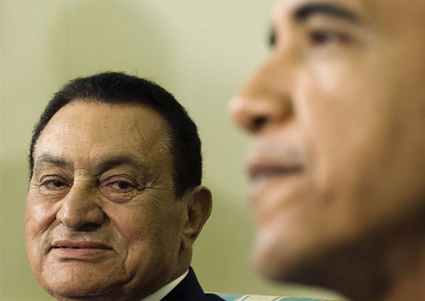
Mubarak and Obama: Their marriage of convenience abruptly ended in acrimonious divorce
Commentators and historians will debate what actually sparked the demonstrations that brought Mubarak down, but for now the most likely explanation is that they were essentially spontaneous, initiated by the demonstrations in Tunisia against the despised Ben Ali government, fuelled by social networks like Twitter and Facebook and more broadly through the internet and email. As in many Third World countries, youth unemployment, especially among those with "university" educations, was widespread; opportunities seemed limited; and 6,000 years of bureaucratic government weighed heavily on the people.
But the critical political motivator was almost certainly opposition to Mubarak's long-feared effort to have his son Gamal succeed him in yet another well-rigged Egyptian election. The elder Mubarak, 82 and ailing, was not likely to run again, but the idea of pharaonic succession was more than most Egyptians could tolerate. Significantly, opposition included Egypt's armed forces: Gamal had never been part of the military, unlike his father, a former commander of the Air Force. Combined with obviously fixed parliamentary elections last November, Mubarak the Second was simply unacceptable.
The spontaneity of the street turmoil was confirmed by the absence of leaders, either from among the demonstrators, or from Egyptian intellectuals, existing opposition political figures, or media moths like Mohammed el-Baradei, former Director General of the International Atomic Energy Agency (IAEA), who rushed back to Egypt from Vienna to speak English to the Western press and unsuccessfully claim leadership of the rising tide of protest.


- An Islamist Winter?
- The Secret of Cheap Energy: Fire Chris Huhne
- It's Crunch Time for Britain in Europe
- Forced Marriages Dishonour Britain
- We Only Pretend to Defend Free Speech
- Dreyfus and the Birth of Intellectual Protest
- 'Over me my father's shadow hovers'
- Lieutenant Gaddafi in Swinging London
- How Brussels Stifles Democracy in Europe
- Nick Clegg Captures the Mandarins' Castle
- What We Didn't Know About Boris and Ken
- Eye-witness to the Final Crowning Glory of the Raj
- Jews, Christians and Judaeo-Christians
- Online Only: Back to the USSR
- A Free Press Means to Publish and be Damned
- Max Hastings, the Repentant Europhile
- David Cameron's Difficulties with Girls
- Europe's Implosion Could Save the UK
- How National Culture Fell into the Gutter
- LORD SACKS LECTURE: The Limits of Secularism


2:03 PM
9:03 AM
8:03 AM
1:02 PM
5:02 PM