



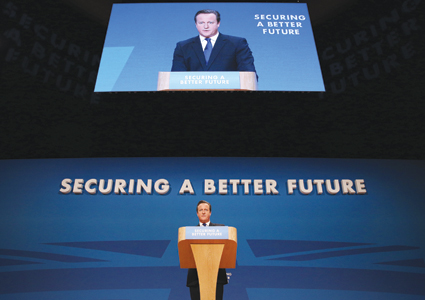
David Cameron: His speeches illustrate the modern prioritisation of style over substance in the language of politics (Peter MacDiarmid/Getty Images)
The miners' strike was an historic struggle. The two passages above show that the oratory of the two greatest leaders of the day rose to the occasion. Neither Kinnock nor Thatcher talked down to their audience. Their language was clear, easy to understand, and grounded in history. Cadence and rhetorical devices are employed to underscore the gravity of the subject and the momentous principles at stake, not to enhance their own likeability or simulate a personal connection with the voter.
Here is David Cameron at the Conservative Party Conference in 2013: "Is it enough to just fix what went wrong? I say no. Not for me. . . Now, I know it'll be tough. But I know we've got what it takes." He treats his government as a collection of individuals on a first-name basis: "They said we couldn't get terrorists out of this country. Well—Theresa knew otherwise." "George" made a brilliant speech and "Boris" made a great speech and Dave himself was Action Man: "I vetoed that treaty. I got Britain out of the EU bail-out scheme. And yes, I cut that budget."
He loves Samantha, and "was incredibly proud of her" when she got her first business cards. The role of Prime Minister is a "job", just like other people have: "I get to visit some amazing factories in my job." "Amazing" and "incredible" are the Prime Minister's two adjectives of choice, though he sometimes uses the terms "huge" or "massive". Houses are now "homes". In David Cameron's universe people are "desperate" to get and have things, people like Emily and James, a couple he claims to have met a few days before. They are aspirational, Emily and James, as is required of today's citizens. So it's a good thing the Prime Minister knows "there's another thing people need—the most important thing of all. More money in their pockets." The shrinking of language and the shrivelling of purpose go hand in hand.
The style of serious, straightforward political discussion employed by Kinnock and Thatcher survived until the early 1990s. The final conference speech of the lost Labour leader John Smith in the autumn of 1993 was perhaps the last time it was heard. With the victory of Tony Blair everything changed at once. Tony Blair mangled traditional discourse. In his short masterpiece, Coping with Post-Democracy, Professor Colin Crouch has described how politicians suddenly ceased to speak like ordinary people and started to present "glib and finely honed statements which have a character all their own".
Blair made one further leap: he assumed that his personal feelings about his actions are in themselves proof of their rightness. This remains as the foundation of his defence on Iraq. He has long abandoned any attempt (admittedly this gets harder and harder) to justify his actions by their results, particularly their impact on British interests. Blair governed by psychodrama; he made decisions because they made him feel like a strong, ethical leader. David Cameron famously views himself as the "heir to Blair". In the speech analysed above, and on other occasions, he has copied Tony Blair's use of language. Both men communicate through very brief messages requiring negligible concentration, often constructing their arguments to appeal to the emotions rather than to the intellect.
Like this article? Share, save or print using the icons below:


More Features
- Now Or Never
- Who Will Heal This Divided Country?
- What Made The West Great Is What Will Save Us
- Shock And Awe: Tales Of A Washington Insider
- We Shouldn't Let Old Men Rot Away In Jail
- Arnold Wesker’s Bid To Build A New Jerusalem
- Our EU Deal Gives Us The Best Of Both Worlds
- Brexit Would Save Us And Set Europe An Example
- Are Both Sides Playing By The Referendum Rules?
- Should We Stay Or Should We Go?
- Ignore Project Fear: Brexit Won't Ruin Us
- Uncontrolled Immigration Means Finis Britanniae
- The Next US President Must Carry A Big Stick
- Can Clinton Or Trump Crack The US Tax Code?
- How to Survive the Fourth Industrial Revolution
- The Spectre Of Mayor Khan's Islamist London
- Students Are Leading The Free Speech Fightback
- Fortress Europe Faces An African Migrant Tsunami
- Trump May Be Bad, But What Comes Next Will Be Worse
- Myth Of Stressed-Out Soldiers On The Street
Popular Standpoint topics

- Empty Seats At The Met
- Labour's Antisemitism Problem
- Why Only Countries Willing To Take Risks Will Survive And Prosper
- Did Burke Betray The Cause Of Liberty?
- Culture And Politics In The Age Of Trumpery
- The Spectre Of Mayor Khan's Islamist London
- Islam and the French Republic
- Rediscovering The Point Of Language
1:04 AM
6:04 PM
10:04 AM
11:03 AM
9:03 AM
6:03 PM
4:02 PM
2:02 PM
9:02 PM
9:02 PM