




Marriage has had a good press lately. More people are marrying and more people are staying married. This is welcome news. I have recently met a number of community groups that promote marriage in schools, colleges and generally in society, an encouraging and hopeful experience for me. But of course while I welcome this greater interest in marriage, both in promoting it and defending it, it is impossible to do so unless we understand what marriage and the family are.
The Cambridge Group for the History of Population and Social Structure carried out a long-term, cross-cultural study of the family in many different countries some years ago. It discovered that the father, the mother and the children are at the heart of family structure, even in cultures that have traditions of extended families. This is the proper use of the term "nuclear". A nucleus is the centre, the heart, the core of a cell or an atom. It is not what it is taken to mean these days: isolated from everything else.
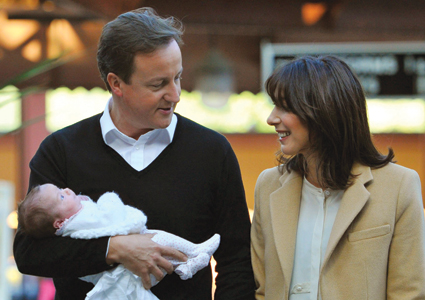
Cost of bliss: David Cameron (with wife Samantha and baby Florence) has yet to fulfil his pledge to recognise marriage in the tax system (Getty)
This research was backed up later by Martin Richards's work at the Cambridge Centre for Family Research, which showed how important it is for children to have both parents for their upbringing, and the consequences for them of divorce. Even in situations of conflict (provided they are not too extreme) children prefer their parents to stay together. These centres were building on the discipline known as the sociology of the family, which began in the 1940s and considered the family in the sense I have just described as "natural" or "normative". This family, expressed as it is in different contexts, is ubiquitous, found in many different cultures and over the course of history.
The Christian church does not claim to have invented the idea of the family. What it has done, at its best, is to identify those things in cultures and places that were there already and which needed to be affirmed and strengthened, sometimes corrected and, on occasion, refuted. So the church built on the Hebraic tradition of the family, as taught in the Old Testament and practised in Judaism, but it also acknowledged some features of the Roman idea of marriage and the family, and built on that. The Greeks were more difficult to learn from because on the one hand you have the statism of Plato, where governors and guardians give up their children to public nurseries — there is nothing new under the sun — so that they can take part in public life. Aristotle on the other hand was overly biological in his understanding of marriage and the family.
The Christian church based its approach to marriage and the family, as it found it to be in different places, on the one-flesh union of man and woman. They were not only given a common mission (known as the cultural mandate in the world) and created and ordered towards one another for the birth and nurture of children, but also for their own fulfilment and security. It is very important to understand this.


- The Hijacking of the Human Rights Debate
- Liberalism, Marriage and Family Values
- Liberty, Faith and Obama's Leviathan
- Cameron Should Scrap His Tired Old Script
- We're Good Europeans Yet They All Hate Us
- Obama's Timidity Risks the World's Security
- How the Left Turned Against the Jews
- Universities Must Be Freed from Meddling
- Forget Wind: Time for Britain to Get Fracking
- Melvyn Bragg Misses the Art of the Matter
- Will Michael Gove Go All the Way to No 10?
- Chaotic Legacy of the Classroom Radicals
- Why Shouldn't I Cheat? Everybody Else Does
- Twelve More Years of Vladimir Putin? Nyet!
- Eternal Land of the Golden Fleecing
- In Search of Vienna's Vanished Jewish Elite
- Faded Glory: In The Footsteps of Old Fritz
- Web Only: The Asymmetry of Racism Awareness
- An Islamist Winter?
- The Secret of Cheap Energy: Fire Chris Huhne


7:05 AM