


The first point to note is that Churchill immediately situates the impending battle in the largest possible historical perspective. The reference to General Weygand, the defeated French commander-in-chief, is significant: it was he who told the French Cabinet that the British stood no chance of surviving alone against the Wehrmacht and the Luftwaffe: "In three weeks, England will have her neck wrung like a chicken." At the time, Churchill said nothing, but a year later he was able to respond in characteristic style: "Some chicken. Some neck."
In June 1940, however, he was under no illusions. In private he compared the danger to that faced by England at the time of the Spanish Armada in 1588, but he knew full well that the threat posed by Hitler was incomparably greater than that of Philip II, who — while a Habsburg, a Spaniard and a Catholic — had after all been the consort of an English Queen, Mary I. This time the stakes were much higher: not only "the continuity of our institutions and our Empire", but "the survival of Christian civilisation". Would any Western statesman speak of "Christian civilisation" today? To ask the question is to answer it: no, not even if he or she were a devout Christian, which Churchill most certainly was not. Yet it is no less true today than it was 70 years ago that Christianity is inextricably woven into the fabric of our Atlantic civilisation, even if we are much less conscious of the fact than our parents and grandparents. For them, the Nazi "war against the West" (as Aurel Kolnai called it already in 1938) was also a war against Christianity.
For the passionately philosemitic Churchill, that also (and crucially) implied a war against the Jewish people. He understood that Jews and Christians in the modern world stand or fall together. As the full horror of the Holocaust became clear from intelligence reaching him about the death camps, he was unique among Allied leaders in calling for bombing raids to halt the genocide, describing it as "probably the greatest and most horrible crime ever committed in the whole history of the world". Today, it is even harder to find Western leaders who grasp the enormity of the crime being prepared against Israel and the Jewish people in the name of jihad.
The second point to note about Churchill's speech is that he links Europe and America in a common destiny. In June 1940, it took remarkable confidence as well as prescience, as invasion by the hitherto invincible Wehrmacht appeared imminent, to predict that if the British could resist Hitler, the liberation of Europe must eventually follow. But Churchill never doubted that the US would recognise, sooner or later, that its own existence as a free country depended on the survival of democracy in Europe. That meant the ultimate defeat of Hitler. The choice for the West was between victory and defeat, nothing else. A negotiated peace, of the kind that some members of the British Cabinet favoured in the summer of 1940, or that Rudolf Hess would propose on his ill-fated mission a year later, was not possible for Churchill. Such a peace, which would in any case have been no more than a temporary truce, seemed to him tantamount to legitimising the barbarism that had engulfed the Continent. Today, we need to recall that resolve never to appease or compromise with those who mean to destroy us.
This leads us on to a third point in Churchill's speech, one that should strike us as all too relevant to our own time. He speaks of the Nazis ushering in a "new Dark Age, made more sinister, and perhaps more protracted, by the lights of a perverted science". This is a reminder of the fact that technology in the service of ideology invariably usurps the proper sphere of ethics, and that this phenomenon has made the Third Reich a uniquely modern model of radical evil. But how often do we pause to consider how science has been perverted even in liberal democracies? The threat of a nuclear attack from a theocratic regime in the name of Islam is more spectacular but no less insidious than the degradation of the human person in the name of medical science or human rights. The Dark Age of which Churchill warned might even be said to exist across large tracts of the globe.
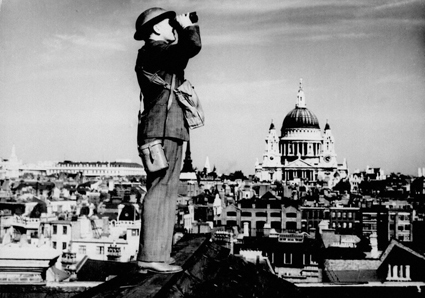
An air observer during the Blitz


- Mr Cameron, Show The Country That You Care
- Campaign Diary
- Defying Duopoly: The Rise Of The Insurgents
- Don't Rig The System In Favour Of Coalitions
- Warring Gangsters Who Run The Country
- Political Correctness Is Devouring Itself
- An Archival Treasure Trove—And All Online
- Do we value freedom of speech in Britain?
- Can Europe's Jews Feel Safe Alongside Muslims?
- We Cannot Avoid The Battle Over Blasphemy
- Inside The World Of 'Non-Violent' Islamism
- We Can Fix The Economy But Not Human Nature
- The Keynesian Versus The Monetarist: A Lost Decade
- The Keynesian Versus The Monetarist: Time To Re-Read Keynes
- The New Language Of Political Narcissism
- Two Words You Won't Hear This Election: Foreign Policy
- The Many Faces Of Holocaust Denial
- Why Is 'Fifty Shades of Grey' the New Normal?
- Obama scuttles. America retreats. Things fall apart
- Putin and the Art of Political Fantasy

- The Loss Of Faith Made Music Mute
- The Great Betrayal: How Liberals Appease Islam
- Political Correctness Is Devouring Itself
- The New Language Of Political Narcissism
- Why The World Still Loves Shakespeare
- Don’t Listen to Britain’s Designer Demagogues
- Who's in Charge of BBC News?
- An English parliament: the only way to save the UK
- The Loss Of Faith Made Music Mute
- The Great Betrayal: How Liberals Appease Islam
- Political Correctness Is Devouring Itself
- The New Language Of Political Narcissism
- Why The World Still Loves Shakespeare
- Don’t Listen to Britain’s Designer Demagogues
- Who's in Charge of BBC News?
- An English parliament: the only way to save the UK
- The Loss Of Faith Made Music Mute
- The Great Betrayal: How Liberals Appease Islam
- Why The World Still Loves Shakespeare
- Who Will Lead The Berlin Band?
- Putin and the Art of Political Fantasy
- Political Correctness Is Devouring Itself
- The New Language Of Political Narcissism
- Inside The World Of 'Non-Violent' Islamism
7:12 PM
9:11 AM
2:11 AM
9:10 AM
2:10 AM
6:10 PM
2:10 PM