


In his final sentence, Churchill urges his compatriots to do their duty. The imperative here is not necessarily Kantian — although Churchill may still have believed that human beings in such circumstances would be bound to resist such a tyranny as Hitler's. (As a melancholy matter of record, most did not.) No, this is an appeal to a specifically British tradition, recalling Nelson's celebrated signal at Trafalgar: "England expects that every man this day will do his duty." Hence the ascent into pure poetry in the peroration is preceded by a reference to the British Empire and its Commonwealth. Today, this romantic imperialism may strike a false, bombastic note, especially when his suggestion that the Empire might last a thousand years was to be proved wrong so quickly. With indecent haste, Churchill was to be evicted from office before the war against Japan was over, and the process of dismantling the Empire was begun immediately. Yet in 1940, Churchill seriously expected that, if Britain were overrun, his successor would continue the war with the help of her colonial allies. The war against Hitler remains the only just war that most of these countries have ever fought. The defence of the British Empire required that sacrifices be made by many colonial combatants who had never seen England. That is why Churchill made it clear that this was their finest hour too.
In fact, he elevated the conflict onto a metaphysical plane: under the incantatory spell of Churchillian oratory, the Battle of Britain was transformed from an aerial dogfight on an unusually grand scale into a cosmic struggle between good and evil. Between Churchill and the British people he had achieved an absolute unity of purpose, a willingness to make the ultimate sacrifice in the face of a deadly peril, an exalted sense of standing before the court of conscience and of history to do God's work in preserving Western civilisation.
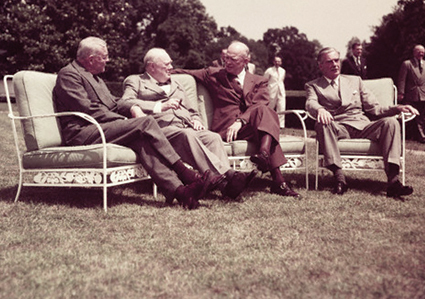 Dulles, Churchill, Eisenhower and Eden in 1954, before the Anglo-US rift over Suez
Churchill cared nothing for his own safety: during the Blitz, he would dine at the Savoy Grill and then go next door to watch the destruction of London from the roof of the Air Ministry — a spectacular view but incredibly dangerous. He was constantly on the move by land, sea and air, yet never thought twice about the risk of being bombed, torpedoed or shot down. And casual remarks by Churchill suggest that if the Germans had conquered the British Isles, he did not expect to survive. Today, we do not allow our leaders to share the risks that the public cannot avoid. Our leaders inhabit a high-security bubble, while the cities in which the rest of us must live, euphemistically known as "multicultural", are places where some of our fellow-citizens turn out to be terrorists.
It is also a question of personal experience. Churchill was, admittedly, the nephew of a duke. But he had fought in India, Sudan and South Africa as a young man; he joined in the last great cavalry charge in history at Omdurman, in Sudan, was captured by the Boers, decorated and considered for the Victoria Cross. In both world wars, he was obliged to take daily decisions that meant life or death for millions. I can think of no present-day European leader who has ever been obliged to fire a shot in anger. In the US and Israel, it is commoner to find politicians who have seen action, such as John McCain or Ehud Barak, although much more typical is the career of Barack Obama, spent mainly at Harvard and in the smoke-free rooms of Chicago and Washington. This rarity of military experience has to do with the comparatively peaceful period that we have now enjoyed for several generations since 1945. Nor do soldiers necessarily make better statesmen than civilians. However, we have paid a price for our pacific politicians, clearly demonstrated in the timid and incompetent leadership of the West in conflicts since the end of the Cold War — from the Balkans to the Caucasus, from Africa to Afghanistan, from Iraq to North Korea. I do not favour a permanent post-mortem on the mistakes that have been made. The first part of Churchill's June 18, 1940, speech was devoted to the blunders that had led to the defeat of France, pleading with the Commons to postpone recriminations until after the war. Leadership requires loyalty in adversity, too. Between the leadership of 1940 and that of today, however, there is a difference: Churchill knew what he was trying to do and how to explain it to the public, whereas today's politicians either don't know what they are doing or cannot explain it.
Churchill had plenty to say on the relationship between the market economy and democracy. Among the many offices he had held, after all, was that of Chancellor of the Exchequer from 1924 to 1929 — an episode in his career mainly remembered for his decision to return Britain to the gold standard, which made him the butt of John Maynard Keynes's tract The Economic Consequences of Mr Churchill. In fact, Churchill does not deserve his bad press as Chancellor. He presided over a period of growth, despite Britain's one and only General Strike in 1926, and stability. Having lost power on the eve of the Wall Street Crash, Churchill could only watch impotently as the world slipped into the Great Depression. By the time he returned to power, he had been converted to a more activist role for the State. It was he who coined the catchphrase of the new welfare state, which promised social security "from the cradle to the grave".


- Mr Cameron, Show The Country That You Care
- Campaign Diary
- Defying Duopoly: The Rise Of The Insurgents
- Don't Rig The System In Favour Of Coalitions
- Warring Gangsters Who Run The Country
- Political Correctness Is Devouring Itself
- An Archival Treasure Trove—And All Online
- Do we value freedom of speech in Britain?
- Can Europe's Jews Feel Safe Alongside Muslims?
- We Cannot Avoid The Battle Over Blasphemy
- Inside The World Of 'Non-Violent' Islamism
- We Can Fix The Economy But Not Human Nature
- The Keynesian Versus The Monetarist: A Lost Decade
- The Keynesian Versus The Monetarist: Time To Re-Read Keynes
- The New Language Of Political Narcissism
- Two Words You Won't Hear This Election: Foreign Policy
- The Many Faces Of Holocaust Denial
- Why Is 'Fifty Shades of Grey' the New Normal?
- Obama scuttles. America retreats. Things fall apart
- Putin and the Art of Political Fantasy

- The Loss Of Faith Made Music Mute
- The Great Betrayal: How Liberals Appease Islam
- Political Correctness Is Devouring Itself
- The New Language Of Political Narcissism
- Why The World Still Loves Shakespeare
- Don’t Listen to Britain’s Designer Demagogues
- Who's in Charge of BBC News?
- An English parliament: the only way to save the UK
- The Loss Of Faith Made Music Mute
- The Great Betrayal: How Liberals Appease Islam
- Political Correctness Is Devouring Itself
- The New Language Of Political Narcissism
- Why The World Still Loves Shakespeare
- Don’t Listen to Britain’s Designer Demagogues
- Who's in Charge of BBC News?
- An English parliament: the only way to save the UK
- The Loss Of Faith Made Music Mute
- The Great Betrayal: How Liberals Appease Islam
- Why The World Still Loves Shakespeare
- Who Will Lead The Berlin Band?
- Putin and the Art of Political Fantasy
- Political Correctness Is Devouring Itself
- The New Language Of Political Narcissism
- Inside The World Of 'Non-Violent' Islamism
7:12 PM
9:11 AM
2:11 AM
9:10 AM
2:10 AM
6:10 PM
2:10 PM