


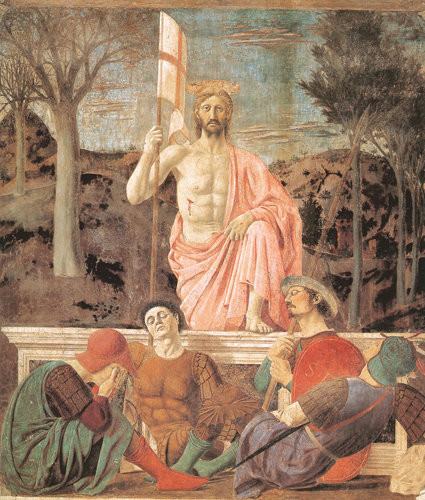
Flesh and blood: Detail from "The Resurrection" (1463-65)
Piero's most enigmatic picture is the small painting entitled The Flagellation. It appears to be dedicated to a religious subject: in one half of the picture there is a figure who seems to be Christ, tied to a pillar and being beaten, while being watched by an imperial figure who is presumably Pontius Pilate. But to stop there is like saying that King Lear is about the inadequacies of inheritance law. The other half of The Flagellation depicts three men who may or may not be in conversation. No one knows who they are or what they symbolise, or even if they symbolise anything. There have been at least 40 different interpretations of what is going on. None of them have achieved general acceptance among scholars. Whatever else The Flagellation is, it is not a conventionally religious picture or an aid to conventional piety.
The geometry of the picture is extraordinarily carefully worked out: so carefully that it has proved possible to construct computer-generated views of the room that show what it would look like from directly above, from the sides, and from the floor. It is clear that Piero cared a great deal more about getting the geometry right than making any religious message in his picture comprehensible to viewers. The fascination that the picture exerts derives from its utterly logical, rational and comprehensible proportion and perspective. Its religious message is so obscure that it is irrelevant to appreciating it — and one senses that Piero was well aware of that fact.
It is of course impossible to get at what Piero's religious beliefs "really" were. But it is striking that when he painted a fresco in his house in Sansepolcro he did not choose to depict a saint or any Christian figure, but the pagan demigod Hercules. He worked for the Franciscans and for religious confraternities — but also for condottieri such as Sigismondo Malatesta, ruler of Rimini, and Federico da Montefeltro, the count of Urbino. Both made their fortunes out of inflicting misery on others. Federico has had a better press than Sigismondo, who earned an excoriating condemnation from Pope Pius II for publicly sodomising the 15-year-old bishop of Fano in Rimini's central piazza. But if Federico was more restrained in his personal conduct than Sigismondo, Federico's troops probably inflicted more damage, most notably in their bloody sacking of Volterra. Piero dutifully painted official portraits of both men, making them look stately and dignified, even pious.
It is of course impossible to get at what Piero's religious beliefs "really" were. But it is striking that when he painted a fresco in his house in Sansepolcro he did not choose to depict a saint or any Christian figure, but the pagan demigod Hercules. He worked for the Franciscans and for religious confraternities — but also for condottieri such as Sigismondo Malatesta, ruler of Rimini, and Federico da Montefeltro, the count of Urbino. Both made their fortunes out of inflicting misery on others. Federico has had a better press than Sigismondo, who earned an excoriating condemnation from Pope Pius II for publicly sodomising the 15-year-old bishop of Fano in Rimini's central piazza. But if Federico was more restrained in his personal conduct than Sigismondo, Federico's troops probably inflicted more damage, most notably in their bloody sacking of Volterra. Piero dutifully painted official portraits of both men, making them look stately and dignified, even pious.
Like this article? Share, save or print using the icons below:


Post your comment
More Features
- Licence To Chill? Not Yet, Prime Minister
- Money Can't Buy Us Love: Profiting From Loneliness
- More Immigration Means Less Integration
- Is France As Doomed As Houellebecq Thinks?
- Compassion To Refugees, Not Capitulation To Islamic State
- How Mervyn King Got Northern Rock Wrong
- Fix Rotten Boroughs Or Risk Voting Wars
- Migrant Crisis? Europe Hasn't Seen Anything Yet
- Why Palmyra Should Matter To The West
- Corbyn's Rise Makes Cameron Redundant
- No, Jeremy: Politics Is All About Borders Now
- Why 'Lady Chatterley' Still Provokes Us
- For Climate Alarmism, The Poor Pay The Price
- Will Putin's Empire Outlast The Soviets?
- British Witnesses To Lenin's Revolution
- Bibliophiles Beware: Online Prices Are A Lottery
- How Jeremy Corbyn's Coup Hijacked Labour
- Corbyn's Signpost Back To The Ghetto
- Unionists, Don't Despair: Scotland Is Not Lost — Yet
- Britain's Apologists For Child Abuse
Popular Standpoint topics
