


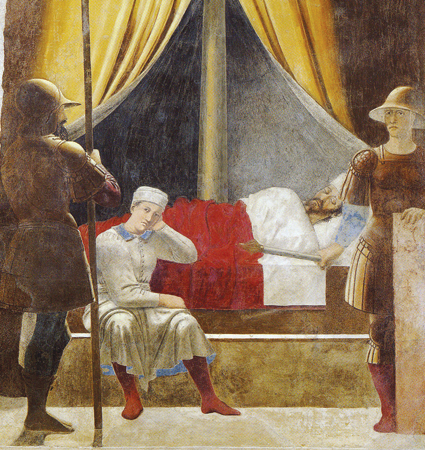
Transformative grace: "Constantine's Dream" (c.1455) from "The Legend Of The True Cross"
Fewer than 20 completed works by Piero survive. When he died at the age of 80 in 1492, he was not particularly respected or valued by his contemporaries. One of the reasons that so few of his pictures have come down to us is that he was not often commissioned to paint them: during his lifetime, demand for his work was not high. Piero never received a single commission to paint in Florence, which was then the art capital of Italy. Even late in his career, he was reduced to painting images on flags and banners used on ceremonial occasions rather than permanent works on church walls or portraits for private patrons. Flag-painting was adequately paid. But it wasn't a medium in which Piero could develop his meticulously worked out compositions, or demonstrate his perfect comprehension of the laws of perspective.
Piero was not even the first choice to paint the Cappella Maggiore in Arezzo. Bicci di Lorenzo, a painter who has now been almost totally forgotten, had that distinction. But Bicci died within a few months of starting his work in the Franciscan church in Arezzo. He and his team had painted the vault and the arch at the main entrance to the chapel when he died, but the walls were bare. Only then did the family paying for the frescos, and the Franciscan friars who were responsible for the church where the pictures were to be painted, turn to Piero.
Piero's art was soon thought to be old-fashioned and unsophisticated. Pope Julius II had no qualms whatever about commissioning Raphael to paint over the frescos that Piero had created in the Vatican within 60 years of Piero having finished them. Piero certainly completed a fresco cycle in Ferrara, and possibly one in Modena: both were destroyed. His Resurrection, which many regard as his greatest work, was plastered over and only rediscovered in the 19th century.
We probably owe the survival of Piero's Legend of the True Cross to Arezzo's slow but continuous economic and political decline. It is quite possible that the Franciscans would have replaced them with something that seemed to them more "modern" had they had the money to do so. Fortunately for us, they did not.
Piero's relatively undistinguished reputation in the 15th and 16th centuries is not easy to understand. The sophistication of his use of perspective and the geometrical perfection of his compositions were very much in line with what the most advanced theorists of art, such as Leon Battista Alberti, advocated as essential to any painting worthy to be termed "art".
Like this article? Share, save or print using the icons below:


Post your comment
More Features
- Migrant Crisis? Europe Hasn't Seen Anything Yet
- Why Palmyra Should Matter To The West
- Corbyn's Rise Makes Cameron Redundant
- No, Jeremy: Politics Is All About Borders Now
- Why 'Lady Chatterley' Still Provokes Us
- For Climate Alarmism, The Poor Pay The Price
- Will Putin's Empire Outlast The Soviets?
- British Witnesses To Lenin's Revolution
- Bibliophiles Beware: Online Prices Are A Lottery
- How Jeremy Corbyn's Coup Hijacked Labour
- Corbyn's Signpost Back To The Ghetto
- Unionists, Don't Despair: Scotland Is Not Lost — Yet
- Britain's Apologists For Child Abuse
- Lift The Fee Cap And Set Universities Free
- The Story Behind One Dead Man's Penny
- Hitler's 'Ecological Panic' Didn't Cause The Holocaust
- Meet The Montalvos: The First Global Family
- Mr Gove, Here Is Our Statute of Liberty
- A British Bill Of Rights
- Something For Nothing Just Won't Do Any More
Popular Standpoint topics
