


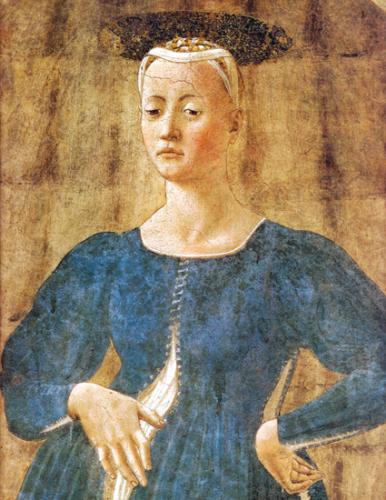
Detail from the "Madonna del Parto" (c.1467)
What is known from the surviving documentation about Piero's life gives no indication of religious opinions. Botticelli became an enthusiastic, even fanatical, follower of Savonarola: he was so committed that he destroyed many of his own works on the grounds that Savonarola condemned art as "vanity".
Fra Angelico and Filippo Lippi were both monks, although only Fra Angelico kept his vows. Piero never married and never had any children, but his chaste continence — if that is what it was — does not seem to have been the result of religious conviction. He seems to have devoted himself entirely to his work, of which painting was merely one part, and perhaps not the part that meant the most to him: he also wrote three books on mathematics. All of them were published in manuscripts written in his own hand.
To judge by his art, Piero's deepest commitment was not to Christian precepts, but to the notion that there is a clear mathematical structure underlying the visible world. The structure and order that his geometrically rigorous compositions generate, where everything is in exactly the right place, means that Piero's world seems fundamentally opposed to a conception that is essential to modern science: ultimately, there is nothing but atoms and the void, a perpetual cycle of interacting forces without purpose.
Piero's world, by contrast, is one that is rationally ordered and comprehensible. For everything that happens, there is not just a cause: there is a reason. That is why Piero's art is deeply consoling. Without invoking any external divinity, it seems to refute the idea that in the end, the world amounts only to unintelligible chaos. Perhaps that is also the reason why his art has become so popular in our age.
Fra Angelico and Filippo Lippi were both monks, although only Fra Angelico kept his vows. Piero never married and never had any children, but his chaste continence — if that is what it was — does not seem to have been the result of religious conviction. He seems to have devoted himself entirely to his work, of which painting was merely one part, and perhaps not the part that meant the most to him: he also wrote three books on mathematics. All of them were published in manuscripts written in his own hand.
To judge by his art, Piero's deepest commitment was not to Christian precepts, but to the notion that there is a clear mathematical structure underlying the visible world. The structure and order that his geometrically rigorous compositions generate, where everything is in exactly the right place, means that Piero's world seems fundamentally opposed to a conception that is essential to modern science: ultimately, there is nothing but atoms and the void, a perpetual cycle of interacting forces without purpose.
Piero's world, by contrast, is one that is rationally ordered and comprehensible. For everything that happens, there is not just a cause: there is a reason. That is why Piero's art is deeply consoling. Without invoking any external divinity, it seems to refute the idea that in the end, the world amounts only to unintelligible chaos. Perhaps that is also the reason why his art has become so popular in our age.


