



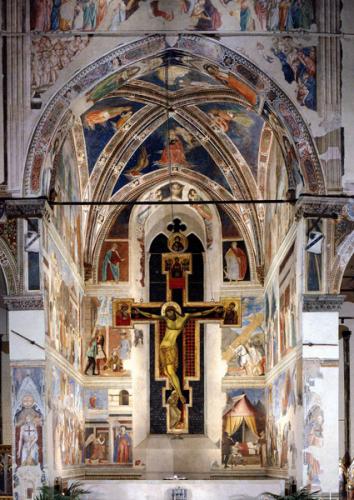
One of the most beautiful man-made places on earth: Piero's frescos in the Cappella Maggiore in the church of San Francesco, Arezzo (Alinari Archives/George Tatge/Getty)
It seems incredible that so tediously mediocre a painter as Bicci di Lorenzo could ever have been preferred to Piero. But perhaps what displeased, or at least did not excite, clerical patrons in the 15th century may have been the element that appeals to us today: the unclear, almost ambiguous, nature of Piero's religious faith.
Piero depicts religious subjects. But he does not do so in an overtly religious way: he does not do religious propaganda, as most of his 15th century contemporaries did. The heart tends to sink at the prospect of a gallery filled with a long sequence of gold-backed Virgins and saints being martyred. Piero's pictures never have that lowering effect, and they always stand out from any crowd of gilded Annunciations or martyrdoms. While they depict incidents that are part of the Christian religion, they also convey the sense that illustrating the truths of the Christian religion is not their real point. As the great (although occasionally perverse) Italian critic Roberto Longhi wrote in his essay "Piero in Arezzo", Piero's Legend of the True Cross frescos "refer only minimally to the ‘religious' core buried within each scene. Instead, we have what looks very much like an extensive epic of secular, profane life."
That is true, and it is true even when Piero depicts the uniquely Christian moment of the Resurrection. The risen Christ in Piero's painting in what used to be the town hall in Sansepolcro emerges with cosmic inexorability from his tomb, but he seems to be propelled by a natural, rather than a divine, force, one closer to the revolution that turns winter into spring than a power that is external to, and independent of, nature — as God is in traditional Christian theology.
Piero's Madonna del Parto depicting the pregnant Virgin, now in Monterchi in Tuscany, has next to nothing in common with the ethereal Virgins who populate so much of medieval and early Renaissance painting. Despite the angels on either side of her, the primary subject of Piero's fresco is not divinity. The woman that Piero depicts is very definitely a flesh and blood human. She is extremely but not impossibly beautiful. And you do not come away thinking that this woman will have a miraculously pain-free birth.
Like this article? Share, save or print using the icons below:


Post your comment
More Features
- Licence To Chill? Not Yet, Prime Minister
- Money Can't Buy Us Love: Profiting From Loneliness
- More Immigration Means Less Integration
- Is France As Doomed As Houellebecq Thinks?
- Compassion To Refugees, Not Capitulation To Islamic State
- How Mervyn King Got Northern Rock Wrong
- Fix Rotten Boroughs Or Risk Voting Wars
- Migrant Crisis? Europe Hasn't Seen Anything Yet
- Why Palmyra Should Matter To The West
- Corbyn's Rise Makes Cameron Redundant
- No, Jeremy: Politics Is All About Borders Now
- Why 'Lady Chatterley' Still Provokes Us
- For Climate Alarmism, The Poor Pay The Price
- Will Putin's Empire Outlast The Soviets?
- British Witnesses To Lenin's Revolution
- Bibliophiles Beware: Online Prices Are A Lottery
- How Jeremy Corbyn's Coup Hijacked Labour
- Corbyn's Signpost Back To The Ghetto
- Unionists, Don't Despair: Scotland Is Not Lost — Yet
- Britain's Apologists For Child Abuse
Popular Standpoint topics
