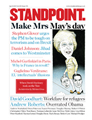



The West may have forsaken God, but has God has forsaken the West? In his new book Shall the Religious Inherit the Earth?, Eric Kaufmann raises the spectre of "demographically turbo-charged piety" overwhelming secularism by sheer force of numbers. There is a major objection to Kaufmann's scenario: he conflates devout adherents of Christianity, Judaism and Islam, treating all as "fundamentalists" who are natural allies against secularism. In reality, as several of our writers this month imply, it is only Islam, in its most radical forms, that poses a threat to the liberties enjoyed by a civilisation that was largely created by Jews and Christians. Unless and until all Muslims settled in the West can unambiguously embrace the open society, non-Muslims may feel threatened by their increasing numbers and influence — even if politicians treat this unease as unmentionable.
At the time of writing, the election result is unexpectedly unpredictable. Dominic Lawson shrewdly cited Freud's "narcissism of small differences" to elucidate the bitter rivalry of David Cameron and Nick Clegg. But the electorate wants clear choices, not "Red Tories" or other political transvestites. If Clegg wants to pose as the new Tony Blair, promising to break with the idolatry of ideology, he will have to justify his party's policies, which are the most ideological of the three. Clegg may be a young man, but he cut his teeth in the Old Europe of Brussels. To adapt Donald Rumsfeld: if Gordon Brown is a known known and David Cameron is a known unknown, Nick Clegg is an unknown unknown. If Britain is about to bet the farm, with the bailiffs already at the gate, God help us.


Post your comment

- Time To Revisit The Two Cultures
- Why The Most Civilised Of Men Felt Like A Fraud
- Trump's Appeal Is More Roosevelt Than Reagan
- Anything Dennett Can Do, Scruton Does Meta
- Who Will Do Justice To Our Judiciary?
- Why France Is Revolting Against The Ancien Regime
- Underrated: Benedict XVI
- The Battle Against The Philistines Never Ceases