



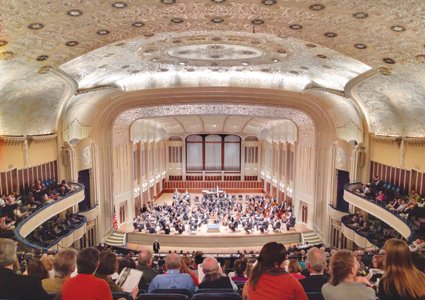
 Art Deco plus acoustics: Severance Hall, home of the Cleveland Orchestra (photo: James G. Milles via Flickr)
America got its first orchestra in 1842 and waited almost 40 years for another. The New York Philharmonic, a players’ cooperative, struggled to cope with capitalism in the raw and a flood of unchecked immigration. It did not begin to thrive until Andrew Carnegie opened his glittering hall.
America’s fourth-largest city was next, in 1880. The St Louis Symphony, rolling in Mississippi river profits, really got things going. It was swiftly followed by the Boston Symphony (1881), Detroit (1887), Chicago (1891), Cincinnati (1895) and Philadelphia (1900) — by which time St Louis, preparing to host the Olympic Games, had proved that an orchestra was a prime emblem of civic prosperity, ambition and civilisation. Soon, every town wanted one.
By the middle of the 20th century, the US accounted for half the world’s symphony orchestras, decked out in more flavours than Heinz (who paid for Pittsburgh’s). There was shameless razzmatazz from “the fabulous Philadelphians”, surgical precision at George Szell’s Cleveland Orchestra, modern music commissioned by Boston and Louisville, rampant charisma from Bernstein’s New York and naked power from Solti’s Chicago. On tour, American orchestras took Europe by storm.
But by the end of the century the boom went bust. The subscription audience greyed and died; the next generation found other distractions. America’s growing minorities resented European culture and shunned the concert hall. Programming got safe and stale, managers were stubbornly white, and musicians, fearful of a shrinking future, demanded greater security. In 2000, the Chicago Symphony broke the bank with a $100,000 starting wage for new players, fresh out of college. The writing could be read on my wall (though hardly at all in US media).
The crash of 2008 drove several orchestras out of business and prompted others to resort to the raw capitalist remedy of locking out musicians without wages or health insurance until they accepted lower compensation. In the worst collision, the Minnesota Orchestra starved its musicians for 16 months until local worthies and a loyal conductor, Osmo Vänskä, forced a board retreat and the sacrifice of a meek English president, Michael Henson (the meeker the manager the more presidential his title).
So when the League of American Orchestras (LAO) went into its annual convention in Cleveland this spring it was in subdued and introspective mood, concerned not to rock a listing boat, exercising a flummery of euphemisms by which every problem is a challenge, every steep decline a temporary setback.
As a guest speaker, I was struck by the forced smiles of wilful denial — and even more struck by the absence of musicians. Not one conductor, not one principal player, was invited (or agreed) to address the heads of their industry. Like Britain in the 1970s American orchestras exist in a collective mindset of them and us. The realism that I offered was respectfully received and politely declined.
At night, I attended the Cleveland Orchestra, an irrational extravagance. Cleveland, a rustbelt town deserted by one-fifth of its population in the past decade, sinking below 400,000, has no right to own an orchestra of world quality and renown — or so the industry wisdom goes. After 2008, insiders foretold its demise. Since then, the orchestra has gone from strength to strength, with winter residencies in Miami and summers at Europe’s elite festivals. Abroad, Cleveland has outshone every other US orchestra, bar perhaps the LA Phil.
Like this article? Share, save or print using the icons below:


- Why On Earth Should Anyone Study Philosophy?
- The Dying Days Of Zuma's South Africa
- His Master's Voice: Scruton On Wagner
- Why The Most Civilised Of Men Felt Like A Fraud
- Political Misconduct
- Trump's Appeal Is More Roosevelt Than Reagan
- Cicero's Analysis Of Decline Offers Lessons For The West
- Andalusia Was No Golden Age
7:06 PM
6:06 PM
4:06 PM
1:06 PM
10:06 AM
1:06 AM