


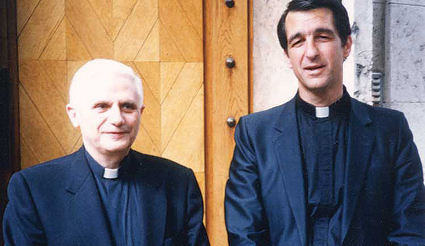
Fr Joseph Fessio, founder of Ignatius Press, with Joseph Ratzinger
Joe Fox, the legendary editor at Random House in New York of Truman Capote and John Irvin, told me back in the late 1980s: "The problem, Piers, is that Catholics who buy books aren't your kind of Catholic and your kind of Catholics don't buy books." He had published two of my novels in New York and we were discussing possible future projects in non-fiction. I no longer remember what it was I had proposed but it must have had something to do with the Catholic Church. He took the view that books by Catholic dissenters such as Hans Küng could become bestsellers but no one was interested in an author taking an orthodox line. We settled instead on a book about the Chernobyl disaster.
Twenty years later, the same view, more or less, was put by my agent, Gillon Aitken, when I showed him the manuscript of a novel, The Death of a Pope. It was written in the form of a thriller. The story opens at the Old Bailey where a member of the IRA, a member of Eta and a Basque aid worker, once a Jesuit in El Salvador, are charged with conspiracy to obtain sarin for terrorist purposes. The ringleader, the Basque aid-worker, Juan Uriate, presents a spirited defence. All are acquitted. A young woman covering the trial for a broadsheet newspaper is so captivated by Uriate that she goes to Africa to write about him and his work. The young analyst at MI5 who gathered the evidence for the trial believes the verdict of the jury is unsound. He suspects that Uriarte is planning some atrocity. But when? And where?
So far so good, but there now enter into the story the heroine's uncle, a Catholic priest; a Dutch curial cardinal; and the cardinal's secretary, a Spanish monsignor. There is much talk about the state of the Church. Pope John Paul II is dying. Who will succeed him? What should or should not change in Catholic teaching? An epigraph to the novel is a quote from Polly Toynbee: "The Pope kills millions through his reckless spreading of Aids." Another is from Pope Benedict XVI's encyclical Spe Salvi. "Jesus was not Spartacus, he was not engaged in a fight for political liberation." A second opinion thought the novel "old-fashioned", and that "the portrayal and discussion of the Catholic Church's history, rituals, customs and protocols and the challenges and dilemmas the Church faces in the modern world can be heavy-handed and intrusive."
Others concurred with this view and I agreed that the novel should not be submitted for publication unless, perhaps, to the specifically Catholic publishing house in San Francisco, Ignatius Press. Ignatius had taken a miscellany of my writing on religious and moral topics, Hell and Other Destinations. I emailed a copy of the novel to California and, while waiting for a response, did some rewriting to enhance the characterisation and to make the novel seem less old-fashioned (short sentences, the present tense, few conjunctions or subordinate clauses). In due course, I heard from Ignatius Press that they would like to publish the novel. Gillon thought this would be harmless: San Francisco is a long way from both London and New York.
Ignatius Press was founded in 1978 by the then 37-year-old Jesuit priest, Fr Joseph Fessio and, in the war between liberal and orthodox Catholicism that has been waged since Vatican II, has been in the vanguard of the forces of orthodoxy. Fr Fessio was raised in San José, California. After joining the Jesuits, he studied theology in Lyons in France and subsequently at the University of Regensburg in Germany: there his director of studies was the then Professor Joseph Ratzinger. A year after obtaining his doctorate from Regensburg, he returned to California where he became a thorn in the flesh of the overwhelmingly liberal province of the Society of Jesus. There were stand-offs with his Jesuit superiors: at one time he was ordered to serve as a chaplain in a hospital; but Fr Fessio had friends in high places in Rome. His friend and mentor, Joseph Ratzinger, became Prefect for the Congregation of the Faith in the Vatican, and in 2005, Pope Benedict XVI.
Pope Benedict's works feature prominently in the catalogue of books published by Ignatius Press. There are also the works of other orthodox theologians such as Hans Urs von Balthasar; apologetics; catechesis, devotional work and occasional works of fiction. Some years ago they had published a novel, A Time Before You Die, by a Catholic friend, Lucy Beckett, that had failed to find a publisher in Britain. I imagined that The Death of a Pope would be published in the same way: a modest printing which would enable the author to give copies to friends.
However, in February this year, I was telephoned by the marketing director of Ignatius Press, Anthony Ryan, to say that Barnes & Noble, the chain of American bookstores, had agreed to lay on book-signings in a number of their stores. Ignatius Press would like to fly me to America for a four-week tour in May to promote The Death of a Pope.
The tour started in Oregon, moved on to Washington state, Colorado, California, Maine, Massachusetts, New York, Washington, DC, Virginia, New Hampshire and back to California. There were around 18 book-signings, 18 interviews for radio, press and television and four talks on the predicament of a Catholic novelist in a secular society. The publishers set up a website, deathofapope.com, and put me on Facebook .
The tour gave me some insights into Catholic culture in America. First, from a professional perspective, there is a "niche market" for Catholic writing and a means of reaching that market that does not exist in the UK. There are more than 67 million Catholics in the US, by far the largest single denomination. Many of these are quiescent and no doubt a large number are "liberal" Catholics who dissent from Catholic teaching on birth control and voted for the "pro-choice" Obama.
But Vatican loyalists have their own media outlets — a plethora of radio stations, journals and blogs, as well as the unique television channel, EWTN, started by a nun, Sister Angelica. The most important media event, from the point of view of Ignatius Press, was my appearance on EWTN's The World Over, hosted by Raymond Arroyo, which reaches 120 million homes worldwide. This was taped in Washington. Arroyo was a charming interlocutor, as interested in literature as religion. Whether some among his millions of viewers in the US, Costa Rica or the Philippines are buyers of hardback fiction remains to be seen.
The signings in the secular Barnes & Noble bookstores were less well-attended than those in the Catholic ones attached to, for example, to the cathedral in Oakland, California, or the National Shrine in Washington, DC. The biggest turnout was for the lectures — essentially onstage discussions about the Catholic novel. Cardinal Stafford, the former Archbishop of Denver and Prefect of the Apostolic Penitentary, was in the audience at the Dominican School of Theology at Berkeley, California. I shared the platform in Santa Clara with a fellow Catholic novelist, Ron Hansen — author of Mariette in Ecstasy and Exiles. Some of the questions put from the floor asked why The Death of a Pope was not being published in the UK. I tried to explain the change in the zeitgeist that had taken place in Britain in my lifetime. In the 1950s, Evelyn Waugh and Graham Greene wrote triumphalist Catholic novels with miracles as part of the story — Brideshead Revisited, The End of the Affair. They were bestsellers. Since Vatican II, however, the tenor of Catholic fiction has been doubt, dissent and disillusion — David Lodge's How Far Can You Go?, John Cornwell's The Spoiled Priest, Jill Paton Walsh's Lapsing. The Christian consensus had evaporated, replaced by an animus against Catholicism. I suggested that the observation made by Bryan Appleyard some years ago was even more pertinent today: "To the modern imagination, Catholicism is the biggest enemy of all. As a result, ‘I hate Catholics' is quite commonly heard in otherwise civilised circles..." We discussed the way in which various pundits now used the rise of Islamic jihadism to castigate all religions.
There are, of course, circles in the US that see Catholicism as a force of reaction — particularly the brand of Catholicism promoted by "the Vatican". One of these circles is that of the self-styled "liberal" or "progressive" Catholics. Such is their residual influence that many of the orthodox Catholics I encountered on my tour — friends of the Ignatius Press who fetched me from airports — were unwilling to send their children to Catholic schools. Home-schooling seemed to them the best way to raise their children in the faith. They did not watch TV or appear to participate in the secular society around them. Some were graduates of Ave Maria College in Florida, founded by the Domino's Pizza millionaire Tom Monaghan, and where Fr Fessio is Theologian in Residence. Unlike many young Catholics in Britain who take the Church's teaching on chastity with a pinch of salt, they eschew sex before marriage and use only natural methods of birth control. The mothers do not work — they are, as Pope Pius XI put it, "the queen of the home". The fathers are not ambitious in any worldly sense. One worked as a chef in a restaurant; another drove a truck. Eccentric? A retro sect like the Amish in Pennsylvania? An Evangelical schoolteacher with whom I conversed on the flight from Maine to California thought home-schooling wrong: one's faith should be strong enough to survive in a secular society. Perhaps. But I recalled how many young Catholics in Britain had lapsed, adopting the values of EastEnders, Friends and Frasier rather than those of their eccentric Catholic father.
The same dilemma cropped up in discussions about the role of the Catholic novelist in a secular society: the Catholic novelists versus the novelist who is a Catholic. Should a Catholic author write only for his or her devout co-religionists or try to reach non-Catholic readers and address their preoccupations — particularly, in what Pope John Paul II called our "aphrodisiac civilisation", their preoccupation with sex?
I discussed this with a Catholic author, Andrew McNab, whom I met in Portland, Maine. He has recently published a collection of exquisite short stories (really short: some little more than a page in length) entitled The Body of This. In some there are candid depictions of sex which would not raise an eyebrow in the average secular reader but might shock the devout. In The Death of a Pope, there is a love affair but there is nothing that would bring a blush to the cheek of a maiden. But expletives used by one of the characters, a member of Scotland Yard's Special Branch, were toned down at the request of my editor at Ignatius. And what would the devout customers of Ignatius Press make of some of the scenes in my earlier novels? Or in a new novel, The Misogynist, to be published next year?
Many of the Catholics I encountered on my tour had anti-abortion stickers on their cars. Abortion is an acute issue in the US in a way it is not in Britain. Here the debate is about the number of months after conception after which it should be unlawful to terminate a pregnancy. There the debate is about whether a termination should be lawful at all. A survey taken while I was on my travels showed that more than 50 per cent of Americans described themselves as "pro-Life". My Catholic friends believe that there should be a total ban on abortion, as in Chile. Also coinciding with my tour was the honouring of President Obama at Notre Dame University — a scandal in the eyes of many bishops and my orthodox Catholic friends because of his consistent support of abortion, including partial-birth abortion in which the baby's head is crushed as it leaves the womb. "An unborn baby is a person" read one of the stickers. It is impossible for a Christian to dissent from this view: God became man at the Annunciation, and in the account of the Visitation in St Luke's Gospel the unborn John the Baptist "leaps in the womb" as he recognises Jesus in utero. However, there is a danger, it seems to me, that the fight for the right to life of the unborn comes to define Catholicism, to the neglect of core beliefs that God became man as Jesus of Nazareth, that he was the Messiah promised by the prophets of Israel, that he died for our sins on the Cross, the Eucharist authorities of the Pope.
I also felt misgivings about the way in which orthodox Catholics, finding common ground with Evangelical Christians on the question of abortion, seemed to bundle it together with other right-wing positions on purely political issues. There was a palpable hatred of Obama not just because he was "pro-choice" but because he was "a socialist" and in favour of gun control. Opinion in the US seems polarised in a way it is not in the UK, partly because the conduits of information about the outside world are themselves polarised. My Catholic friends would watch Fox News because they feel affronted by the liberal stance of CBS or NBC. When I asked if there was anyone who, like Pope John Paul II, was against both abortion and the war in Iraq, they could only come up with the Catholic blogger Mark Shea.
Also coinciding with my four-week book tour in the US was an issue of the Economist with a special report on business in America. The view taken was that American business, though battered by the recession, would bounce back because it had an inherently optimistic propensity to take risks. This was unquestionably true of the Ignatius Press. It is a non-profit-making enterprise, an apostolate as much as a business. Most who work in its office in an old fire station in San Francisco pray together three times a day.
But they saw an opportunity with The Death of a Pope to reach out into the secular market and made a major investment to bring this about. It is inconceivable that a religious publishing house in the UK would take the same risk. It may not turn out to have been cost effective but, like Mother Angelica's EWTN, it shows how the entrepreneurial energy found in the US can be harnessed to evangelisation and the propagation of the faith.


- Beirut: Hariri — An Assassination Too Far
- New York: A ‘Post-racial’ American vs an Old Coot
- Pristina: Kosovo's Liberal Islam
- Oslo: Courage and Cowardice in Scandinavia
- ONLINE ONLY: Washington, D.C.: It's Not Rocket Science!
- La Hague: Recycling the French Model
- Jerusalem: No Via Media for Anglicans
- ONLINE ONLY: Beirut: Blood Holiday
- Rome: Arrivederci Roma
- Darfur: Panic at the Palace
- ONLINE ONLY: Letter from Bamian
- Caucasus: Diary, August-September, 2008
- ONLINE ONLY: South-East Asia: The Demons of Ignorance
- New York: Diary
- Ypres: Never Say Never Again
- New York: A Cousin in the White House
- Caracas: Chávez's Secret Fan Club
- Prague: Diary
- Park City, Utah: Movie that Pulls Aside the Veil
- Beirut: Blood on the Streets
- India: Tariq Ali's Plan for Pakistan
- Berlin and Cologne: A Tale of Two German Cities
- Mumbai: On the 'Slumdog' Trail
- Budapest: Screwed Left, Right and Centre
- Paris: Mayhem in the Marais
- Stanford, CA: Intellectual Life Under Obama
- Colombia: A Nation Reborn
- Paris: Prisoner of the Barbarians
- United States: The Path to Rome via San Francisco
- ONLINE ONLY: Black Russian
- South Africa: The ANC'S Health Lesson for Obama
- Lisieux, France: Relics of Thérèse
- Germany: Heidegger - Being, Time and Place
- Moscow: Putin's Empire Strikes Out
- Connecticut: My Battle Against Google
- Montana: Home From Home on the Range
- Siberia: In Search of the Gulag
- Rio's Heart of Darkness
- Mogadishu: Armageddon on Steroids
- Havana: The Castros Will Not Be Absolved
- Kaliningrad: Russia's Outpost in Europe's Heart
- Bishkek: Bloodsoaked Revolution
- Bishkek: Downfall of a Dictator
- Oslo: Signing OFF on Human Rights
- Bajaur: A Talk with the Taliban
- Bahrain: Women Drivers Welcome Here
- Tajikistan: In Search of the Yeti
- ONLINE Only: Ankara's Proxy
- Johannesburg: Hard Pressed
- Istanbul: Press Freedom Alla Turca
- Xinjiang: Taming China's Wild West
- The Lesson of Oz
- The Surge is Working — So Far
- A Tale of Love, Bulls and Goats
- Old-order Collapse
- Egypt's New Dawn Chorus
- From Carthage to Kasserine
- After Gaddafi: A New Libya Emerges
- To the Polo Saddle Born
- The Settlements: Life Between the Lines
- Exposed: Carnita's Cover Story
- "At last, I feel proud to be Libyan"
- Books Do Furnish a Little Freedom
- Fat Chance for Christie—This Time
- Easy Lies the Head that Wears the Crown
- Putin's Chinese Whispers
- Cain Isn't Able and Newt Defies Gravity
- The Ten Years' War against the Taliban
- We The People Say: Get Out of The Way
- Wanted: A New Ronald Reagan
- Time to Crunch the Numbers
- Who's Really Supreme?
- From Art as Life to Blood and Soil
- Talking Tactics
- The Wagner Family Soap Opera Rolls On
- Winning the Veepstakes
- Romney Takes a Risk with Ryan
- Window Brothels Get the Red Light
- Can Romney Spring an October surprise?
- Canada's Crusader for Conservatism
- No-Go Areas on the Campaign Trail
- Republicans Must Avoid Civil War
- Norway's Problem with Anti-Semitism
- Turks, Arabs and Jews: The Middle East in Crisis
- Nations United in Hypocrisy
- Siberia: Shamans, Spies and the Secret Police
- Barracked by Obama's Oratory
- Women Come Last in Syrian Refugee Camps
- The Dawn of Obamageddon
- Americans Know Her True Worth. Do We?
- Hapless Hollande’s French Farce Flops
- Save the NYPD So It Can Save the City
- Obama's Secrets Start Unravelling
- Syria Isn't Bosnia: Don't Arm the Rebels
- Who Can Stop Hilary in 2016?
- Teaching China's Anglophiles
- On Pilgrimage with the Hasids
- From Eastern Europe to the East End
- True Grits
- The Rise and Rise of Marine Le Pen
- Cold Comfort On Global Warming
- Hunting the Lynx with the Old Believers
- High-tech Israelis Aim For The Moon
- The Russians Are Coming
- The Turbulent Minister is Right
- Bad Times for Good Samaritans
- This Expat Paradise is a Woman’s Nightmare
- Two Generations Lost to Communism
- Strangers in their own Holy Land
- The Isles are Full of Big Noises
- The Kurds: Israel's not so Improbable Allies
- Islam and Innocence: Canada’s Predicament
- The Fifth Republic’s Darkest Days?
- Let's Make Putin's London Cronies Sweat
- The Global Politics Of Netanyahu's Victory
- A Grim Prospect For South Africa's Jews
- No End In Sight To The Exodus From Libya
- Undeterred, Erdogan Usurps Ataturk's Legacy
- Gaza Withdrawal Symptoms
- Red Flags Flying Over Parliament Square
- Mutinous Talk In The Highlands
- Our Principles Are All We Have
- Why The Swedes Have Had Enough
- Canada's First Nations Come Last
- Islam and the French Republic
- Unconventional Convention
- The Dying Days Of Zuma's South Africa
- I'm Not Antisemitic, But...
- The ELM, Dispatches and Awlaki
- A Larger Than Life Predator

1:05 PM