


In 1997, Peter Horrocks, the then editor of Newsnight and now director of the World Service, told his staff that the hard-hitting journalism of the Tory years should cease now Tony Blair was in power. "Labour has a huge mandate," he said as if he thought it should influence impartial journalism. "Our job should not be to quarrel with the purpose of policy but question its implementation. Ennui is over — for now. Much of our tricksiness and world-weariness was an appropriate way of capturing the repetitiveness of the dying days of Conservatism. Our job now is to explore what's new...We don't need to be clever-clever."
Thirteen years on, it is easy to forget the depth of the media's love for Blair, or recall that New Labour was as much a movement among broadcasters and print journalists as politicians. Tory columnists and editors abandoned their party to declare their admiration for the inspiring young leader. Greg Dyke and his contemporaries sent profits from the sale of their London Weekend Television shares Blair's way in the form of Labour party donations.
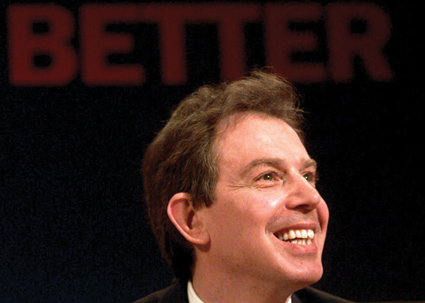
Love-hate relationship: Tony Blair in 1997
Blair's combination of social and economic liberalism appealed to rich, right-thinking media executives, as did his telegenic charisma. He was the finest political performer they had seen, as I found out in the late 1990s, when Verso, a left-wing publisher, produced a book of my determinedly anti-Blair essays. The hapless designer searched for unflattering pictures of Tony to illustrate the cover, and concluded that they did not exist.
From the moment he used to leave his home, Blair knew that photographers could catch him at any moment in an unflattering pose. So he was forever smiling, forever affable. He was the best, and the media adored him for it. "The corridors of Broadcasting House were strewn with empty champagne bottles," said BBC Radio Five Live's Jane Garvey, as she tactlessly revealed her colleagues' glee at Labour's victory. "There was always the suggestion that the BBC was full of pinkos who couldn't wait for Labour to get back into power. That may have been the case...Er, I wish I hadn't started this now."
You don't need a weatherman to know which way the wind blows in liberal London, you just need to tune in to Andrew Marr. Watching him reduce Alastair Campbell to tears after his appearance at the Chilcot Inquiry last month, I wondered, not for the first time, what had happened to the intelligent and principled Blairite I had known in the 1990s. "600,000 people" had died in Iraq, Marr told Campbell, as he made the case for the prosecution, and his battered interviewee did not have the wit to reply that 600,000 people had done nothing of the sort. Marr's figure came from the Lancet in 2006 — the journal that had also published the claim that the MMR jab could cause autism — and did not begin to tally with returns from Iraq's hospitals and mortuaries. Only Trotskyists, Islamists and BBC presenters credit it, and they repeat the accusation without ever specifying who did the killing — which, as ever, is a warning to everyone listening to be on their guard. When Marr said that "600,000 people died", he left the implication hanging in the air that British and American forces rather than Baathist and Islamist death squads had murdered them. Marr and all those like him have to hide the killers' identities because precision would force them to admit that, whatever they thought of Blair's decision to go to war, they had a duty to shake themselves out of passivity and oppose fascism in its secular and clerical varieties. They might then have to admit that the men and women in the armed forces who were fighting both forms of fascism were not necessarily the criminal accessories of an "illegal" war. That they can never do.
Campbell complained that Marr was "settling scores". It was a weak reply, but it captured the element of vindictiveness in today's Blair-baiting. Like spurned teenage lovers, former Blairites wail that he ravished them and then betrayed them, and that he must pay by suffering every kind of humiliation. They cannot accept that Blair made an honourable mistake: knowing that Saddam Hussein had possessed the means and the will to commit genocide in the past, he believed that the dictator continued to possess them in 2003. The accusation that he was guilty of human error is not good enough. Blair must have lied to Parliament and the country. He must have known that there were no WMD in Iraq but went to war anyway. The result of the almost sexual revulsion behind the campaign against him is that we are now on our fifth inquiry into Iraq. Like the European Union with the Irish electorate, the media class will keep demanding inquiries until they get the right result and find that Blair conspired to steal their virginity.
The peculiar rules of British television add to the adolescent atmosphere. Because they require broadcasters to pretend to be impartial, journalists cannot admit that they made a political misjudgment and analyse their own failings as well as Blair's. You can never ask them why they supported a politician they now damn as wicked, and invite them to explain their mistake. The ideological mistakes and betrayals must be on the other side and on the other side alone because they must maintain the fiction that they are innocents who do not possess political beliefs. Infantilism follows because only children can be the truly innocent victims. Political maturity requires grown men and women to accept responsibility for their choices.
Do not expect the fit of petulance to pass. Blair is like Margaret Thatcher now — a politician for whom the broadcasters can never have a good word. In Mo, Channel 4's otherwise excellent drama-documentary on the last years of Mo Mowlam, Blair appeared as a despicable and vain figure who plotted to take the credit for Mowlam's hard work. Channel 4 could not say the British Prime Minister had to get involved in the peace process because the Irish Taoiseach and the American President were already involved. It ignored the realities of international diplomacy and dismissed Blair's achievements because, I suspect, the climate in broadcasting is such that to declare that he was not all bad is like announcing that you have seen the sweet side of a serial killer or possess sympathy for the Devil.
One day, probably about 30 years from now, a cultural historian will go through the political television of our time and wonder why, if Blair was such a palpably evil man, he managed to win so many elections.


12:03 PM
11:03 PM
10:02 AM
5:02 PM
4:02 PM
1:02 PM
10:02 AM
5:02 PM