


I wonder whether enough has been made by Adam Smith scholars, which I do not claim to be, of the intellectual connection between Smith and Charles Darwin. Darwin himself records how, during his last year at Cambridge, he spent much of his time studying Smith. And I have long been struck by the parallel between Smith's explanation of how economic order and growth is secured by the free interaction of individuals seeking their own personal satisfaction, "as if by an invisible hand", and Darwin's revolutionary insight, a century later, of how the remarkable natural order could arise spontaneously as a result of natural selection, without the need for an intelligent designer or divine watchmaker.
Be that as it may, I have been toiling in the field of political economy — and how refreshing it is to see the revival of that almost obsolete but wholly accurate term — for the best part of half a century now, first as an observer of policy-making as a journalist, starting on the FT in the 1950s, and for the past 36 years as a politician and sometime minister, as both a close observer and a practitioner.
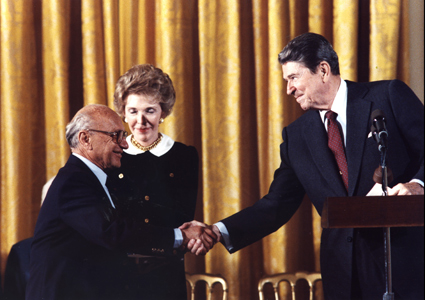
Against protectionism: Milton Friedman and Ronald Reagan
Throughout that time, I have found both Adam Smith's insights and his approach to the subject, however distant in time, both convincing and congenial. Not that I was brought up on him. My economics tutor at Oxford (I specialised in philosophy, but I did do some economics) was Keynes's pupil and first biographer, the endearingly eccentric Roy Harrod. Keynesianism ruled the roost, and Smith was known, to the extent that he was known at all, as the author of two books, one — The Wealth of Nations — of purely historical interest, and the other — The Theory of Moral Sentiments — of no interest at all. But I discovered him, to my instruction and delight, myself, and I hope the themes of this article are in his spirit. (I have borrowed my title from the film Four Weddings and a Funeral.)
Myth No.1
Myth number one is that economics is a science. It goes back quite a way. Economists, at least since Marshall, have mistakenly sought to dignify their calling by describing it as a science, and increasingly chosen to add verisimilitude to this pretence by clothing their propositions in the language of science, that is to say, mathematics. But economics is not a science. On scientific matters we rightly expect a high degree of certainty, and are ready to leave many important decisions to properly educated experts. By contrast, economic policy is more like foreign policy than it is like science, consisting as it does in seeking a rational course of action in a world of endemic uncertainty.


- The Coalition We Need To Defeat Islamism
- Are We Losing The War On Home-Grown Terror?
- Cameron Gave Libyans A Chance. Pity They Blew It
- Brexit Will Give Global Free Trade A Boost
- The Real EU Referendum Winner May Surprise You
- Is Theresa May The True Heir To Mrs Thatcher?
- Race To The White House Through The Looking-Glass
- Brexit Gives Us A Historic Opportunity
- American Conservatives Must Stand Up To Trump
- Cicero's Analysis Of Decline Offers Lessons For The West
- Deepdene: Rise and Fall of the House of Hope
- Debunking the EU Referendum Myths
- Britain's Opportunity Is Europe's Warning
- Controlling Immigration Is Good For Democracy
- The Pied Piper of Islington
- The West Cannot Afford To Ditch Nato
- End Of History — Or Clash Of Civilisations?
- We Can Defeat Islamist Terror — But Not On Our Own
- Without the Emperor, What is Left of Old Japan?
- Now Or Never

3:09 PM
9:02 PM
9:01 PM
4:01 PM
2:01 PM