



Happy International Women's Day.
Did you know it was IWD? Do you care? And should you?
In Britain, it's easy to think not. However, IWD is not a newfangled feminist thing; today marks the centenary of what began as a demand for improved working rights and female suffrage in early 20th-century America and Europe. So 100 years ago today, Western women had already begun to think about what they wanted, and what they needed to live and work. But what do contemporary working women want? Is it part-time hours, flexible working, better childcare provision, increased paternity leave? Not to have to work at all? A holiday from having to think about it?
Depends who you listen to — or on what day you ask her. It's clear though that while the previous Labour government afforded women as many family-friendly allowances as the economy could bear, "work-life balance" and "satisfaction" are yet to have happily set up home together. According to a 2009 study by Cristina Odone for the Centre for Policy Studies, only 12 per cent of the 4690 women surveyed wanted to work full time; and in a recent YouGov/Sunday Times poll, 53 per cent of participants believed that women are under undue pressure to skip back to work, post-pregnancy. Have-it-all feminism, it seems, has left them with a frying-pan to ironing-pile dilemma — Sisyphea knackerdom for those that work and breed, or scrub-wifely shame for the Vesta non-virgin rest. At the same time, and I say this as a flag-flying feminist, gender equality has been commandeered by feminist self-interest. Of course women still need their rights fighting for. But despite their commitment to ending gender-based discrimination, you won't hear a similar clarion call for shorter prison sentences for male criminals (women get less time for equivalent crimes), for more men in fashion, HR and professional administration work; for better male mental health provision (men are three times more likely than women to commit suicide), or for more fathers to be given joint custody of children following divorce or separation.
Gender pay gap figures are thrown out faster than a stray male from a ladies' changing room. But the gap is a false friend to feminist statistics. Economists such as the LSE's Catherine Hakim distinguish between horizontal occupational segregation (whereby the sexes choose "different but equivalent" careers — eg women housekeepers vs. male carpenters) and vertical occupational segregation (where women choose jobs of a lower pay and status than those of men within the same industries — eg female secretaries vs. male managers). But feminist campaign groups and right-on governments rarely do. Which explains why so many men and women fail to get their heads round the boggling statistics proclaiming that women earn less than men. Women do earn less, overall. But 14 per cent of the gap (according to the Fawcett Society) can be attributed to the break in employment women take to care for family. Not necessarily because they are paid less for doing an equivalent, or even the same job, as men. And it's this kind of unqualified clamour that only serves to undermine the real cases of discriminatory pay, which do exist, while causing everyone else to wonder whether female colleagues are automatically paid less than male.
What's more, in her recent paper "Feminist Myths and Magic Medicine", Hakim claims that the last Labour government's work policies were in fact counterproductive for gender equality. Encouraging part-time work may have increased the number of women employed, but ultimately, it only depresses women's long-term earning potential, as women take up lower-skilled, lower-paid positions, which outlaws them from the many professions in which long and dedicated hours are a prerequisite for success, and for which high salaries are the reward. At the same time, the burden on men to bread-win is only compounded.
So if helping women to a work-life balance is currently still pricing them out of the competitive jobs market, how can we stop it from being a lacklustre compromise, the fatalistic result of choosing to have children? Nick Clegg's recent proposal for increased paternity leave, a potential solution, was about as popular as the offer of a flaccid pig's bladder. Which tells you a lot about how poorly part-time work is regarded by both men and business, and how resistant to change so many apparently accommodating fellows are when presented with hitherto "ladies only" options. The papers were awash with pointed examples of men who had jacked it all in to bring up baby, but the reality is that there is no househusband revolution on its way soon. Gender stereotypes aside, in the current economic climate, no one can afford it. Or at least, that's the get-out-of-playpen card for countless reluctant fathers.
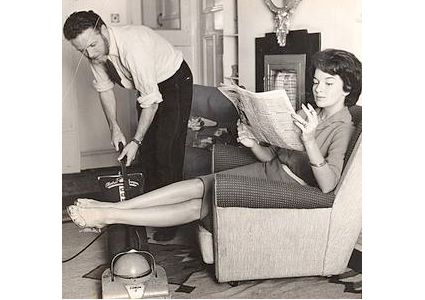
But economics need not hamper equality: there is a cheap and cheerful (depending on which side of the Hoover you're standing on) alternative. If so many women work part-time in order to balance home and work life, why not just increase male participation in domestic duties? So simple, so often said, yet still not taken up. According to the National Office for Statistics 2005 Time Use survey, women spend an average of 20 minutes longer than men on both paid and domestic work per day, regardless of their occupation and the number of hours worked. While it seems sensible for anyone who works part-time to do more at home, professional full-timers suffer from a "hyper-homemaker" guilt, which finds them taking on the bulk of domestic duties, lest their male partners are "emasculated" by their success. Surely this cannot be some kind of biological compulsion at work; nature's way of keeping us in our place, lest women stretch their feeble, feminine, mental muscles and get so distracted evaluating the flaws in Aristotle's theory of justice, they forget to put the washing on. What intelligent working woman genuinely believes that saying no to late-night ironing equals child abuse, or spouse neglect? Whatever happened to simply — and very reasonably — asking a male partner to give a helping hand? Is it that more men than we thought are essentially lazy, chauvinistic anti-dishwashers? Or have so many women been brainwashed by the legacy of that boy-girl miscommunicative bible, "Men are from Mars, Women are from Venus", that they've forgotten that sentient, grown men can be asked to do things sometimes, and that, sometimes, men even do what they are asked. Besides, if reasonable communication does fail, even a total Neanderthal cannot fail to recognise the power of the cooking/cleaning/canoodling strike.
So while domestic burden may be at the root of the gender pay gap in Britain, it's really a luxury to be able to wrangle over household chores. Which makes it worth considering for whom International Women's Day is vitally important. All those females who will be subjected to culturally sanctioned rape within marriage today, to infibulation, to violent abuse. All those who will be deprived of education, healthcare, basic pay, or who will be simply treated as second best because of misfortune of birth. We, in the lucky West, owe it to them to refuse to be victims of feminism, or a latent sexism that is long overdue a push out of the double bed. A little duster redistribution is the least we can do.


- The Coalition We Need To Defeat Islamism
- Are We Losing The War On Home-Grown Terror?
- Cameron Gave Libyans A Chance. Pity They Blew It
- Brexit Will Give Global Free Trade A Boost
- The Real EU Referendum Winner May Surprise You
- Is Theresa May The True Heir To Mrs Thatcher?
- Race To The White House Through The Looking-Glass
- Brexit Gives Us A Historic Opportunity
- American Conservatives Must Stand Up To Trump
- Cicero's Analysis Of Decline Offers Lessons For The West
- Deepdene: Rise and Fall of the House of Hope
- Debunking the EU Referendum Myths
- Britain's Opportunity Is Europe's Warning
- Controlling Immigration Is Good For Democracy
- The Pied Piper of Islington
- The West Cannot Afford To Ditch Nato
- End Of History — Or Clash Of Civilisations?
- We Can Defeat Islamist Terror — But Not On Our Own
- Without the Emperor, What is Left of Old Japan?
- Now Or Never

10:09 AM
8:07 AM
12:04 PM
4:03 PM