



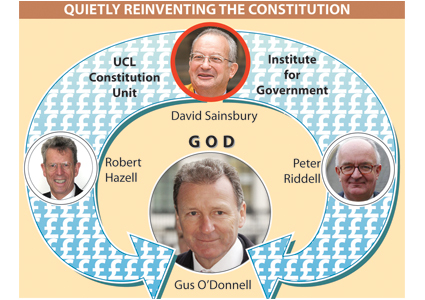
On May 5 the British constitution faces a potential tsunami. If electors succumb to boredom, apathy and ignorance, and fail to tick the box against the Alternative Vote in the forthcoming referendum, the consequence will be the virtual destruction of the Westminster model of democracy. The political institutions which have served the country so well for many generations have already come under a succession of attacks which have proved all the more effective and dangerous for being mounted by methods of guerrilla warfare rather than frontal assault.
The technicalities of the Alternative Vote hardly matter. There is, in any case, a whole family of voting methods called AV. They share the characteristic of being rare and complex. The key political reality is that the form of AV being presented to the UK electorate will, if accepted, make coalition government the norm. It will make it extremely hard to remove Nick Clegg and the Liberal Democrats. AV will give the third party an extra 25 seats. Unless there is a huge imbalance of support for the two main parties, the Liberal Democrats will be able to choose between a deal with the Tories or a deal with Labour.
If the Liberal Democrats gain power within the current Coalition government as a result of success in obtaining AV, they will then use their increased strength to argue for other constitutional changes designed to consolidate their strength even further.
There is a simmering battle between Conservatives and Liberal Democrats within the government over the proposed reforms of the House of Lords. If a reformed House of Lords is largely or completely elected, and if — as already agreed between the two parties of the Coalition — such elections are held under a system of proportional representation, the Liberal Democrats will then be able to become the pivot of power in the Upper House. To limit the damage, it will be in the Conservative interest to reduce the role of the Lords and in the Liberal Democrat interest to extend it.
If the Liberal Democrats consolidate their veto role over British politics, they will be able to block policies favoured by a majority of electors almost permanently. In particular, it will be hard to contain the successive losses of sovereignty to the European Union.


- Euphoric Labour won’t win power led by a pied piper
- Don’t be ‘difficult’ — try ‘formidable’, Mrs May
- Enough is enough of terror — but also of our self-doubt
- Iraq’s Christians pray for help that never comes
- The Atlantic alliance may be broken beyond repair
- Catholic tastes: both English and European
- Brexit as myth: Exodus, Reckoning, or Sacrifice?
- A Decent Woman Betrayed By Her Gruesome Twosome
- Can Macron Save France — Or Is He Its Undertaker?
- Europe's Revival Is At Hand, Thanks To Brexit
- Is This The Most Important British General Election Since 1979?
- The New Europe Must Be About More Than Money
- Our Best Brexit Policy Is All-Out Free Trade
- The Bursting Of Our 'Kabubble' Fantasies
- Gambling On A Greater More Gracious Britain
- Xi Versus Trump: The Emperor And The Tycoon
- Can Trump Square The Circle On Fiscal Reform?
- Donald Trump And The Dividing Of America
- Theresa May Emerges From Thatcher's Shadow
- Not Tweets And Anger But Redoubled Vigilance

- Time To Revisit The Two Cultures
- Opposites meet in the land of Scrugletopia
- The Battle Against The Philistines Never Ceases
- How The EU Elite Paved The Way For Populism
- Anything Dennett Can Do, Scruton Does Meta
- Why France Is Revolting Against The Ancien Regime
- Can Macron Save France — Or Is He Its Undertaker?
- A Decent Woman Betrayed By Her Gruesome Twosome
11:04 AM
4:03 PM
12:03 PM