


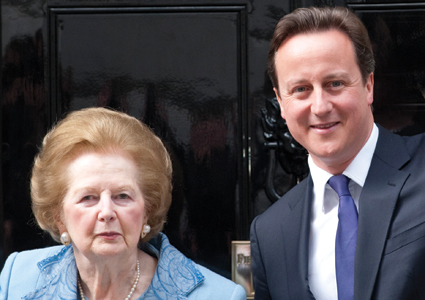
No Iron Man: David Cameron receives Lady Thatcher at 10 Downing Street. Now he must engage with her legacy (PA Images)
David Cameron's party doesn't really love its leader. Talk to a cross-section of his MPs and it is clear that many respect him — admiring his considerable self-confidence, his to-the-manor-born command of the House of Commons and composure in the aftermath of crisis such as this summer's rioting. But for a lot of Tories in parliament and out in the country it appears to go no further than that.
"I feel almost schizophrenic when I see him perform in the House," says a veteran Tory MP. "In one sense it is captivating. He has a very stylish delivery and sounds as though he means it all, the conservative stuff I mean. And then the other part of me thinks no, it's just hot air and in the end he'll never do what needs doing."
Watch him in front of a crowd of big-money Tory donors at one of the party's black-tie fundraisers and you see that the applause is polite but little more than perfunctory. Some guests shift uncomfortably in their seats when they are shown smug films of senior Cameroons mending youth-centre roofs and are told patronisingly in the subsequent after-dinner speeches about the need to build the "Big Society". Even Cameroon true believers, a pretty small band in the first place, suddenly seem rather deflated with how his tenure is going.
Conservatives have had plenty of time to get to know their deeply frustrating leader properly and to come to a rounded judgment on his merits and his weaknesses.
It is easy to forget, thanks to the impression of youthful vigour that the Prime Minister conveys, that he is no longer the new kid on the block. Next month is the sixth anniversary of his famous Blackpool peroration in which he offered to take his party, in the ghastly modern parlance, on "a journey". That sunny message in the autumn of 2005 made front-runner David Davis look out of date. Weeks later Cameron swept to the leadership.
Six years is as long as his hero Macmillan was Tory leader (1957-1963) and almost as long as Major was (kind of) in charge of the Conservative party from 1990 to 1997. If the next election is held in May 2015, as the coalition plans, Cameron will fight it having been leader for almost the same length of time as the disastrous Ted Heath.
The typical pattern of British postwar party leadership suggests that he is already probably around halfway through his allotted time, and perhaps even on a downward trajectory. Cameron himself has indicated that he has no desire to go "on and on", in the phrase of a former party leader. He tells friends that he has seen what staying too long has done to previous prime ministers' sense of equilibrium and consequently is not aiming to be a record-breaker. Indeed, the working assumption internally (certainly the expectation of George Osborne, who hopes to secure the Tory succession) is that Cameron aims to win an election in 2015 and step aside a couple of years later.
Intrinsically optimistic, and incredibly comfortable in his own skin, he says that if his premiership ends before then he will always have his family to fall back on.
Yet underneath the faux modesty and the liberal Anglican sense of detachment the Tory leader is also an intensely competitive creature. An Old Etonian well used to the bar of White's — a club he resigned from reluctantly ahead of becoming PM for fear of bad publicity over its men-only policy — could hardly be anything else. Indeed, it is difficult to imagine David Cameron being content to fail. Is he pleased with the idea of his premiership turning out to be of little consequence and of him ending up an unremarkable historical also-ran? At this point greatness doesn't appear to be on the agenda.
The Cameron record so far might politely best be described as mixed. He narrowly made it to Number 10, an achievement which eluded his three predecessors. But in opposition he fixated for far too long on the attempted "detoxification" of his party's "brand" and encouraged by an equally cautious George Osborne foolishly accepted Gordon Brown's leftist framing of the economic debate (signing up to a "share the proceeds of growth" consensus of high tax-and-spend). The Tory leadership couldn't say "we told you so" when the crash eventually came because they hadn't.
Then there was the matter of the general election, in which the absence of a clear Conservative message meant that voters were rightly confused about what on earth they were being offered. The resulting hung parliament produced a coalition with Nick Clegg that initially pleased a certain kind of liberal Conservative and voters who like their politics with any notion of combat removed.
But in the 18 months since it was formed the coalition has drifted. Osborne started well by promising deficit reduction, although the figures since suggest that those cuts are proving difficult to deliver. For all the hype, spending is much higher now than it was a year ago.
On Europe the coalition has made much of its introduction of a supposed "referendum lock", which will require future changes to treaties to be put to a national vote. Yet, simultaneously it has been defeatist and accepted the extension of European powers in all manner of areas such as justice and, catastrophically, regulation of the City of London.
Of course, in the credit column there are important reforms being implemented in welfare by Iain Duncan Smith and in education by Michael Gove. But in health Cameron — encouraged by Osborne, who thinks Cameron should present himself as a "safety-first" prime minister in the mould of Stanley Baldwin — abandoned attempts to introduce greater market discipline into the NHS.
That retreat followed Cameron's convincing victory in the AV referendum, when his intervention helped squash the Lib-Dem-dominated campaign to abandon the first-past-the-post electoral system.
But from that victory he drew precisely the wrong conclusions. Rather than feeling emboldened and realising that his coalition partners had nowhere to go, he became obsessed with keeping them sweet — hence the concessions on NHS reforms.
The attempts by Cameron and Osborne to copy the postmodern Blair approach, by cosying up to Rupert Murdoch and his executives and viewing the acquisition of power as a transaction, had always looked out of date. The explosion of the News of the World hacking scandal, and the arrest of Cameron's former spindoctor Andy Coulson, who had edited the paper before being signed up by the Tory leader, increased the sense that this is a government ageing prematurely. The overall impression is of a somewhat slapdash administration travelling without either a map or a compass but implementing some useful changes along the way. "We must not forget that Cameron is," a colleague of mine remarked ruefully recently, "very much a seat of the pants kind of guy."
And yet, this summer when a shooting in Tottenham and demonstrations about police tactics mutated into a sickening spree of looting, or "shopping with violence", in other parts of the capital and beyond, there was a glimpse of a different Cameron. It suggested that all might not quite be lost.
After the riots the Tory leader showed again how well he can respond under pressure. His pitch-perfect reaction was classic Cameron. Leaving it late is one of his well-established traits. He got his act together for his A-levels, for his finals at Oxford and in the Tory leadership contest only at five minutes to midnight. His middle names, jokes a colleague, might as well be "Justin Time".
Holidaying in a rented palazzo in Tuscany in early August, he made the decision to head back to Britain with only hours to spare. That night television news channels were carrying deeply disturbing images. The rioting was spreading beyond the enclaves where the underclass created by decades of counter-productive welfarism, moral relativism and leftist educational betrayal are usually contained. Solidly respectable Ealing was ablaze and London, in a temporary form of lockdown, felt unsafe.
By arriving when he did, just as the police toughened their tactics, it looked as though the PM had helped restore order (a primary duty for any Tory prime minister). Then he made powerful speeches that were refreshingly conservative in tone and content, diagnosing a moral malaise in parts of British society. He referenced the misguided 40-year war conducted against the family by middle- class liberals. That he was accused portentously by the ultra-liberal New York Times of "divisive moralising" suggested he was doing something right.
He had not spoken in such coherent and promising terms since the autumn of 2007, when his response to the tragic shooting of 11-year-old Rhys Jones in Liverpool was the formulation of his Broken Britain meme. For a few weeks — with Gordon Brown threatening to hold an early election he ended up ducking — the Tory leader became a much more fleshed-out figure, more serious, more conservative and authentic.
And then, as so often happens with Cameron, the caravan moved on and he lost focus.
Those impulses eventually surfaced again in the ill-fated "Big Society", a campaign which has rightly been much ridiculed. The project had genuinely conservative roots — a desire to shrink the statist behemoth and encourage non-state actors to take greater responsibility via volunteering and civic engagement — but it was all hopelessly vague.
Indeed, it is often said by Cameron's critics that he is merely a marketing man who believes in nothing. It is more accurate to say that he is poor at marketing his better (and more conservative) ideas.
A complicating factor is the relationship with Osborne. The pair are extremely close, which is unusual when it comes to prime ministers and chancellors. But Osborne's default position is caution and the pursuit of short-term tactical advantage dressed up as long-term strategic thinking, a tendency he encourages in Cameron.
A common mistake made by commentators is to presume that the key Cameroons share precisely the same world view. Osborne is much more liberal — in the social, rather than economic sense — than Cameron, creating a little-discussed policy divide that the Chancellor absolutely hates any attention being drawn to.
Cameron has long advocated the tax system being recalibrated to support the family. Under the cover of the excuse that the Lib Dems would never allow it, the Chancellor resists such traditional conservative thinking.
Steve Hilton — Cameron's close friend and guru — certainly views the world very differently from Osborne. He was at root a restless reformer before the coalition, being most interested in social breakdown and the kind of welfare and education reforms aimed at tackling it. But he has been properly radicalised by contact with what he sees as a complacent civil service machine, growing increasingly Eurosceptic (to the point where he advocates potential withdrawal from the EU) and arguing loudly in Number 10 for more supply-side reform to encourage economic growth.
Cameron, who has a deep distaste for conflict among his subordinates, tries to manage these tensions by seeking compromise and then privately occasionally losing his temper (as he did in Number 10 at the height of the hacking imbroglio).
As we have seen, none of it is a recipe for consistent leadership of the kind that Britain's current position desperately requires. And it seems an inadequate response when the social and economic challenges, involving the relative decline of the West, are so immense.
The riots, it has rightly been said many times since they erupted, present an opportunity for Cameron to break out of this depressing cycle. He could use this moment to give his government a proper sense of purpose. But how?
The answer should lie in at last engaging intelligently with the legacy of Margaret Thatcher. It does not mean turning her into a religious icon and treating her speeches as sacred texts. After all, her governments made policy mistakes even as she rescued Britain.
Thatcher has always been a highly problematic figure for the Cameroons. Worshipping at the shrine of Blairite centrism (believing that was the way to win the last election, which it turns out it wasn't), they have seemed embarrassed by her existence. Some concluded that it was best to define themselves in opposition to her "divisive" ideas.
It doesn't help that quite a few Cameroon camp-followers are also the ideological spawn of David Owen, having begun life in his SDP. However, the Owenite centre ground turns out to be, unsurprisingly, a barren place, particularly when it comes to searching for answers to the greatest problems of our age.
To tackle social breakdown and the rise of the underclass it will be essential to take on and defeat the post-1960s liberal consensus on family, welfare and education. Fatherhood, or the frequent absence of fathers in the underclass, was insufficiently discussed in the aftermath of the riots. A more muscular approach would mean persistently offending liberal sensibilities, and would also create problems for the Tory modernisers whose credo is that if it is modern it must be accommodated.
Gove's education reforms — which increase the number of schools free from local authority control — are good. But they should go further, with academic selection, discipline and a new wave of technical schools needed in the ghettoes that fostered the rioters.
Equally, it is no good being apologetic or half-hearted about the need for a dramatic shift of resources towards the private sector and away from the state, which is spending half of GDP under a Conservative-dominated government. That means tax cuts and deregulation of the labour market to stimulate investment and increase emploment. There can be no other way if we are to invest, save and produce our way out of this mess.
Of course, on social breakdown Thatcher's record was poor. The incapacity benefit scandal — signing millions off work and into a culture of welfare dependency — escalated dramatically on her watch as she unravelled uncompetitive industries. Yet, surely in her pro-enterprise, free-market credentials Cameron could find inspiration. Much of what is presented today as capitalism — for example monopolistic mega-banks, some of them owned by the state — is actually corporatism and a conspiracy against the consumer. Thatcher understood that to be viable, proper capitalism had to have a degree of popularity, and promoted it relentlessly to the aspirational as the route to improvement and prosperity.
But the key lesson from Thatcher is behavioural: you cannot be friends with everyone. Forget trying to please all. To get things done it is necessary to make enemies, and rather a lot of them.
This cuts right across Cameron's "One Nation" view of politics. Although he venerates Harold Macmillan-in opposition placing a picture of him above his desk-his approach owes as much to an earlier Tory prime minister who was also a coalition man.
Like Stanley Baldwin, Cameron is interested in the notion of the classes coming together in an effort to moderate social division — hence his "all in it together" rhetoric about deficit reduction and happy-clappy Big Society invocations. It helps explain his failure to identify with what Thatcher termed "our people" the strivers, the aspirational. Even the statist Macmillan — once he lost his seat in Stockton in 1945 and transferred to the upwardly-mobile Bromley in Kent —understood the importance of aspiration and getting on.
It is those strivers who are most likely to start the new small businesses that the country so badly needs. They will also be most receptive to strongly conservative messages about responsibility and effort being rewarded. Thatcher understood this instinctively and Blair found a way of mimicking her. Cameron — who failed to break the crucial 40 per cent barrier with the C2s at the election — acts as though such Britons don't exist and shows his "inner conservative" only when pressed in a crisis.
Can he change? Blair-style transformations — in his case from consensus builder to foreign policy fanatic and evangelist for choice in public services — are rare. Leaders tend in office simply to become more exaggerated versions of their original selves. Often the characteristics that initially made them attractive turn in time into weaknesses that are their eventual undoing.
Thatcher's against-the-odds determination was hugely appealing during the Falklands crisis and when she was defeating the unions, but it became an unshakeable conviction that she was always right and could afford to scorn her colleagues. She had learnt that she had to be daring to succeed (although it was tempered in her early years in power with a sense of realism about what was possible).
In time that hardened into what Nigel Lawson described as recklessness and a belief that having gambled audaciously and won so many times before her bets would always pay out. The result was the poll tax experiment and an aggressive tone of voice on Europe that alienated important sections of her party. Incidentally, recent events in the Eurozone have illustrated that she was absolutely right about the substance of the issue, in particular spotting ahead of her colleagues that the Exchange Rate Mechanism and moves towards a single currency were a mistake of epic historical proportions.
Cameron is very different. His great strength when he won the Tory leadership was supposedly his pragmatism and ideological flexibility. Now that looks like being nowhere near good enough.
What should trouble the Tory leader most is that significant parts of his party are concluding regretfully that they already know he cannot grow. Instead, their thoughts are starting to turn to what a more authentically conservative future might look like.
Next month's Tory conference will be dominated by this theme, particularly on the fringe — where the action really takes place in public events organised by right-of-centre thinktanks. To coincide, several books of essays by MPs are scheduled for publication which will examine the policies a majority Conservative government might pursue. One will be titled After the Coalition — which sounds like a polite way of saying After David Cameron.
Much of this thinking is coming from those in the new Tory intake, whose members are the largest injection of new blood into the Tory party in parliament since the 1930s. They have been cast as being new-model Thatcherites to a man and woman. There is obviously more diversity of opinion among them than that, but in conversations one can detect a deep frustration with the compromises of coalition and a hunger for the Conservatives to be unashamedly conservative and free-market.
Any thought of a new Tory leader is a long way off, thanks to the weakness of the Labour opposition, although the Thatcherite Priti Patel is one women to watch. George Osborne is on manouevres, building support among MPs for an eventual run at the leadership — although it is difficult to see the Tories opting for another heir to Blair when the day arrives. In the cabinet the reforming Education Secretary Michael Gove (a close friend of Cameron) is impressive and his eventual leadership ambitions look increasingly credible.
Yet if Cameron was to decide this autumn to lead his hungry new MPs — and the rest of his party — in a new direction they would surely follow. Great leadership-as Churchill showed in 1940, or a resolute Thatcher did when she seemed temporarily adrift on a sea of Tory wets before the 1983 election — in the end is usually about defying difficult circumstances. The realities of coalition, the deep-set nature of the social problems bequeathed by an orgy of liberal moral relativism and the residual caution of some of Cameron's colleagues are formidable obstacles. Of course they are. But they can be overcome by force of conviction, will and an appeal to those who do much of the work and pay so many of the taxes in Britain (the strivers).
Respond bravely and Cameron's premiership can amount to something important. If he lets the caravan move on this time it is not difficult to see where he is headed.


- The US Can Still Help Save Syria — and Iraq
- Russian Resurgence has Blindsided Nato
- On Europe, Nothing Less than Treaty Change will do
- Putin has his Useful Idiots on the Left and the Right
- Sarajevo: Where the Century of Terror Began
- Allen Lane’s Pelicans Take Wing Once More
- How Not to Remember the First World War
- Opera is Not Just Our Most Expensive Noise
- Jonathan Miller: One Man, Two Cultures
- Without a Big Idea, Cameron Will Lose
- A Christian Country? No, a Conservative One
- How to Get School Competition Right
- The War on the Firmest Bulwark of our Liberty
- How Modern Liberals Created Nigel Farage
- Caught in the Trap of His Own Metaphysics
- In Search of My Father, Agent of the Comintern
- Geoffrey Hill and the poetry of ideas
- Master of the Glories of the English Country Garden
- Independence Will Do Nothing for Scots
- Bullying and Bluff on the Road to Referendum

1:09 PM
5:09 PM
1:09 PM
11:09 AM
10:09 AM
10:09 AM
10:09 AM
10:09 AM
11:09 PM