



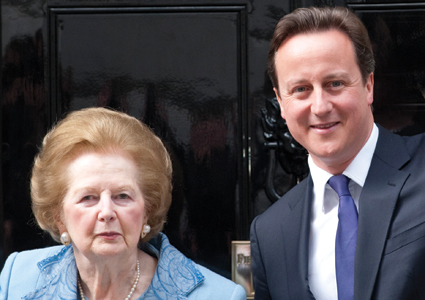
No Iron Man: David Cameron receives Lady Thatcher at 10 Downing Street. Now he must engage with her legacy (PA Images)
David Cameron's party doesn't really love its leader. Talk to a cross-section of his MPs and it is clear that many respect him — admiring his considerable self-confidence, his to-the-manor-born command of the House of Commons and composure in the aftermath of crisis such as this summer's rioting. But for a lot of Tories in parliament and out in the country it appears to go no further than that.
"I feel almost schizophrenic when I see him perform in the House," says a veteran Tory MP. "In one sense it is captivating. He has a very stylish delivery and sounds as though he means it all, the conservative stuff I mean. And then the other part of me thinks no, it's just hot air and in the end he'll never do what needs doing."
Watch him in front of a crowd of big-money Tory donors at one of the party's black-tie fundraisers and you see that the applause is polite but little more than perfunctory. Some guests shift uncomfortably in their seats when they are shown smug films of senior Cameroons mending youth-centre roofs and are told patronisingly in the subsequent after-dinner speeches about the need to build the "Big Society". Even Cameroon true believers, a pretty small band in the first place, suddenly seem rather deflated with how his tenure is going.
Conservatives have had plenty of time to get to know their deeply frustrating leader properly and to come to a rounded judgment on his merits and his weaknesses.
It is easy to forget, thanks to the impression of youthful vigour that the Prime Minister conveys, that he is no longer the new kid on the block. Next month is the sixth anniversary of his famous Blackpool peroration in which he offered to take his party, in the ghastly modern parlance, on "a journey". That sunny message in the autumn of 2005 made front-runner David Davis look out of date. Weeks later Cameron swept to the leadership.
Six years is as long as his hero Macmillan was Tory leader (1957-1963) and almost as long as Major was (kind of) in charge of the Conservative party from 1990 to 1997. If the next election is held in May 2015, as the coalition plans, Cameron will fight it having been leader for almost the same length of time as the disastrous Ted Heath.
The typical pattern of British postwar party leadership suggests that he is already probably around halfway through his allotted time, and perhaps even on a downward trajectory. Cameron himself has indicated that he has no desire to go "on and on", in the phrase of a former party leader. He tells friends that he has seen what staying too long has done to previous prime ministers' sense of equilibrium and consequently is not aiming to be a record-breaker. Indeed, the working assumption internally (certainly the expectation of George Osborne, who hopes to secure the Tory succession) is that Cameron aims to win an election in 2015 and step aside a couple of years later.


- Licence To Chill? Not Yet, Prime Minister
- Money Can't Buy Us Love: Profiting From Loneliness
- More Immigration Means Less Integration
- Is France As Doomed As Houellebecq Thinks?
- Compassion To Refugees, Not Capitulation To Islamic State
- How Mervyn King Got Northern Rock Wrong
- Fix Rotten Boroughs Or Risk Voting Wars
- Migrant Crisis? Europe Hasn't Seen Anything Yet
- Why Palmyra Should Matter To The West
- Corbyn's Rise Makes Cameron Redundant
- No, Jeremy: Politics Is All About Borders Now
- Why 'Lady Chatterley' Still Provokes Us
- For Climate Alarmism, The Poor Pay The Price
- Will Putin's Empire Outlast The Soviets?
- British Witnesses To Lenin's Revolution
- Bibliophiles Beware: Online Prices Are A Lottery
- How Jeremy Corbyn's Coup Hijacked Labour
- Corbyn's Signpost Back To The Ghetto
- Unionists, Don't Despair: Scotland Is Not Lost — Yet
- Britain's Apologists For Child Abuse

12:09 PM
4:09 PM
12:09 PM
10:09 AM
9:09 AM
9:09 AM
9:09 AM
9:09 AM
10:09 PM