


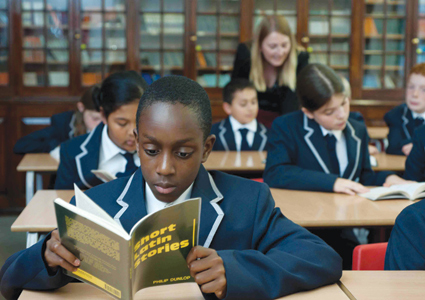
A return to traditional methods: Desks are arranged in rows during Latin lessons at Toby Young's West London Free School
Jane Mitchell was the daughter of a lorry driver. Reflecting on her education during the 1940s, she wrote: "I enjoyed the mental drill and exercise I was put through, even the memorising from our geography book of the principal rivers and promontories of the British Isles . . . It never occurred to me to question the purposes or methods of what we were made to do at school. The stuff was there to be learned, and I enjoyed mopping it up."
Jane went on to become a classics lecturer at Reading University. It is hard to imagine a child of her background taking so academic a career route today. Then again, it is hard to imagine that such a child today would receive the rigorous education she enjoyed.
What has changed between then and now? This question has dominated my thoughts since I became a history teacher at one of Britain's abundant failing state schools. Having been educated in the private sector since the age of seven, I was not ready for the deprivation that confronted me at my new job. However, this was no material deprivation. At around £6,200 a year, average state spending per pupil is not far off the cost of a good private day school. Instead, it was a deprivation of effective teaching methods.
One in five pupils leaves British secondary schools functionally illiterate. It comes as no surprise, therefore, that a 2010 Confederation of British Industry report found 22 per cent of employers who hired school-leavers were obliged to give them remedial training in literacy. How can such a large proportion of our pupils pass through 11 years of state schooling and still not have the basics of literacy? The answer can be found in a pedagogical outlook which renounces rigour, embeds underachievement, and dominates the state sector.
During my teacher training, the university reading list covered the canon of "child-centred" educators. One of the most influential is the Californian academic and self-styled "liberation psychologist" Carl Rogers. In his 1969 work Freedom to Learn he proclaimed, "Traditional teaching is an almost completely futile, wasteful, over-rated function in today's changing world," adding, "no one should ever be trying to learn something for which one sees no relevance."


- Migrant Crisis? Europe Hasn't Seen Anything Yet
- Why Palmyra Should Matter To The West
- Corbyn's Rise Makes Cameron Redundant
- No, Jeremy: Politics Is All About Borders Now
- Why 'Lady Chatterley' Still Provokes Us
- For Climate Alarmism, The Poor Pay The Price
- Will Putin's Empire Outlast The Soviets?
- British Witnesses To Lenin's Revolution
- Bibliophiles Beware: Online Prices Are A Lottery
- How Jeremy Corbyn's Coup Hijacked Labour
- Corbyn's Signpost Back To The Ghetto
- Unionists, Don't Despair: Scotland Is Not Lost — Yet
- Britain's Apologists For Child Abuse
- Lift The Fee Cap And Set Universities Free
- The Story Behind One Dead Man's Penny
- Hitler's 'Ecological Panic' Didn't Cause The Holocaust
- Meet The Montalvos: The First Global Family
- Mr Gove, Here Is Our Statute of Liberty
- A British Bill Of Rights
- Something For Nothing Just Won't Do Any More

9:03 PM
1:05 PM
5:07 AM
12:07 PM
10:06 AM
9:06 PM
7:06 AM
9:06 PM
3:06 PM
3:06 PM