



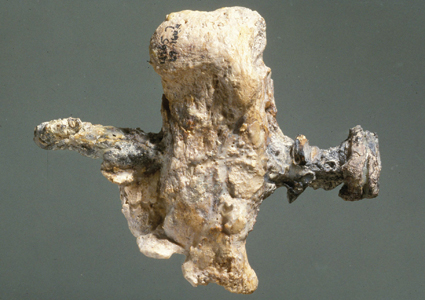
 Yohanan's foot: his bones were discovered in Jerusalem in 1968
The idea of crucifixion, for many people linked to the story of Jesus, is in general associated with Rome's infliction of "the most cruel and abominable form of execution" (Cicero) on foreigners and slaves. Jesus of Nazareth, condemned by Pontius Pilate, governor of Judaea (26-36 CE), is unquestionably the most famous victim of this brutal death penalty to die on the cross. It would occur to few, if any, outside the select company of specialists to inquire whether the cross might have had a role in the Jewish legal system towards the end of the pre-Christian era.
It is hardly necessary to point out that in the contemporary Western world the idea of the death penalty is generally abhorred. Many see it as judicial murder. Disapproval of capital punishment is quietly backed by the United Nations' call for a moratorium on executions in the countries where it is still on the statute book, and the European Union has outlawed it. However, this 21st-century outlook stands in stark contrast with the worldview expressed in biblical and late antique Judaism, whose religious and social ethics were inherited by nascent Christianity.
The legal systems of Jewish antiquity were developed in two periods: the biblical era, reflected in the books of the Hebrew Scripture (c. 1000-500 BCE), and the age of the Rabbis, based on the earliest code, the Mishnah, and further developed in the Talmud (c. 200-500 CE). The intervening epoch, known also as the Second Temple period, represented by the Apocrypha, the Pseudepigrapha or pseudonymous extra-biblical writings, the Dead Sea Scrolls and the monumental literary output of Flavius Josephus (37-c. 100 CE), takes us down to the end of the first century of the Common Era. The question of crucifixion, as part of Jewish penal law, arose during those centuries and left copious marks not only in Josephus, but also in the Targums, the Aramaic paraphrases of the Hebrew Scriptures, which although reaching their finally redacted form between the third and seventh centuries CE, preserve much earlier, at times pre-Christian, traditions.
The Hebrew Bible, the Old Testament of the Christians, does not provide a systematic presentation of criminal law and the relevant passages must be collected from various places in four books of the Pentateuch: Exodus, Leviticus, Numbers and Deuteronomy. Dispersed in them figure no fewer than eight types of offence punishable by death.


- Why Only Countries Willing To Take Risks Will Survive And Prosper
- From The Berlin Wall To Brexit: Why Politics Needs A Free Press
- Saying Yes To Sara
- The Viagra Triangle
- Two Languages And The Chasm Between Them
- Western Civilisation In Crisis
- The Man On Whom Everything Was Lost
- The Long Shadow Of Malthus
- Beyond Obama: Advice To The Next President
- Salerno Diary
- Saved From The Bonfire: The Tom Wolfe Papers
- Liberty And Sovereignty
- Art And Public Culture In The 1830s And Today
- The Casanova Of LaSalle Street
- The Writer
- New Poetry
- Cartagena Poems
- A British Subject
- Travels with Betjeman
- Kizerman and Feigenbaum

- Empty Seats At The Met
- Labour's Antisemitism Problem
- Why Only Countries Willing To Take Risks Will Survive And Prosper
- The Cowardice Of John Le Carré
- A Fascist Coup In Poland? Give Us Poles A Break
- Did Burke Betray The Cause Of Liberty?
- Culture And Politics In The Age Of Trumpery
- Two Languages And The Chasm Between Them
12:04 PM
1:04 AM
2:04 PM