


Two conflicting forces have been at work in the British debate over the EU in the last 25 years, opening up a large space between what people wanted and what their government meant to deliver. But politics, like nature, abhors a vacuum. The rise of the UK Independence Party has started to fill the empty space, creating an extraordinarily uncertain and fascinating backdrop to the 2014 European elections and the 2015 general election. The eventual result may well be that Britain leaves the European Union, but the process of withdrawal could be complex and messy, and its outcome ambiguous and incomplete. UKIP has been in existence for 20 years, but in some respects its work has only just begun.
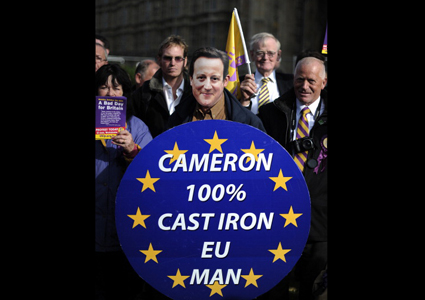 Out of touch: UKIP supporters demonstrate against Tory Europhilia
The first of the two conflicting forces stemmed from the Single European Act of 1986 and later treaties that transferred "competences" from the nation states of Europe to EU institutions, above all to the European Commission in Brussels. This led to an anomalous situation in which every nation had two governments, one in its capital city and the other in Brussels, and the two governments vied with each other for power. As the nation states were unwilling to hand over the powers to tax and spend, the Brussels agenda was to grow the EU's constitutional remit by introducing ever more rules and regulations. These were incorporated in the purportedly irreversible acquis communautaire. Meanwhile, European courts passed judgments that widened their own jurisdiction, obviously at the expense of the national legal systems.
The expansion of the acquis imposed extra burdens on finance and industry, and seriously undermined the efficiency of Europe's economies, including Britain's. Virtually every business faced additional costs that had no clear benefit to anyone, while many small businesses ceased to be viable because of one or another EU regulation. The EU's popularity declined as its regulations proliferated. Opinion polls showed a steady erosion of public support for "the European construction", so that by, say, 2005 and certainly by 2010 more people in the UK were against the EU than were for it. Resentment towards European integration was exacerbated by frankly silly verdicts from the European Court of Human Rights which, under the treaties, had to be accepted by Her Majesty's Government.
The second of the two conflicting forces was that a majority of the British political elite became more comfortable with the European construction, and more eager to work within the EU framework. For them the transfer of competences was welcome and to be promoted. Close assimilation with the EU was most obvious within the Civil Service, as the UK and EU bureaucracies worked together on the drafting of new directives and regulations. These European "laws" were endorsed in the EU Council of Ministers and, over ever more areas of national life, our own Parliament could do nothing but rubber-stamp the Council's decisions. It might have been expected that Britain's parliamentarians would early have recognised the enormity of the constitutional hijack that was under way. Such figures as Enoch Powell and Margaret Thatcher did articulate great concern. However, the Conservative Party, the party that might have been expected to defend Britain's traditions and institutions, actively participated in the hijack, and marginalised the efforts of Powell, Thatcher and numerous others to halt or reverse it.


- We Need Churchill's Vison of Liberty More Than Ever
- The Play's The Thing, So Leave The Words Alone
- An Aesthetic and Moral Disaster
- How we Syrians destroyed our home — with your help
- Euphoric Labour won’t win power led by a pied piper
- Don’t be ‘difficult’ — try ‘formidable’, Mrs May
- Enough is enough of terror — but also of our self-doubt
- Iraq’s Christians pray for help that never comes
- The Atlantic alliance may be broken beyond repair
- Catholic tastes: both English and European
- Brexit as myth: Exodus, Reckoning, or Sacrifice?
- A Decent Woman Betrayed By Her Gruesome Twosome
- Can Macron Save France — Or Is He Its Undertaker?
- Europe's Revival Is At Hand, Thanks To Brexit
- Is This The Most Important British General Election Since 1979?
- The New Europe Must Be About More Than Money
- Our Best Brexit Policy Is All-Out Free Trade
- The Bursting Of Our 'Kabubble' Fantasies
- Gambling On A Greater More Gracious Britain
- Xi Versus Trump: The Emperor And The Tycoon

- Opposites meet in the land of Scrugletopia
- The Battle Against The Philistines Never Ceases
- Home from home for the Bolshevik elite
- Can Macron Save France — Or Is He Its Undertaker?
- Why France Is Revolting Against The Ancien Regime
- How The EU Elite Paved The Way For Populism
- A Decent Woman Betrayed By Her Gruesome Twosome
- Last Of The Great Elitists
1:06 PM
8:06 AM
7:06 AM
9:06 PM
10:06 AM
11:06 AM