



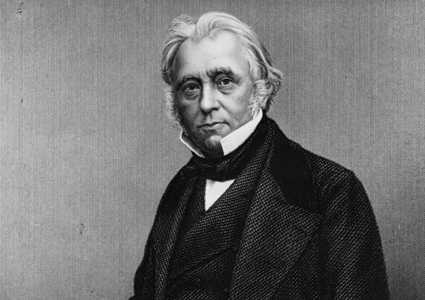
 Thomas Babington Macaulay: Victorian apostle of high culture
Are we living through the end of history? Not in the Hegelian sense that Francis Fukuyama used the phrase in the immediate aftermath of the Cold War, meaning that with the triumph of liberal democracy, world history had reached its ultimate goal. As subsequent events have shown, this was a case of wishful thinking by a political scientist, not a historian.
No, I mean the end of history as the central pillar of high culture and national identity. History in this sense is not the same as historiography or historical scholarship, of which there is more than ever before. Nor is it the same as the popularisation of history, history as pure entertainment, which is also flourishing. What has become problematic is the assumption that general historical knowledge, an informed consciousness of our past, is the essential framework for Western civilisation. It is the decline of history in this sense that lies behind the heated debates about the teaching of history at school and university. The loss of such a temporal dimension has brought about a profound change in the outlook of the West: a loss of organic connection, not only with those who came before us, but with our place in the world. Clive James memorably described this phenomenon as "cultural amnesia", and Eric Voegelin adopted the theological concept of "anamnesis" to describe our attempts to preserve transcendent memories. Yet such remembrances of time past, whether they express rage against the dying of the light of history as a force in intellectual life, or acquiescence in its oblivion, are at best rearguard actions.
That an educated person could lack such historical awareness would not have occurred to the 19thcentury apostles of high culture, the Mills and Arnolds, père et fils, or the brothers Humboldt and James. The 18thcentury philosophes had tried to create a "philosophical" or "conjectural" history of mankind, as Anthony Pagden writes in his encyclopaedic new book The Enlightenment (OUP, £20). "The purpose of these histories was . . . not only descriptive — it was emancipatory. In providing a proper scientific understanding of the origin and evolution of the human condition, they would, it was hoped, release man from his servitude to . . . prejudice." In the 19th century, however, this emancipatory impetus was allied to the romantic cult of genius, which gave weight to what Max Weber would later call "charisma". History was the story of liberty, but also of the liberator. To be human was to be an actor on the stage of history; the human sciences were those governed by the historical method. To have a place in the history books was not only the definition of fame, but the very purpose and meaning of life.
Among the most remarkable and influential of these Victorian polymaths was Thomas Babington Macaulay. He was among the greatest essayists, poets, orators and historians of an age that excelled in all these accomplishments. Yet it is not for any of these that he most deserves to be celebrated today, according to his latest biographer, Zareer Masani. In his splendid and original Macaulay: Britain's Liberal Imperialist (Bodley Head, £20), Masani evokes a recent birthday party in Delhi for the eminent Victorian, given by the intellectuals of the Dalit community and their liberal supporters. The Dalits, the modern name for pariahs, were (and in some places still are) treated as untouchable by the higher castes. They revere Macaulay as the man who gave India the English language, British education, freedom of the press and the rule of law. English, the world's lingua franca, has enabled India's untouchables to connect with the world. It was Macaulay's famous Education Minute of 1835 that set out to create "a class who may be interpreters between us and the millions whom we govern; a class of persons, Indian in blood and colour, but English in taste, in opinions, in morals, and in intellect." This Anglophone administrative and commercial class became known as "Macaulay's children". Macaulay's Minute, in Masani's enthusiastic words, "outlined an imperial mission more ambitious and global than any since ancient Rome".


- Can Macron Save France — Or Is He Its Undertaker?
- Europe's Revival Is At Hand, Thanks To Brexit
- Is This The Most Important British General Election Since 1979?
- The New Europe Must Be About More Than Money
- Our Best Brexit Policy Is All-Out Free Trade
- The Bursting Of Our 'Kabubble' Fantasies
- Gambling On A Greater More Gracious Britain
- Xi Versus Trump: The Emperor And The Tycoon
- Can Trump Square The Circle On Fiscal Reform?
- Donald Trump And The Dividing Of America
- Theresa May Emerges From Thatcher's Shadow
- Not Tweets And Anger But Redoubled Vigilance
- Why France Is Revolting Against The Ancien Regime
- How The EU Elite Paved The Way For Populism
- Trump's America: The End Of Exceptionalism
- The Kaliningrad Contingency
- Mrs May Is Too Canny To Say Farewell To Arms
- To Understand Trump, Read Huxley — Not Orwell
- A Letter To Our Great-Grandchildren
- Trump Is No Loser, But Government Will Be Harder

- Time To Revisit The Two Cultures
- The Battle Against The Philistines Never Ceases
- Who Will Do Justice To Our Judiciary?
- How The EU Elite Paved The Way For Populism
- Trump's Appeal Is More Roosevelt Than Reagan
- Anything Dennett Can Do, Scruton Does Meta
- Why France Is Revolting Against The Ancien Regime
- A Letter To Our Great-Grandchildren
12:08 PM
12:08 AM
1:07 PM
1:07 PM
11:07 AM
11:07 PM
1:07 PM
1:07 PM
3:07 PM
8:06 AM