



Why can't we have a new hall like Paris? If you want to know what divides England and France, it's not a language or a strip of water. It's an attitude to building for the arts.
When a concert hall or opera house starts crumbling in London, officials give a sigh and sign a massive cheque for a modest makeover. In Paris, they go "pouff!" and call in the top architects to produce a new landmark. It costs much the same in the end. (Are you reading me, Boris?)
Here's how it works. London's South Bank Centre-a horrible clutter of three concert halls and an unneeded art gallery-has been the bane of my working life. I won't bore you for long with its shortcomings. Designed in postwar austerity materials as a Royal Festival Hall and augmented with 1960s concrete afterthoughts, it fails every test, acoustic and aesthetic. No part of it is fully fit for purpose. Music lovers have long prayed for its demolition. Artists complain of its frigidity. Burglars have walked off-twice-with its grand piano. It is Britain's biggest guzzler of public arts subsidy.
When it started falling to pieces in the 1990s, officials made the following excuses for not tearing it down and starting again: (1) listed buildings of architectural merit; (2) huge cost; (3) what if that ghastly Zaha Hadid got the job? So they okayed a refit that ran up a £120 million bill and made the Royal Festival Hall a tiny bit cleaner and tidier. Pound for pound, it was the biggest waste of public money for least public gain since the long-grounded Anglo-French Concorde. Around the same time, the same officials blew £214 million on redoing the Royal Opera House while Glyndebourne knocked down its old country shed and built a glorious, eco-friendly, privately funded opera house for a mere £35 million.
You see, that's the Whitehall way, and Whitehall never learns. This month, plans are going in for a second refit of the South Bank: a £120 million makeover of the Queen Elizabeth Hall, Purcell Room and Hayward Gallery, starting next year. Come 2017, trust me, it will look little better than before. A site that ought to display the very best of British creativity blazons instead the crabby limits of public administration. It's enough to make me do a reverse-Depardieu and emigrate to France.
They do things differently, over there. Seven years ago, the city of Paris took a look at the Salle Pleyel, an 80-year-old hall in the heart of the bourgeois eighth arondissement, and decided it was no longer fit for social purpose. Despite a 2002 restoration that retuned the acoustics and renovated the piano-shaped interior, the hall, it was decided, was in the wrong location to reach a young, multicultural population.
By two strokes of a pen, the mayor and the minister of culture resolved to build a new hall, the Philharmonie de Paris, a 40-minute traffic jam away-in the Parc de la Villette, a former abattoir located beside the peripheral motorway, near the end of the pink Metro line. The site already housed a science museum and the Boulez-inspired Cité de la Musique. A new concert hall would give it broader cultural credence.
An international competition was held to create an orchestra hall with a social conscience, delivering world-class performance to a shifting demographic. Ms Hadid made the shortlist, as usual; the winner was a French architect, Jean Nouvel, who had created the state-of-the-art floating concert hall in Lucerne, as well as the spaceship Louvre extension in Abu Dhabi. I was curious to see how it might turn out.
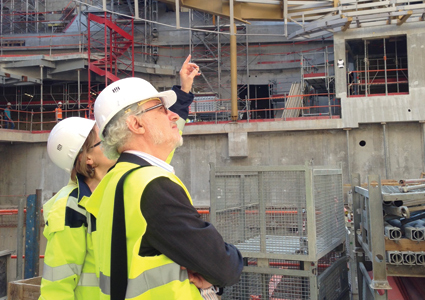
When I was taken on a hard-hat tour by Bruno Hamard, general director of the Orchestre de Paris, my heart sank with each clump of industrial boots on concrete foundations. M. Nouvel is a man of vision. His concept takes the archaic concert hall out of its enclosed, forbidding, elitist past and integrates it with the bustle of modern life.
The Parc and its play spaces run beneath the building, and above it, enfolding the severity of art in a ring of recreation. The roof, a gentle slope, can be ascended as a public walkway, delivering spectacular views over the city and a skateboard ride for the kids. Homeward drivers on the motorway see concert announcements flashed up on the exterior walls, like lane closures.
Inside, rehearsal rooms are flooded with greenery and light. The concert space is surprisingly compact-surely uneconomic, I protested. Not at all, replies M. Hamard. It has 2,400 seats, hundreds more than the Salle Pleyel. The reason it feels small is that Nouvel stipulated a maximum 35-metre distance from top row to stage, an intimacy rare to orchestral concerts. The front rows can be removed to enlarge the stage space for mega-symphonies. The sound design is by Yasuhisa Toyota, the acoustician behind the impeccable sound of Los Angeles's Walt Disney Hall.
The new Philharmonie is a statement hall — a building which shouts from every angle, over and again, that Paris believes in its public and will take risks to please it, as London seldom does. The hall howls out our deficiencies. It is tantamount to the Mayor of London ordering the demolition of Brent Cross shopping mall and replacing it with a temple of music to serve the slumbrous north-west suburbs. Fantasy time.
And the cost? The Philharmonie was budgeted at €200 million — not much more than a South Bank refit — and is running some way over at €387 million. No one blinks an eye at the overrun. Successive presidents and mayors have gone on record to endorse the project with every semblance of faith and enthusiasm.
There you have it. English politicians are afraid and ashamed of providing for the arts — afraid of philistine MPs, media and voters and ashamed of their own ignorance and timidity. The French are proud of their patrimony and willing to invest in a vaguely imagined future. Half-English, half-French, I am torn internally between prudence and vision, always knowing which quality I much prefer. London needs a decent concert hall. Dammit, Boris, why can't we have one like Paris?


1:07 PM
11:07 AM
12:06 PM