



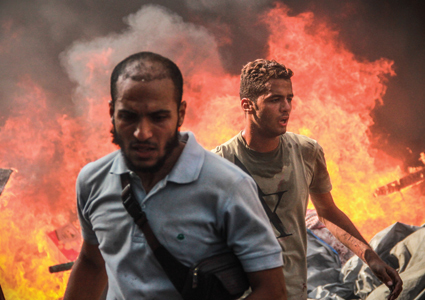
 Egypt in flames: Muslim Brotherhood supporters clashed with security forces after their protest camp was forcibly removed (Credit: Mosa'ab Elshamy)
There was really no Arab Spring. There was certainly the bursting forth of a pent-up desire amongst the poor for a place at the table. There were protests, even self-immolation, against police brutality attempting to keep the poor out of any productive economic activity. Then there was the jeans-clad and laptop-toting brigade of westernised youngsters who created an electronic revolution which the world's media mistook for a real one.
If there was a real "revolution", the revolutionaries were the well-organised, thoroughly trained and sometimes armed cadres of Islamist movements raging from the "moderates" of the Ikhwan Al-Muslimun (or Muslim Brotherhood), the Salafis and overt or covert affiliates of al-Qaeda. Surveying the scene, I was irresistibly and repeatedly reminded of Tehran in 1979. At that time also, republicans, secular groups, even Communists, as well as moderate Islamists teamed up with those who wished Iran to be a theocracy. The single thing they had in common was a desire to oust the Shah. In this aim, they were, of course, wholly successful; but as soon as the Shah had been removed, the radicals got rid of their erstwhile allies.
This raises one of the crucial and recurring questions about Islamism and democracy: is it sufficient to win power at the ballot box if this is only a means of replacing the totalitarianism of nationalist despots with that of Islamist radicalism? How can a plural democracy be introduced in such circumstances? What safeguards and checks and balances need to be put in place to ensure the emergence and flourishing of such a democracy?
The dictators had provided a limited amount of personal and religious freedom in return for strict restrictions on political freedom. That was the bargain. You could have stability and an economy that functioned, more or less, in place of political participation and the prospect of change. These arrangements have broken down irretrievably and the question is what is to take their place.
There may not have been an Arab Spring but this has certainly been a long hot summer: whether with the increasing influence of Salafis in Tunisia, the continuing atrocities on every side in the Syrian civil war or in the dramatic events in Egypt.


- A Recipe For Disaster
- Culture And Politics In The Age Of Trumpery
- Will Labour Listen To Its Eurosceptic Voters?
- Would Brexit Play Into Putin's Hands?
- Why Brexit Could Be A Blessing For Europe
- Will The Pollsters Get It Right On The Referendum?
- The Great Illusion: Why We Are Still Europe’s Fall Guys
- Make June 23 Britain’s Independence Day
- Don't Pit Generations Against Each Other
- Let Justice Be Done Though The Liberal Heavens Fall
- A Fascist Coup In Poland? Give Us Poles A Break
- It's Sharia, Not Alcohol, That Threatens Women
- Double Games Of The UK Muslim Brotherhood
- The Land Where History Repeats Itself As Tragedy
- Holocaust Survivors Are Still Waiting For Justice
- Rhodes, Race, And The Abuse Of History
- Shame On The Liberals Who Rationalise Terror
- France, Islam, And The Second Class Sex
- Isis Is Not Invincible — If The West Has The Will
- After Paris, Who Will Speak For France?

- Shame On The Liberals Who Rationalise Terror
- The Cowardice Of John Le Carré
- Beyond Obama: Advice To The Next President
- The Establishment Is In Denial — Yet Again
- Is There A Right Way To Write?
- Did Burke Betray The Cause Of Liberty?
- Double Games Of The UK Muslim Brotherhood
- Two Languages And The Chasm Between Them
10:10 PM