



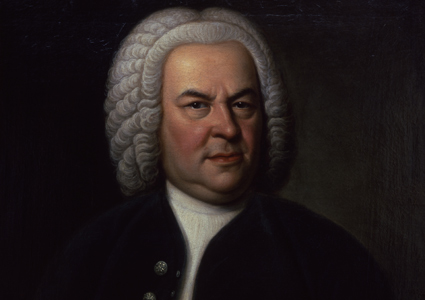
 Bach from birth: This 1748 portrait of Bach by Haussmann was stored in Gardiner's childhood home during the Second World War (Credit: Courtesy of William H. Scheide, Princeton, New Jersey)
There are lots of Bachs, but only one Sebastian — and Gardiner is his prophet. It is hard to believe that Sir John Eliot Gardiner is only just 70. He has been performing Bach for as long as I can remember — longer, actually, because he founded the Monteverdi Choir and Orchestra (later renamed the English Baroque Soloists) already as a budding conductor in the 1960s, before the rediscovery of period instruments and performances. He later extended the pursuit of authenticity from baroque to classical and romantic music by founding the Orchestre Revolutionnaire et Romantique. As a teenager in the 1970s I heard Gardiner conduct with tremendous energy at the Proms — dashingly attired, I recall, in a white dinner jacket of which my grandmother did not approve. He was still just as energetic last month, when he conducted the Easter and Ascension Oratorios with the same force in an unforgettable late-night Prom. Forty years on, his Bach-playing has matured into something miraculous: at once spontaneous, virtuosic and as authentic as humanly possible, at least in the present state of our knowledge.
Surprisingly, given an academic distinction which ranges far beyond music, Gardiner has waited until now to write a book — but it was worth waiting for, being the summa of a lifetime's theory and practice in the interpretation of Bach. Music in the Castle of Heaven (Allen Lane, £30) is not a biography — that job has already been done for our time by Christoph Wolff in Johann Sebastian Bach: The Learned Musician-but a more personal "portrait". There is a difference, after all, between the Bach of a musicologist and the Bach of a musician. Gardiner explains that his aim is "to give the reader a real sense of what the act of music-making would have been like for Bach". In this book, Gardiner devotes a lifetime's artistic experience to submerge us in Bach's magical sound world.
In Gardiner's youth and my boyhood, the image of Bach was still overshadowed, at least at my grammar school, by his best-known biographer and performer, Albert Schweitzer. The Alsatian medical missionary, theologian and organist had died in 1965 at the height of his fame, celebrated for the African field hospital that earned him the Nobel Peace Prize, the Order of Merit and a reputation for holiness that did not outlive him for long. By 1970 Schweitzer was already being satirised as a character in the Good versus Evil cricket match sketch by Peter Cook and Dudley Moore, pounding away on the organ in the bushes. If anything, their satire was too gentle. The doctor's unashamedly racist attitude to his African patients would not pass muster today, any more than his volumes on the "historical" Jesus or those on Bach, whom he saw in mystical terms and whose works he used to play for the edification of Wagner's widow Cosima and her anti-Semitic acolytes. Even Schweitzer's edition of the organ works has long been superseded.


- Time To Revisit The Two Cultures
- The Battle Against The Philistines Never Ceases
- Who Will Do Justice To Our Judiciary?
- How The EU Elite Paved The Way For Populism
- Trump's Appeal Is More Roosevelt Than Reagan
- Anything Dennett Can Do, Scruton Does Meta
- Why France Is Revolting Against The Ancien Regime
- A Letter To Our Great-Grandchildren
5:07 PM
3:09 AM