


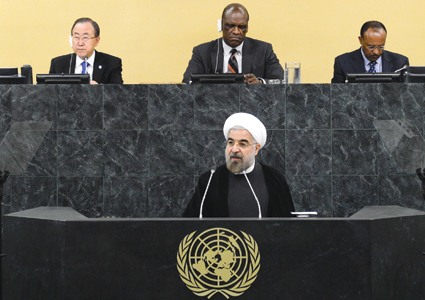
 His charm could be offensive: The Iranian President Hassan Rouhani speaking at the UN in September. Should we believe him?
While waiting to hear Iranian President Hassan Rouhani's much anticipated UN speech in September, I read a brilliant essay, "Islamists Assemble", by Michael Weiss on the news website Now Lebanon. His subject was the splintering of Syria's fractious opposition and the coming internecine battle between Bashar al-Assad's enemies, amid fading hopes that President Obama's promise of red lines and hints that "Assad must go" meant anything much.
Much has been made of the fractious nature of the Syrian rebels — the bewildering number of names and groups fighting on different fronts; the atrocities some of them have committed; the reported acts of ethnic cleansing; the public beheading of pro-regime fighters and soldiers. Weiss drew a vivid picture of the galaxy of Islamist groups vying for supremacy as they fight the regime, fight Christians, Kurds and Alawites, and fight among themselves.
Suddenly, I was reminded of Camillo Berneri, a youthful obsession of my university days. Berneri was an Italian anarchist and intellectual who lived a tumultuous life in the interwar period and mixed with the leading Italian anti-Fascist thinkers of his generation-Piero Gobetti, the Rosselli brothers and Ernesto Rossi.
His writing style was terse and clear. His knowledge was encyclopaedic. He had studied with Gaetano Salvemini, the great Italian historian who eventually migrated to the United States to escape fascism and taught at Harvard.
Berneri lived in exile, mostly in Paris, though he was periodically arrested and expelled for agitating and plotting with other anarchists. He was an undesirable, yet a towering figure among exiled intellectuals and anti-fascist activists. And like so many of his generation, he was gripped by the ideological fervour — and fractiousness — of socialism and its many splinters.
What Berneri had to do with Syria becomes evident when one looks at his untimely death. Like so many other young European leftists of his time, Berneri rallied to the cause of Republican Spain in the aftermath of General Franco's uprising against the Popular Front government. And like many of his comrades, he was felled by the bullets of an opponent from his own ideological galaxy. Berneri died in Barcelona, in 1937, shot by the local Stalinist police, not killed by the fascists. Others would meet a similar fate.


- Trump Is No Loser, But Government Will Be Harder
- Trump's Appeal Is More Roosevelt Than Reagan
- The Trump Presidency: A Worst-Case Scenario
- We Cannot Take Liberal Democracy For Granted
- No Need To Fear Russia. The Bear Is Broke
- Who Will Do Justice To Our Judiciary?
- Trust Westminster On Brexit: It's All We've Got
- Back to the "Future Of Socialism", Mr Corbyn?
- Would The Little Lady Like A Wee Dram?
- The Coalition We Need To Defeat Islamism
- Are We Losing The War On Home-Grown Terror?
- Cameron Gave Libyans A Chance. Pity They Blew It
- Brexit Will Give Global Free Trade A Boost
- The Real EU Referendum Winner May Surprise You
- Is Theresa May The True Heir To Mrs Thatcher?
- Race To The White House Through The Looking-Glass
- Brexit Gives Us A Historic Opportunity
- American Conservatives Must Stand Up To Trump
- Cicero's Analysis Of Decline Offers Lessons For The West
- Deepdene: Rise and Fall of the House of Hope

- Why On Earth Should Anyone Study Philosophy?
- The Dying Days Of Zuma's South Africa
- His Master's Voice: Scruton On Wagner
- Political Misconduct
- Why The Most Civilised Of Men Felt Like A Fraud
- Cicero's Analysis Of Decline Offers Lessons For The West
- Andalusia Was No Golden Age
- Trump's Appeal Is More Roosevelt Than Reagan
2:11 PM
12:11 PM
9:11 PM