


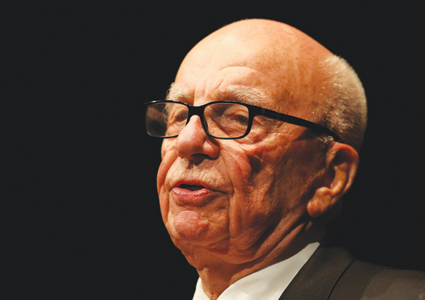
 Disrupter disrupted: BSkyB, formed by Rupert Murdoch in 1990, has overtaken the BBC in revenue but is threatened by BT
Time and technology wait for no organisation, no matter how revered. The next two years will see a lively debate over the future of the British Broadcasting Corporation, with the current Royal Charter due to run out at the end of 2016. The early talk is of an extension of the licence fee for a further decade to 2026, but of possible reductions in its value and certainly of freezing it in real terms. According to an ICM poll in the Sunday Telegraph last month, 70 per cent of voters believe that the licence fee should be abolished or cut.
A huge and very public intellectual brawl seems certain. Already a former BBC director-general, Greg Dyke, has quarrelled openly with Grant Shapps, the Conservative Party chairman, over Shapps's suggestion that after 2016 licence fee money ought not to given exclusively to the BBC. The debate so far has tended to take for granted both the survival of the licence fee in some form and the Beeb's status as a nationalised organisation. But can a case be made that the licence fee is now obsolete as well as unpopular? And what would the ending of the licence fee mean for the structure of British broadcasting? With the licence fee scrapped, should the BBC remain in public ownership? Or should the BBC be privatised, so that it can compete on a level playing field with the global media giants that are now emerging?
A potted history of the licence fee and its place in British broadcasting is needed to answer these questions. In the early days of television in the 1940s technology imposed tight constraints. The transmission of programmes "over the air" from land-based masts and towers was limited by a shortage of spectrum. Only one channel was readily feasible. Further, if programmes were broadcast "free to air" from the masts, any household with a TV set could watch. Pay per view and subscription for a particular channel were impossible. Although payment could have been by advertising, the postwar Attlee government was unenthusiastic about capitalism, consumerism and marketing jingles. The introduction of the BBC licence fee in 1946 was almost inevitable, given the contemporary political and technological context. Paul Samuelson, the Nobel-prize-winning American economist, advanced the concept of "public goods" in his classic 1954 paper "The Pure Theory of Public Expenditure", demonstrating that such goods had to be financed by taxation and could not be left to the free market. The hostility to advertising meant that broadcasting was the textbook paradigm of a "public good".
Still benefiting from the halo conferred by its wartime role, the BBC was by far the most influential broadcasting service in the world. Further, with the UK accounting for almost 10 per cent of world output in the late 1940s, its state-owned monopoly was a vast broadcasting business by international standards. The BBC may not have been part of the British constitution, but it was undoubtedly a "national champion". However, its special status was already being undermined. Spectrum scarcity — the original rationale for monopoly — was being overcome. In 1954 the Conservative government under Winston Churchill passed the Television Act, so that independent broadcasting financed by advertising could compete with the BBC. For the next 20 years British broadcasting was a highly regulated duopoly of Auntie Beeb and the profit-hungry (and indeed very profitable) "independent" television companies.
Advertising is sometimes demonised by left-wing commentators as capitalism without taste or shame, and as free enterprise at its selfish worst. As long as advertising was the only alternative means to finance broadcasting, the licence fee was safe. But by the 1980s satellites with programme transmitting capability could be launched into space, promising a new world of satellite-based broadcasting. At first two businesses were envisaged, Sky Television and British Satellite Broadcasting, but they merged in 1990 to form BSkyB. The plan of the entrepreneurs behind BSkyB, notably Rupert Murdoch, was that viewers would pay for TV channels by subscription, usually on a monthly basis.


- We Need Churchill's Vison of Liberty More Than Ever
- The Play's The Thing, So Leave The Words Alone
- An Aesthetic and Moral Disaster
- How we Syrians destroyed our home — with your help
- Euphoric Labour won’t win power led by a pied piper
- Don’t be ‘difficult’ — try ‘formidable’, Mrs May
- Enough is enough of terror — but also of our self-doubt
- Iraq’s Christians pray for help that never comes
- The Atlantic alliance may be broken beyond repair
- Catholic tastes: both English and European
- Brexit as myth: Exodus, Reckoning, or Sacrifice?
- A Decent Woman Betrayed By Her Gruesome Twosome
- Can Macron Save France — Or Is He Its Undertaker?
- Europe's Revival Is At Hand, Thanks To Brexit
- Is This The Most Important British General Election Since 1979?
- The New Europe Must Be About More Than Money
- Our Best Brexit Policy Is All-Out Free Trade
- The Bursting Of Our 'Kabubble' Fantasies
- Gambling On A Greater More Gracious Britain
- Xi Versus Trump: The Emperor And The Tycoon

- Opposites meet in the land of Scrugletopia
- The Battle Against The Philistines Never Ceases
- Home from home for the Bolshevik elite
- Can Macron Save France — Or Is He Its Undertaker?
- Why France Is Revolting Against The Ancien Regime
- How The EU Elite Paved The Way For Populism
- A Decent Woman Betrayed By Her Gruesome Twosome
- Last Of The Great Elitists
3:01 PM
6:01 PM
6:12 PM
5:12 PM
12:11 PM
8:11 PM