


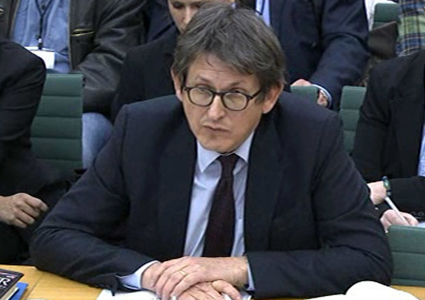
 I'm no threat: Guardian editor Alan Rusbridger appears before the Home Affairs Select Committee
I could recite from memory a scene from A Man for All Seasons for years after I saw Robert Bolt's play. An ardent young man called William Roper is telling Thomas More that he must arrest a spy working for his enemies at Henry VIII's court. More refuses, even though he knows Roper is right. He is the Lord Chancellor of England. He has sworn to uphold the law, and the spy has committed no crime. "So now you'd give the Devil benefit of law!" cries the exasperated Roper.
The idea of freedom of speech is in a dangerously enfeebled condition in Britain. Hardly anyone understands why no editor has agreed to comply with the state's attempt to regulate the press — a measure which takes us back, if not to the court of Henry VIII, then at least to the Stuarts and Presbyterians John Milton fought. "But the BBC is regulated," people lecture me in a voice of irritated incomprehension. "It is not in the government pocket, or a propagandistic state broadcaster. On the contrary, it is impartial and far less propagandistic than half the newspapers and websites you are perversely seeking to defend."More: Yes. What would you do? Cut a great road through the law to get after the Devil?
Roper: I'd cut down every law in England to do that!
More: Oh? And when the last law was down, and the Devil turned round on you — where would you hide, Roper, the laws all being flat? This country's planted thick with laws from coast to coast-man's laws, not God's — and if you cut them down — and you're just the man to do it-d'you really think you could stand upright in the winds that would blow then?
I try to tell them that the BBC keeps its independence because a forest of free institutions surrounds it. Allow the state to fell the trees and a cold wind will blow through the corporation. No one should doubt that the state is now sharpening its axe and running its finger along the blade. The celebrities and media studies academics at Hacked Off have pushed the politicians into illiberalism — not, I should add, that our leaders required much of a shove.
Mark Damazer, the former Controller of Radio 4, gave me a wonderful comparison to explain the extremism of our times. Hacked Off became like the Ulster Unionists, he said. It could not accept that it had won.
Just so. By the end of the Leveson Inquiry, Hacked Off could have had 90 per cent of what it wanted, which in politics or any other form of human endeavour is more than anyone can reasonably expect.


- Shame On The Liberals Who Rationalise Terror
- The Cowardice Of John Le Carré
- Beyond Obama: Advice To The Next President
- The Establishment Is In Denial — Yet Again
- Is There A Right Way To Write?
- Did Burke Betray The Cause Of Liberty?
- Double Games Of The UK Muslim Brotherhood
- Two Languages And The Chasm Between Them
5:01 PM
9:12 PM