


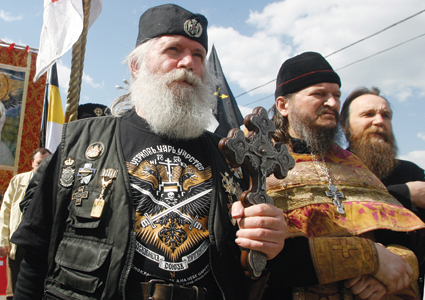
 Go east: Aleksandr Dugin, the leading Eurasion advocate (right), at a 2008 Russian nationalist rally in Moscow in support of Serbia. (credit: Mikhail Metzel/AP/Press Association Images)
"An elite without an ideology is a threat." This is the central point in an article by Aleksei Podberezkin in the first issue of 2014 of the Moscow weekly Zavtra. This is the organ of the Russian far-Right, Podberezkin being a leading figure in these circles. He is a strong believer in Russian nationalism and therefore critical of the present state of affairs in Russia in which politicians are preoccupied with "technical" issues such as macroeconomics, but he also wants to preserve much of Soviet Communism. As a politician he was not very successful: competing in the elections for the presidency of Russia he scored 0.1 per cent of the vote. But he still is a respected figure in these circles as a political thinker. Whether the absence of an ideology is really a threat is not at all clear; Russia has suffered from many disasters in its history but they were more often caused by a surfeit of ideology rather than the absence.
But it is certainly true that the recent period in Russian history has been marked by the absence of an ideology (or doctrine or strategy) comparable to the past. This has been noted by many authoritative interpreters of the Russian political scene irrespective of their political orientation. To give but one example, Dmitri Trenin, head of the Carnegie Moscow Centre, wrote ten years ago that in Russia at present ideas hardly mattered and interests reigned supreme. The world view of Russian elites centred on financial interests.
Pan-Mongolism — the name is monstrousbut it caresses my ear
As the Soviet Union disintegrated there was bound to be an ideological vacuum. It was relatively easy to reintegrate the Orthodox church in the new Russian ideology. The church were permitted to exist under Communism, admittedly under strict controls. Leading church dignitaries up to the very top were KGB informers. Independent priests were persecuted, sometimes arrested and sent to the Gulag. Under Boris Yeltsin much more freedom was granted to the church, which gave unconditional support to the government. This was widened further under Vladimir Putin. The church shared the governmental anti-Westernism and its conservative ideological orientation. Patriarch Kyrill accused Western European elites of being anti-Christian and anti-religious. As Father Vsevolod, head of the synodal department, declared in January, the Western models of society had become increasingly marginal for the rest of the world, incapable of coping with the challenges of the modern world. He envisaged growing resistance against the West based on a coalition of the Orthodox church, China, Africa and the rest of mankind. What form of resistance he left open — partly, apparently, spiritual partly military. This "spiritual response" of the church impressed Solzhenitsyn and others but they were not entirely convinced: how quickly the church had turned from being a tool of the KGB to an independent force.
There were certain bones of contention between state and church. The Orthodox church wanted supervision and control over all religions, not just the Pravoslav, but this the secular authorities could not give them. In recent years preparations have been made to reintroduce military chaplains in the Russian armed forces and even mobile churches. But this raised problems: would other religions, for instance Islam, be given similar privileges? Why should there be no mobile mosques? The number of Muslim recruits amounts, according to estimates, to 25 per cent in certain regions (the Caucasus, the lower Volga region, perhaps even in Moscow).
Under Patriarch Aleksei II (1990-2008) and his successor Kirill no serious conflicts developed but there were some curious mishaps, perhaps the inevitable result of less intervention by the organs of state security. There was the curious case of the priest Vyacheslav Polosin, who headed the parliamentary committee dealing with religious affairs. He converted to Islam and has devoted much of his time and energy in the years since to attacking the Rothschilds and George Soros who, he claimed, were the real forces behind the Arab Spring, which he thought an exceedingly nefarious phenomenon.
Another scandal was caused by a leading but controversial Moscow cleric who claimed that within the church a powerful homosexual lobby was active. But if there was indeed such a lobby it seems not to have been very effective since it failed to prevent anti-gay legislation in 2013. Putin and former President Medvedev as well as the Moscow mayor have paid respect to the Orthodox church by attending services on various occasions, notably at Easter. But such gestures were not sufficient to prevent widespread riots with a religious-ethnic background in southern Moscow, especially in Biryulyovo, a neighbourhood of markets, in 2013.
Not all supporters of the Russian extreme Right are practising Christians. There has also been a certain influence of neo-paganism, especially among neo-fascist groups and also in the teaching of Aleksander Dugin, perhaps the most influential single theoretician in these circles. But the church has history on its side and an organisation dating back many centuries. Hence the neo-paganists have been cautious not to stress their Orthodox deviations.
Over the last decade anti-Westernism has become perhaps the most important single item in the development of a new Russian ideology. It is certainly popular: according to opinion polls including Gallup more than 60 per cent of Russian citizens believe that the US is the greatest danger to world peace — three times as many as in Iran and most Arab countries. True, when asked in which country they would like to live if it were not Russia, an overwhelming majority of Russians opt for the US. But such contradictions are the exception rather than the rule in the rise of anti-Americanism.
How to explain the wide appeal of anti-Westernism? To a certain extent it is the result of the Russian tendency to believe in conspiracy theories. Significant numbers of believers in such theories can be found in every country, including Europe and the US, but their number is particularly high in Russia and the Middle East. This may have to do with certain periods in Russian history such as Stalinism when such theories were state-sponsored and became part of official propaganda. The West is held responsible not only for the downfall of the Soviet Union but also for such specific events as the 1986 Chernobyl nuclear disaster and the sinking of the Russian submarine Kursk in 2000. Such conspiracy theories have been reinforced by more or less systematic propaganda in the Russian media. A few examples should suffice.
Father Tikhon Shevkunov is a friend of Putin; he accompanied him on several trips abroad. He also has the reputation of being Putin's father confessor — which is almost certainly wrong because, according to those who may know, Putin is his own father-confessor.(Father Tikhon's autobiography, published a few years ago, sold more than a million copies.) Tikhon opted for a career in the church when he was a student at the Soviet film academy. He belonged to a group of young people experimenting with a ouija board to communicate with the dead. They contacted Gogol, who advised them to commit suicide by swallowing poison — whereupon, deeply shocked, they decided to be baptised.
Several years ago, Father Tikhon produced a movie entitled Gibel Imperii (The Fall of the Empire) in which he argued that Byzantium had fallen, not as the result of the Ottoman onslaught, but because its rulers and elites had foolishly agreed to copy Western economic and political models, such as free enterprise and a free common market. As a result of these alliances Byzantium was impoverished, and lost its independence, power and freedom of action. Its wealthy merchants were ruined. A new oligarchy emerged, a Western party and fifth column of sorts. The West (above all Venice) supported separatist movements in the Balkans and as a result the central government became weaker. Western individualism undermined the soul of Byzantium, its religion, and the young generation went to the West to study and absorb all kind of alien ideas.
Most historians derided Gibel Imperii as a crude attempt to falsify history and draw misleading parallels with Putin's Russia. But there could be no doubt about the purpose of such propaganda exercises (frequently repeated) and no doubt it had a certain effect.
Our second exhibit is not connected with the Middle Ages or television: it is a futuristic novel by one of Russia's oligarchs, Mikhail Yuriev, entitled The Third Imperium. He started his political career among the liberals of the Yabloko party but moved to the opposite camp. The book is the report of a young Brazilian sociologist visiting the Russian empire in the year 2053; only four empires have survived. The Russian empire has greatly expanded, Russia has left all international organisations and withdrawn from all international treaties; it is therefore in much better shape than ever before. Provoked by America it has launched a preventive nuclear strike-though for humanitarian reasons only thinly populated states such as Utah and Nevada were targeted. America retaliated with a massive counter-attack but since Russia was protected by an anti-missile umbrella this had no effect whatsoever. The author goes into considerable detail: Russia is ruled by an emperor who is partly of Chinese origin. Russian and American oprichniki have agreed to receive the same salary, 1,216 roubles a month or $5,000 or 300 grams of gold. (The oprichniki appointed by Ivan IV, the Terrible, were predecessors of sorts of the KGB.) The Third Imperium, like other such political utopias, is vague on economic issues.
The anti-Western Russians seem to favour capitalism but usually in combination with autarky. No mention is made of the special interests of the ruling elite — above all, to stay in power. In 2013 Yuriev announced that he would take up residence in the US because conditions for investing in shale funds were better there.


- Euphoric Labour won’t win power led by a pied piper
- Don’t be ‘difficult’ — try ‘formidable’, Mrs May
- Enough is enough of terror — but also of our self-doubt
- Iraq’s Christians pray for help that never comes
- The Atlantic alliance may be broken beyond repair
- Catholic tastes: both English and European
- Brexit as myth: Exodus, Reckoning, or Sacrifice?
- A Decent Woman Betrayed By Her Gruesome Twosome
- Can Macron Save France — Or Is He Its Undertaker?
- Europe's Revival Is At Hand, Thanks To Brexit
- Is This The Most Important British General Election Since 1979?
- The New Europe Must Be About More Than Money
- Our Best Brexit Policy Is All-Out Free Trade
- The Bursting Of Our 'Kabubble' Fantasies
- Gambling On A Greater More Gracious Britain
- Xi Versus Trump: The Emperor And The Tycoon
- Can Trump Square The Circle On Fiscal Reform?
- Donald Trump And The Dividing Of America
- Theresa May Emerges From Thatcher's Shadow
- Not Tweets And Anger But Redoubled Vigilance

- Opposites meet in the land of Scrugletopia
- The Battle Against The Philistines Never Ceases
- How The EU Elite Paved The Way For Populism
- Anything Dennett Can Do, Scruton Does Meta
- Why France Is Revolting Against The Ancien Regime
- Last Of The Great Elitists
- A Decent Woman Betrayed By Her Gruesome Twosome
- Can Macron Save France — Or Is He Its Undertaker?
11:04 AM
10:03 AM
3:03 PM
2:03 PM